Tuesday, 8 March 2011
Boat vs Whale
A couple of days ago a sailboat named "Luffin It" entered the harbor under tow. It was a Pearson 367, a 36 foot cruising cutter that is slightly larger than the Honcho. I have downloaded a couple of photos of a sistership, which I got from Yachtworld.com to give you a sense of the size and shape of this boat. Or you can visit this web site for a lot more information on it: http://www.yachtworld.com/core/listing/boatMergedDetails.jsp?boat_id=2013084&ybw=&units=Feet¤cy=USD&access=Public&listing_id=1644&url=
Luffin It was leaving Bahia Tenacatita a few days ago when it came into contact with a whale. The result was a severely damaged boat and what I can only speculate was an unhappy whale. Fortunately, aside from a few bumps and minor bruises, there were no injuries to the couple onboard, and no visible injuries to the whale.
I spoke to the owners about their experience and looked at the boat after it was hauled out at the La Cruz Shipyard. They were under sail around 1530, moving at a slow 3-4 knots on a course taking them out of the anchorage at Tenacatita, headed toward Chamela when the whale apparently attempted to surface, unaware that there was a boat above it. They felt the boat heave upward and thought at first that they had run aground, but then immediately saw the whale close alongside with its tail apparently still under the boat and caught between the keel and rudder. In its effort to free itself it flapped its tail several times before swimming away. It left the boat with a bent propeller shaft and strut, a chunk missing from the rudder, and structural cracks in the hull. This is what was visible from the outside. The owner told me that the internal damage was extensive. Many of the internal bulkheads and floor timbers were displaced as the hull flexed, knocking the head loose, jamming doors and drawers, and other damage. They immediately broadcast a mayday on their VHF radio and within minutes other cruisers in Tenacatita came to their aid. They got the leaks under control and eventually made it to La Cruz, partly under their own power and partly under tow. You can read their firsthand account of the incident on their blog: http://www.sailblogs.com/member/luffinit/?xjMsgID=164231
We don't usually wear lifejackets when we're sailing in light air and flat seas, and the crew of Luffin It weren't either. Fortunately neither of them went overboard, but it's a reminder that you never know when a life threatening emergency will occur, and it's good policy to wear your PFD all the time. I don't plan to do that but we'll keep them at the ready in the cockpit in the future.
Whale sightings are very common in these parts this time of year. I can't count how many times we've been sailing along on a perfectly peaceful sea when suddenly a whale comes rocketing out of the water like a submarine launched cruise missile within a couple hundred yards of the boat. There is no warning, just an explosion of white water and a whale's head 20 or 30 feet out of the water. Such displays inspire lots of respect from us. I did some searching on the Internet regarding how much power resides in a whale's flukes and could not find an answer but it is clearly an enormously powerful animal, as the encounter between Luffin It and the whale shows.
How can sailboats safely travel upon seas that are also home to these magnificent animals? Aboard the Honcho we take a few precautions, but I don't think there is any reasonable way to prevent all accidental contacts with whales. During the nighttime hours we frequently run the diesel engine whether or not we have sails up. The hours of darkness are a good time to charge batteries, run the watermaker, etc. and I think the engine noise might help to let the whales know we're in the neighborhood. Some people play music instead of running the engine. At any rate, I'm fairly confident that sailboat/whale collisions are very rare, and most likely accidental. Still, it's something to think about as we share the ocean with them.
 |
| Pearson 367 Sistership to Luffin It |
 |
| The whale's tale was apparently caught between the keel and rudder. The bronze strut is about 1/2" thick and was bent nearly 90 degrees |
I spoke to the owners about their experience and looked at the boat after it was hauled out at the La Cruz Shipyard. They were under sail around 1530, moving at a slow 3-4 knots on a course taking them out of the anchorage at Tenacatita, headed toward Chamela when the whale apparently attempted to surface, unaware that there was a boat above it. They felt the boat heave upward and thought at first that they had run aground, but then immediately saw the whale close alongside with its tail apparently still under the boat and caught between the keel and rudder. In its effort to free itself it flapped its tail several times before swimming away. It left the boat with a bent propeller shaft and strut, a chunk missing from the rudder, and structural cracks in the hull. This is what was visible from the outside. The owner told me that the internal damage was extensive. Many of the internal bulkheads and floor timbers were displaced as the hull flexed, knocking the head loose, jamming doors and drawers, and other damage. They immediately broadcast a mayday on their VHF radio and within minutes other cruisers in Tenacatita came to their aid. They got the leaks under control and eventually made it to La Cruz, partly under their own power and partly under tow. You can read their firsthand account of the incident on their blog: http://www.sailblogs.com/member/luffinit/?xjMsgID=164231
We don't usually wear lifejackets when we're sailing in light air and flat seas, and the crew of Luffin It weren't either. Fortunately neither of them went overboard, but it's a reminder that you never know when a life threatening emergency will occur, and it's good policy to wear your PFD all the time. I don't plan to do that but we'll keep them at the ready in the cockpit in the future.
Whale sightings are very common in these parts this time of year. I can't count how many times we've been sailing along on a perfectly peaceful sea when suddenly a whale comes rocketing out of the water like a submarine launched cruise missile within a couple hundred yards of the boat. There is no warning, just an explosion of white water and a whale's head 20 or 30 feet out of the water. Such displays inspire lots of respect from us. I did some searching on the Internet regarding how much power resides in a whale's flukes and could not find an answer but it is clearly an enormously powerful animal, as the encounter between Luffin It and the whale shows.
How can sailboats safely travel upon seas that are also home to these magnificent animals? Aboard the Honcho we take a few precautions, but I don't think there is any reasonable way to prevent all accidental contacts with whales. During the nighttime hours we frequently run the diesel engine whether or not we have sails up. The hours of darkness are a good time to charge batteries, run the watermaker, etc. and I think the engine noise might help to let the whales know we're in the neighborhood. Some people play music instead of running the engine. At any rate, I'm fairly confident that sailboat/whale collisions are very rare, and most likely accidental. Still, it's something to think about as we share the ocean with them.

Sunday, 6 March 2011
Life in La Cruz
The Honcho has been berthed at the Marina Riviera Nayarit for the last week, where we have done some routine maintenance and given the boat a thorough washing. We've also taken time out to socialize with fellow yatistas and enjoy the local culture here in La Cruz. In this town, the local culture is a very pleasant mix of Mexican food, art, music and society on one hand, and the whole expat sailing community on the other. The sailing community consists of people who are following the dream of traveling by boat to foreign destinations. Most are Yanks or Canadians, a few Europeans, and the occasional Aussie or Kiwi. I'm fortunate to be fairly fluent in Spanish and have enjoyed becoming acquainted with some of the locals who live and work here in town. Both groups seem to be happy with their lives and are very friendly. One of the most pleasant surprises for me is meeting young Mexicans who are university students. I love hearing their ideas and opinions regarding their lives. Overall, they seem to be quite optimistic about their futures as well as the future of Mexico. I think their optimism bodes well for this country, in spite of the widespread poverty and the ongoing drug wars in some areas.
The Honcho has sailed almost exactly 2,000 miles since leaving Long Beach and I am happy to report that the boat has performed very well throughout the voyage and has done everything we've asked of her without complaint. Once a fuel filter became clogged and the engine wouldn't start. Another time, we took a wave over the bow with the window over the galley open. Sea water ran into the stove burners and clogged them up. Aside from that, the boat just keeps on keeping on. I brought a 'Baja Filter' from Long Beach, but didn't use it at first because it appeared that all the fuel we bought was clean. I was wrong about that, so now I use the filter whenever we fuel up. It slows down the process of fueling, but I think it's well worth the extra hassle to be assured of clean fuel. If you're getting ready to head south, pick up a Baja Filter at your local West Marine store. It's cheap insurance. Overall I'm very happy with the boat and all of its systems. Of course we're only about halfway through this voyage, and only the little half at that. As we travel north into the Sea of Cortez, we'll be visiting more deserted anchorages, and more primitive places, so reliable equipment and self sufficiency will be necessary.
Part of the reason we're hanging out in La Cruz is the upcoming XIX Regata Internacional, otherwise known as the Banderas Bay Regatta March 10-12. I'll be sailing aboard a Beneteau 42s7 called 'Tivoli' in that event. It should be a lot of fun and I'll post a report on all the festivities after the regatta.
The Honcho has sailed almost exactly 2,000 miles since leaving Long Beach and I am happy to report that the boat has performed very well throughout the voyage and has done everything we've asked of her without complaint. Once a fuel filter became clogged and the engine wouldn't start. Another time, we took a wave over the bow with the window over the galley open. Sea water ran into the stove burners and clogged them up. Aside from that, the boat just keeps on keeping on. I brought a 'Baja Filter' from Long Beach, but didn't use it at first because it appeared that all the fuel we bought was clean. I was wrong about that, so now I use the filter whenever we fuel up. It slows down the process of fueling, but I think it's well worth the extra hassle to be assured of clean fuel. If you're getting ready to head south, pick up a Baja Filter at your local West Marine store. It's cheap insurance. Overall I'm very happy with the boat and all of its systems. Of course we're only about halfway through this voyage, and only the little half at that. As we travel north into the Sea of Cortez, we'll be visiting more deserted anchorages, and more primitive places, so reliable equipment and self sufficiency will be necessary.
Part of the reason we're hanging out in La Cruz is the upcoming XIX Regata Internacional, otherwise known as the Banderas Bay Regatta March 10-12. I'll be sailing aboard a Beneteau 42s7 called 'Tivoli' in that event. It should be a lot of fun and I'll post a report on all the festivities after the regatta.
Wednesday, 2 March 2011
Return to La Cruz
Leaving Ixtapa and Zihuatanejo behind, our northbound course took us once again past the busy port of Lazaro Cardenas. Our approach this time was about 10 miles offshore, giving us plenty of time to spot and avoid the ship traffic around the harbor entrance. The wind was very light and we motored throughout the night, arriving at a rough little anchorage called Caleta de Campos around 0800. There is a small bay here called Bahia Bufadero. It is wide open to the southwesterly swell and we anchored a hundred yards or so outside the surf line and slept for a few hours with the boat rocking in the large swells and the surf booming nearby. Around 1400 the Honcho sailed from Caleta de Campos with a good westerly breeze, bound for Bahia Manzanillo, 114 miles distant.
By nightfall the wind, as it usually does, fell light so the Honcho motored the rest of the way to Bahia Manzanillo. We anchored once again off Las Hadas and spent a couple of days relaxing around the pool and touring the city. Bahia Manzanillo is separated from Bahia de Santiago by the Peninsula de Santiago. Both bays are ringed with broad, beautiful sand beaches and luxury hotels, but we were more intrigued by the old city of Manzanillo and spent our time wandering around the old waterfront town, enjoying the sights around this picturesque area.
Rested and well provisioned, we left Las Hadas, bound for Bahia de Tenacatita, about 40 miles up the coast. We arrived there in the late afternoon and had time to drop the anchor and enjoy a fiery sunset from the cockpit of the Honcho. We did not go ashore here, just relaxed and enjoyed the scenery of the place. This bay is home to a pod of dolphins that seem to enjoy rubbing against the chains of the anchored boats. While the water wasn't clear enough to see them, we could feel the vibrations and see it moving around as they played with our chain. Strange sensation.
The following day we made the short hop from Tenacatita to Bahia de Chamela, anchoring in the northwest corner of the bay just off the little town of Perula. Chamela is about 70 miles down the coast from Cabo Corrientes, the southern border to Banderas Bay. Cabo Corrientes is known for its frequently rough conditions and cruisers usually wait for predictions of light winds in the area before making the dash around that corner and into the relative safety of Banderas Bay. The winds had been strong the last few days, but with a forecast of light winds in the offing we departed from Bahia Chamela around 1800 so we could pass the cape early the following morning, when conditions were predicted to be fairly calm.
Clearing Punta Rivas, the outermost point of land that protects Bahia Chamela, we ran into a 15 knot headwind and 6 foot seas. These stayed with us all night, making for a bumpy ride up the coast. Tacking in close to shore, the Honcho made the best of it as we slowly worked our way along the rugged coastline, arriving at the cape around 0700 the following morning. Here the sea was still rougher than we had hoped, but as we rounded the cape and entered the southern reaches of Banderas Bay, conditions steadily improved. By 1000 it was calm and we were motoring across the bay with the Islas Tres Marietas and Punta de Mita on our port beam. We felt like we were returning to our friendly home waters with our arrival at La Cruz. But the bay also serves up a breeze now and then, and by the time we reached the anchorage outside the harbor the wind was over 20 knots. With our oversize ground tackle, anchoring in a stiff breeze is a cinch and within a few minutes we were snugly anchored and had time to ponder the large number of boats anchored and bobbing around in the wind before the sun set. When we left here about a month ago there weren't many boats anchored here. Now I count nearly 50.
In the evening the wind died down, but the swell rolled us uncomfortably all night long and all the next day. We had planned to spend a few days in the marina anyway, so the following day we upped the anchored and took a berth in the marina, where we'll stay until mid-March, when weather conditions should be better for heading north into the Sea of Cortez.
By nightfall the wind, as it usually does, fell light so the Honcho motored the rest of the way to Bahia Manzanillo. We anchored once again off Las Hadas and spent a couple of days relaxing around the pool and touring the city. Bahia Manzanillo is separated from Bahia de Santiago by the Peninsula de Santiago. Both bays are ringed with broad, beautiful sand beaches and luxury hotels, but we were more intrigued by the old city of Manzanillo and spent our time wandering around the old waterfront town, enjoying the sights around this picturesque area.
Rested and well provisioned, we left Las Hadas, bound for Bahia de Tenacatita, about 40 miles up the coast. We arrived there in the late afternoon and had time to drop the anchor and enjoy a fiery sunset from the cockpit of the Honcho. We did not go ashore here, just relaxed and enjoyed the scenery of the place. This bay is home to a pod of dolphins that seem to enjoy rubbing against the chains of the anchored boats. While the water wasn't clear enough to see them, we could feel the vibrations and see it moving around as they played with our chain. Strange sensation.
The following day we made the short hop from Tenacatita to Bahia de Chamela, anchoring in the northwest corner of the bay just off the little town of Perula. Chamela is about 70 miles down the coast from Cabo Corrientes, the southern border to Banderas Bay. Cabo Corrientes is known for its frequently rough conditions and cruisers usually wait for predictions of light winds in the area before making the dash around that corner and into the relative safety of Banderas Bay. The winds had been strong the last few days, but with a forecast of light winds in the offing we departed from Bahia Chamela around 1800 so we could pass the cape early the following morning, when conditions were predicted to be fairly calm.
Clearing Punta Rivas, the outermost point of land that protects Bahia Chamela, we ran into a 15 knot headwind and 6 foot seas. These stayed with us all night, making for a bumpy ride up the coast. Tacking in close to shore, the Honcho made the best of it as we slowly worked our way along the rugged coastline, arriving at the cape around 0700 the following morning. Here the sea was still rougher than we had hoped, but as we rounded the cape and entered the southern reaches of Banderas Bay, conditions steadily improved. By 1000 it was calm and we were motoring across the bay with the Islas Tres Marietas and Punta de Mita on our port beam. We felt like we were returning to our friendly home waters with our arrival at La Cruz. But the bay also serves up a breeze now and then, and by the time we reached the anchorage outside the harbor the wind was over 20 knots. With our oversize ground tackle, anchoring in a stiff breeze is a cinch and within a few minutes we were snugly anchored and had time to ponder the large number of boats anchored and bobbing around in the wind before the sun set. When we left here about a month ago there weren't many boats anchored here. Now I count nearly 50.
In the evening the wind died down, but the swell rolled us uncomfortably all night long and all the next day. We had planned to spend a few days in the marina anyway, so the following day we upped the anchored and took a berth in the marina, where we'll stay until mid-March, when weather conditions should be better for heading north into the Sea of Cortez.
Tuesday, 22 February 2011
Ixtapa
 |
| Zihuatanejo |
 |
| Hobie Cat |
Judy's birthday was much more than a simple party, it was an Event, with guests flying in from various points in the States, and as far away as Denmark for five days of festivities. We arrived on Feb. 12th and participated in a day long outing to Isla Grande, then a day of Hobie Cat racing and the grand finale party on the 15th. We met a lot of great people and had a wonderful time at the party, the highlight of which was Torben, Judy's husband, shedding his conservative Danish demeanor to grab the mike and belt out an excellent rendition of Blue Suede Shoes. He truly rocked the place. After three days of partying, we spent the next day taking care of boat chores and relaxing. The following day we took some friends out to Isla Grande where we swam and relaxed and I had an opportunity to scrub the bottom of the boat myself. I'm glad to report that it was surprisingly clean, with only some serious growth on the speed and depth sensor thru-hulls. I checked the rudder, prop shaft, strut and prop as well as the zincs, all in good shape.
 |
| Pina Colada Isla Grande Style |
On our last day in Ixtapa we decided to visit the Cocodrilario (Crocodile preserve) in Playa Linda, since we had yet to see any crocs in the wild, except for one poor little duffer in a flood control canal in Puerto Vallarta. Taking the bus, which is our usual mode of land transportation in Mexico, is always interesting. Local buses charge between 5 and 12 Pesos and if they don't have a music system, a local musician often climbs aboard and serenades the riders with a guitar and song. The cocodrilario is located at the bus stop in Playa Linda so we got to see the crocs, iguanas, turtles and other wildlife up close. I like that there's nothing but a chain link fence between the spectators and the animals, you can get within a few feet of them, so we got lots of up close and personal photos. Playa Linda is a beautiful beach with dozens of vendor stalls selling everything from toy crocs to clothing, along with delicious food and Mexican beer. Isla Grande lies less than a mile off the coast and tourists arrive by the busload to take pangas out to the island for a day of snorkeling, sipping and sun. We wandered around the place for a while, but quickly tired of the tourist crowds and grabbed a bus back to the marina, where we began preparations to leave Ixtapa. Lisa went up to the office to check us out while I loaded the boat with diesel...a few minutes later she came running back, telling me that finally there was a crocodile swimming through the marina, which she got photos of. Frankly, I'm a bit croc'd out and didn't need to see it myself.
 |
| Croc |
We cleared the breakwater around 1630, and set a course that would take us out around Punta Ixtapa and northwest, back toward Manzanillo. I must say I felt a twinge of regret as we rounded the point. Ixtapa marks the furthest south we will go on this voyage, and every mile we travel from now on will be homeward bound. I'd rather be headed for the other horizon.
Sunday, 13 February 2011
Barra de Navidad to Ixtapa
We spent three days anchored in the lagoon at beautiful Barra de Navidad, but the days were slipping by and soon it was time to move on, as the Honcho needed to be in Ixtapa no later than February 12th. So we upped the anchor and headed south once again toward Las Hadas, in Bahia Manzanillo, about 25 miles down the coast. The sailing was excellent, with bright sunshine, following seas and a pleasant 15 knot breeze. Alas, the fishing was not as good as the sailing. Trolling the trusty cedar plug, we caught nothing except a 10 pound cavally, which is not good eating, so we released it and sailed on, still hungry for some fresh dorado.
We anchored in a lovely spot at Las Hadas, across the bay from the city of Manzanillo. Manzanillo is an old city, having been a stopover for Spanish galleons en route from Manila to Panama in the 16th century. Today it is Mexico's busiest commercial port, handling over 22 million tons of cargo in 2008. Part of the reason for this commercial success is that it is a convenient alternative to the congested ports of Los Angeles and Long Beach in California. Manzanillo is located in a beautiful bay with lots of beaches and excellent fishing so it's also a popular vacation destination and served about 30 cruise ships in 2008.
Aside from relaxing around the pool at the Las Hadas resort, we made a couple of sorties to the local supermarket and Walmart for some much needed provisons, then sailed for Ixtapa, about 180 miles south. Our course took the Honcho southwest across Bahia Manzanillo and out past Roca Vela (Sail Rock). From there we turned south, then southeast for the long run down the coast. Leaving at 1600, we had a fresh breeze and great sailing until dark when the wind fell light and we were obliged to start the motor. By 1000 the next morning the wind came up again and we hoisted the jib and doused the engine, sailing close inshore so we could enjoy the beautiful scenery of the Mexican coast. By nightfall we were approaching the busy commercial port of Lazaro Cardenas. For several hours we dodged between fast moving freighters as we motored past the harbor. Hurrying to get past Lazaro Cardenas, we crossed Bahia de Peticalco then had to slow down as we approached Isla Grande, also called Isla Ixtapa, to wait for sunrise so we could pick our way through the many rocks around the entrance to Marina Ixtapa, where we planned to stay for a few days. By mid morning the Honcho was tied up in the marina and the crew was enjoying a meal at one of the nearby waterside restaurants.
We anchored in a lovely spot at Las Hadas, across the bay from the city of Manzanillo. Manzanillo is an old city, having been a stopover for Spanish galleons en route from Manila to Panama in the 16th century. Today it is Mexico's busiest commercial port, handling over 22 million tons of cargo in 2008. Part of the reason for this commercial success is that it is a convenient alternative to the congested ports of Los Angeles and Long Beach in California. Manzanillo is located in a beautiful bay with lots of beaches and excellent fishing so it's also a popular vacation destination and served about 30 cruise ships in 2008.
Aside from relaxing around the pool at the Las Hadas resort, we made a couple of sorties to the local supermarket and Walmart for some much needed provisons, then sailed for Ixtapa, about 180 miles south. Our course took the Honcho southwest across Bahia Manzanillo and out past Roca Vela (Sail Rock). From there we turned south, then southeast for the long run down the coast. Leaving at 1600, we had a fresh breeze and great sailing until dark when the wind fell light and we were obliged to start the motor. By 1000 the next morning the wind came up again and we hoisted the jib and doused the engine, sailing close inshore so we could enjoy the beautiful scenery of the Mexican coast. By nightfall we were approaching the busy commercial port of Lazaro Cardenas. For several hours we dodged between fast moving freighters as we motored past the harbor. Hurrying to get past Lazaro Cardenas, we crossed Bahia de Peticalco then had to slow down as we approached Isla Grande, also called Isla Ixtapa, to wait for sunrise so we could pick our way through the many rocks around the entrance to Marina Ixtapa, where we planned to stay for a few days. By mid morning the Honcho was tied up in the marina and the crew was enjoying a meal at one of the nearby waterside restaurants.
Saturday, 5 February 2011
Barra de Navidad
The Honcho sailed from Tenacatita on Thursday, February 3rd, bound for Barra de Navidad, about 14 miles down the coast. For this short hop we didn't hoist any sails. Instead we motored along the coast, looking in on a couple of coves where we might like to anchor in the future. As we approached the entrance to the lagoon at Barra, the wind piped up to about 20 knots and the sea grew lumpy and confused. The lagoon where we planned to anchor is up a narrow channel with shoals on both sides. Using waypoints taken from Shawn Breeding and Heather Bansmer's "Pacific Mexico, A Cruiser's Guidebook", I programmed the GPS with our route into the anchorage, and we got in around 1400 without mishap. We got the hook down in about 10 feet of murky water and sat back to enjoy the view while the wind whistled in the rigging.
The next day we joined some friends for a bus ride to Melaque, a seaside town on the northern side of Bahia de Navidad. Not a particularly picturesque place, Melaque does boast a bank and the excellent Hawaiian Market. We stocked up on food and beverages at the market, and pesos at the bank, then had lunch in a seaside restaurant before heading back to the boat.
A word on cruising guides. The Honcho left California with copies of "Charlies Charts" by Charles and Margo Wood, and "Mexico Boating Guide" by Pat Rains. In Puerto Vallarta we picked up a copy of the Pacific Mexico Guide. Charlies Charts, originally published in 1982 and periodically updated has been the most widely used guidebook for this area. The Rains guidebook was first published more recently and offers better maps and charts as well as some photographs. The Pacific Mexico book, published in 2010, is illustrated with accurate charts and maps using satellite photos and GPS technology. It is a significant improvement over the other guides in terms of providing accurate navigational information. Since acquiring this book, the others have, for the most part, stayed in the bookshelf. I highly recommend the Pacific Mexico Cruising Guide, as well as Shawn and Heather's other book, Sea of Cortez Cruising Guide.
The next day we joined some friends for a bus ride to Melaque, a seaside town on the northern side of Bahia de Navidad. Not a particularly picturesque place, Melaque does boast a bank and the excellent Hawaiian Market. We stocked up on food and beverages at the market, and pesos at the bank, then had lunch in a seaside restaurant before heading back to the boat.
A word on cruising guides. The Honcho left California with copies of "Charlies Charts" by Charles and Margo Wood, and "Mexico Boating Guide" by Pat Rains. In Puerto Vallarta we picked up a copy of the Pacific Mexico Guide. Charlies Charts, originally published in 1982 and periodically updated has been the most widely used guidebook for this area. The Rains guidebook was first published more recently and offers better maps and charts as well as some photographs. The Pacific Mexico book, published in 2010, is illustrated with accurate charts and maps using satellite photos and GPS technology. It is a significant improvement over the other guides in terms of providing accurate navigational information. Since acquiring this book, the others have, for the most part, stayed in the bookshelf. I highly recommend the Pacific Mexico Cruising Guide, as well as Shawn and Heather's other book, Sea of Cortez Cruising Guide.
Tenacatita
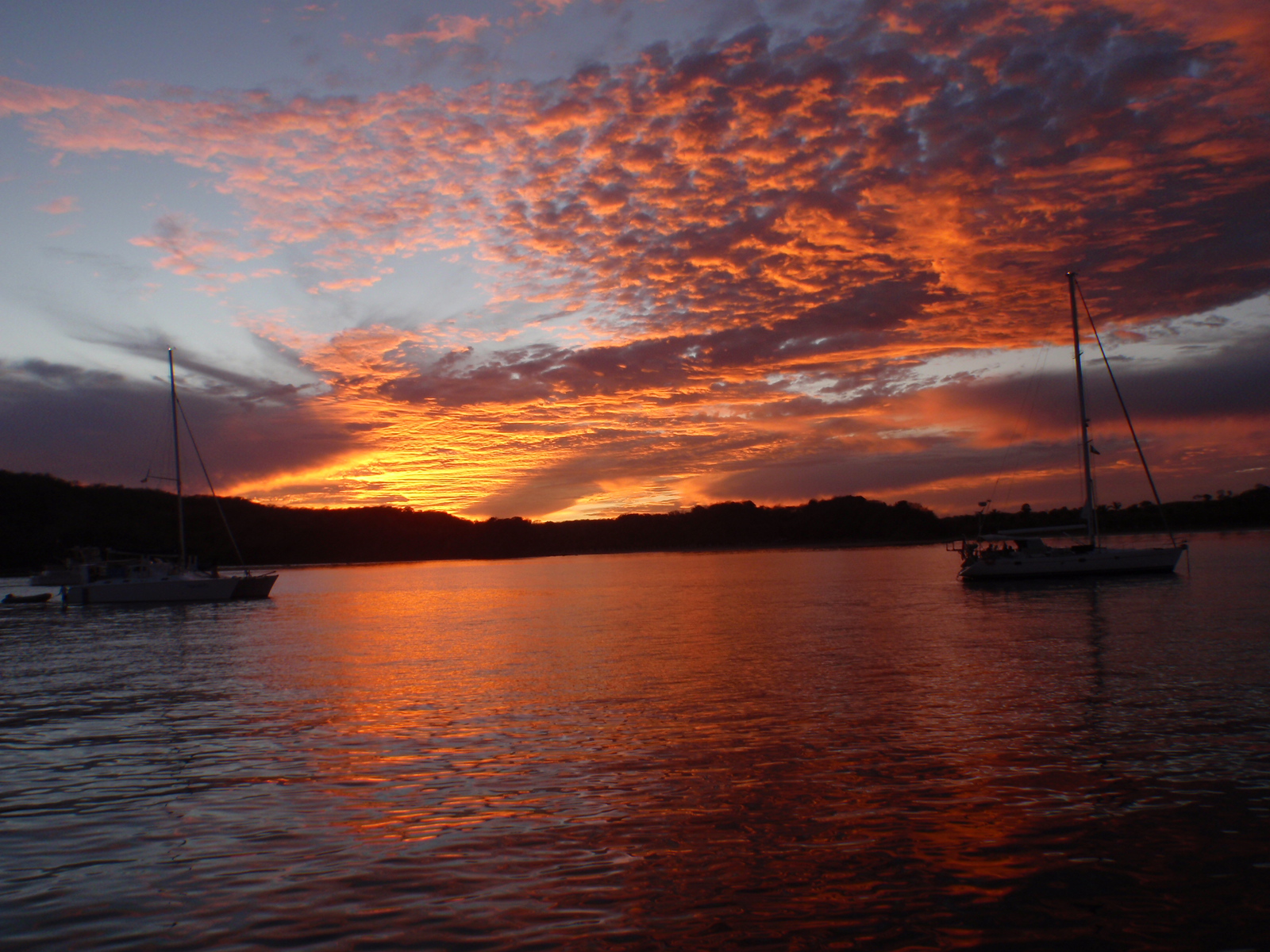 |
| Tenacatita Sunset |
Bahia Tenacatita is the most beautiful place the Honcho has visited so far on this voyage. After we arrived here we just sat in the cockpit and enjoyed the magnificent views of the golden sand beaches to our north and east, the craggy rocks to our west and southwest, and the pretty little town of La Manzanilla across the bay to our south, then were treated to a beautiful sunset. We've been here three days, doing very little except enjoying the scenery and visiting with friends. Wednesday we took the dinghy up the small estuary where there are supposed to be crocodiles but we didn't see any. That was fine by me, as we did see lots of other wildlfe as we motored slowly through the mangroves. In spite of the beauty of the place, there has been trouble here recently. A developer showed up a few months ago with armed guards and bulldozers and chased everyone off the beach in one part of the bay where there had been some palapa restaurants that locals and yatistas liked to hang out, claiming that he owned the land that others thought they owned. Apparently the developer won this argument because we were met with some of the guards a mile or so up the estuary, and that's as far as we got to go.
 |
| Another Approach to Cruising We've seen this Nordhavn 63 in various places along the Mexican coast. |
The day before we left Tenacatita we took the dinghy across the bay to La Manzanilla, a quaint fishing and tourist village, where we stocked up on fresh vegetables. Located on the southeast side of the bay, it is exposed to the open ocean so going ashore means landing the dinghy through the surf. We stayed dry going in but got a bit damp going out, as the wind and waves had built during the afternoon. If you're looking for a quiet seaside vacation, far from the crowds, but still with a little spice, you might like La Manzanilla. To me, it appears to be Mexican with a Mediterranean twist.
Subscribe to:
Posts (Atom)


.jpg)


