Tuesday, 15 January 2013
Americas Cup 2013
Anybody who has even the slightest interest in the Americas Cup competition has seen the video of Team Oracle's spectacular crash last October. It is amazing that there was no serious damage to the boat except for the carbon wing, which was demolished. Until the crash, no one truly knew where the edge of the envelope was for these extremely powerful boats, so it was a learning experience for the crew of Oracle 17. The question now is whether they will overcome this setback in time to mount a competitive defense of the cup. The crash was certainly a serious bump in the road for them, but now they have a real, rather than theoretical understanding of how hard to push and, probably more importantly, that feeling in the collective gut of the crew of where the edge is. Anyone who has pushed a high performance boat, whether it's a 49er or TP52 beyond the edge of control, knows that feeling. Ironically, that experience, and the experience of quickly putting a broken AC72 back together, could turn out to be a winning edge when the big boats race on the bay.
Yesterday I visited the Oracle compound at Pier 80 in San Francisco and had a chance to see the nearly completely repaired 17 as well as the newest boat, which is still under construction in the same building. While there I also got a look at the newly delivered wing mast whose basic structure was built in New Zealand for completion in San Francisco. Here are some observations:
1. It wasn't until I was right up close to both the wing and the hulls that I could truly appreciate the power to weight ratio of this boat.
2. The hulls are beautifully sculpted shapes that hardly appear to be up to the task of supporting the vast size of the rig, until you realize that the wing, which towers about 130 feet above the deck, weighs only about 3,000 pounds.
3. I was impressed by the fineness of the bows of the hulls. These are almost delicate shapes that will be extremely fast in light air, but will be more challenging in a breeze. I say that because they are very fine, with commensurately little reserve buoyancy. When you consider that the center of effort in the wing is some 65 feet or so above the waterplane, with its center of gravity likely a few feet down from there, it's easy to understand that if the boat is at speed and sticks a bow or two into a wave, the chances of pitchpoling are significant. It's interesting to note that the boat that crashed didn't flip, that is, it didn't fall over sideways, it pitchpoled, or sailed over its bows. Clearly, sailing these boats will be more about power management than power generation in the conditions they are likely to encounter on San Francisco Bay.
4. The wing mast is a fairly simple shape in the profile view. It is a two-element structure, that is, a main element and a flap, and it appears to me that the real technology is in its structural design and control system.
5. Clearly the trick will be in knowing how to control the power in this rig. If there is much breeze at all during the actual races, the winner may well be the crew that has learned how to allow the rig to generate enough power without overpowering the boat and capsizing. As we have already seen, bearing off an AC72 in a breeze will be tricky. The trimmers will have to be in perfect sync with the helmsman to ease the throttle as the boat turns away from the wind.
6. The course seems awfully short for these 72 foot boats. The marks appear to be set fairly close inshore so there will be little room on the left side of the course. The venue along the city front will make for spectacular viewing but the legs are only about 3 miles long, so these boats that are easily capable of 30 knots might take 15 minutes to get from the leeward mark to the windward mark. That doesn't leave much time for tactics, so I think the key will be to win the start and then don't crash.
Yesterday I visited the Oracle compound at Pier 80 in San Francisco and had a chance to see the nearly completely repaired 17 as well as the newest boat, which is still under construction in the same building. While there I also got a look at the newly delivered wing mast whose basic structure was built in New Zealand for completion in San Francisco. Here are some observations:
1. It wasn't until I was right up close to both the wing and the hulls that I could truly appreciate the power to weight ratio of this boat.
2. The hulls are beautifully sculpted shapes that hardly appear to be up to the task of supporting the vast size of the rig, until you realize that the wing, which towers about 130 feet above the deck, weighs only about 3,000 pounds.
3. I was impressed by the fineness of the bows of the hulls. These are almost delicate shapes that will be extremely fast in light air, but will be more challenging in a breeze. I say that because they are very fine, with commensurately little reserve buoyancy. When you consider that the center of effort in the wing is some 65 feet or so above the waterplane, with its center of gravity likely a few feet down from there, it's easy to understand that if the boat is at speed and sticks a bow or two into a wave, the chances of pitchpoling are significant. It's interesting to note that the boat that crashed didn't flip, that is, it didn't fall over sideways, it pitchpoled, or sailed over its bows. Clearly, sailing these boats will be more about power management than power generation in the conditions they are likely to encounter on San Francisco Bay.
4. The wing mast is a fairly simple shape in the profile view. It is a two-element structure, that is, a main element and a flap, and it appears to me that the real technology is in its structural design and control system.
5. Clearly the trick will be in knowing how to control the power in this rig. If there is much breeze at all during the actual races, the winner may well be the crew that has learned how to allow the rig to generate enough power without overpowering the boat and capsizing. As we have already seen, bearing off an AC72 in a breeze will be tricky. The trimmers will have to be in perfect sync with the helmsman to ease the throttle as the boat turns away from the wind.
6. The course seems awfully short for these 72 foot boats. The marks appear to be set fairly close inshore so there will be little room on the left side of the course. The venue along the city front will make for spectacular viewing but the legs are only about 3 miles long, so these boats that are easily capable of 30 knots might take 15 minutes to get from the leeward mark to the windward mark. That doesn't leave much time for tactics, so I think the key will be to win the start and then don't crash.

Sunday, 13 January 2013
Finisterra Update 1-13-13
We had been planning to spend the first few days of the new year at Catalina Island but the recent cold temperatures (highs in the 50's and lows in the 30's) made that plan unappealing. So instead I worked on a couple of winter projects. First I removed the old dodger and cut the frame down a bit. The old dodger was taller than it needed to be and was not the best design. The photo below is a 'before' shot, and I'll post some pictures of the revised dodger in a couple of weeks.
Here are a couple of photos of the finished ground tackle system. It includes a chain stop mounted on a teak block and bolted through the deck, which was reinforced with a large backing plate. The chain is 200' of 5/16" type G40 spliced to 150' of 9/16" nylon 3-strand rode.
 |
| Finisterra's dodger is taller than it needs to be |
This dodger is about eight years old and is showing its age. The new one will be about four inches longer along the roof-line and two inches lower, and it will have Strataglass instead of plain vinyl window material. I think Strataglass is vastly superior to other materials because it is doesn't wrinkle and distort your view, yet it is flexible enough to roll up when you want to. I never fold the dodger down so there is no value in the extra flexibility of regular vinyl. We'll replace the bimini along with the dodger. It is also showing its age and I want to tweak the design of it a bit as well.
Another project that got underway this week was the new cockpit table. The first step was to remove the old one. I have a good deal of respect for the designers at Beneteau. They generally do a pretty good job with styling and ergonomics in their boats, but in my opinion they simply missed the mark with this table. I have tried to like it, and even encouraged others to do so, but unfortunately we could never quite get there. It's clunky looking, it's too big and it gets in the way of sailing the boat. It also makes the cockpit cramped for anything besides sitting and eating or drinking. So I took it out...Man, what a difference! We've got room to move now.
 |
| The cockpit is almost four feet wide between the seats. |
With about 3'-6" of width between the seats, the cockpit now feels spacious. With this much room it will need some foot-braces which I'll install using the existing holes in the sole. I'll build a smaller table module and mount it just forward of the binnacle. It will include a dropleaf table, storage compartment, grab-rails on the sides and a housing for a GPS that will swivel so we can see it from anywhere in the cockpit.
 |
| I love the new-found space here! |
 |
| Beneteau installs a clear plastic cover on hinges over the instruments at the helm. Nearly every Beneteau we've looked at, ours included, showed signs of the hinges coming adrift. Naturally they were installed with self tapping #6 screws which usually lose no time in working loose, so it's not long before those itty-bitty threads are stripped. I took the plastic cover off permanently, and will do something creative with the leftover holes. |
Here are a couple of views of the cockpit table. It's not pretty but with the drop-leaves attached, it makes into a large dining table in the cockpit. On our boat the leaves are beautifully varnished teak.
 |
| The table is stoutly made with a nice welded stainless steel frame that includes a foot-rest. The table comes with a plastic lid that fits loosely on top. |
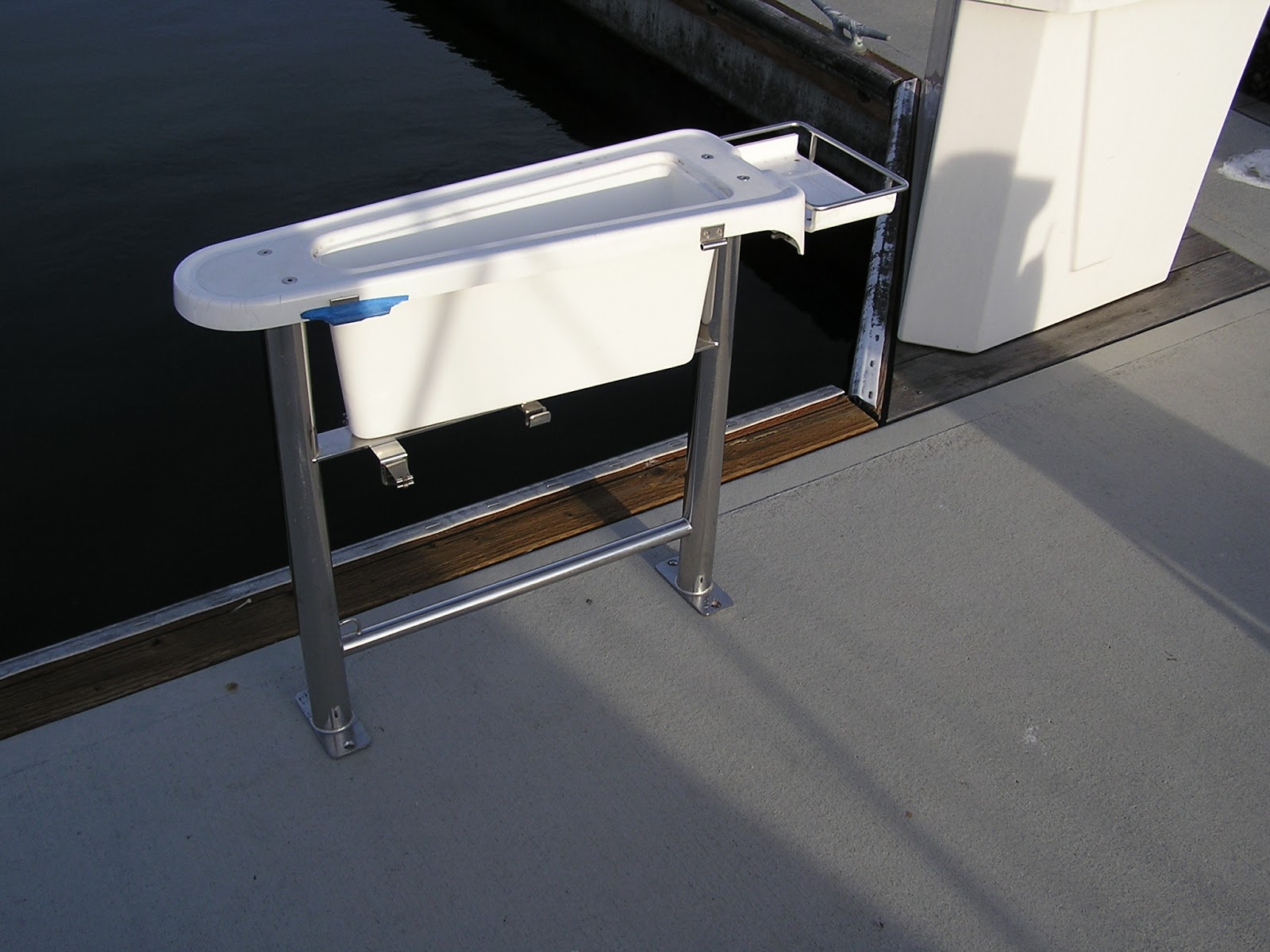 |
| The drop-leaves are attached to the table with slip-pin hinges, and the blue tape covers the forward one because it had an uncanny ability to grab clothing as you go past it. Beneteau used a RTM (Resin Transfer Molding) process to make this molded fiberglass part. This is a cost effective and environmentally responsible process that results in a strong, lightweight part with a smooth finish on both sides. I'm a big fan of RTM. |
Here are a couple of photos of the finished ground tackle system. It includes a chain stop mounted on a teak block and bolted through the deck, which was reinforced with a large backing plate. The chain is 200' of 5/16" type G40 spliced to 150' of 9/16" nylon 3-strand rode.
 |
| The chain stop is mounted on the block to align it with the chain between the windlass and bow roller. Notice the shiny underside of the hatch. It was also made using an RTM process. The waterproof plastic box holds the handheld windlass controller. |
 |
| Anchor installed. |
There has been considerable controversy in the last few years regarding anchors, with all sorts of accusations flying in all directions. For many years I used Danforths on my racing boats. They are relatively compact and fairly reliable anchors, and are a good solution for boats that don't get into challenging anchoring situations. When I began outfitting our last boat for cruising I chose a Manson Supreme. It is what I call a spade type, as opposed to a fluke type of anchor such as a Danforth or Fortress, and while there may be disagreements about which brand anchor is better, I think the spade type of anchor is superior to the fluke types. The Manson 35 we had on the Honcho is one of the few items I kept when we sold her. When it came time to buy an anchor for the Finisterra, I felt there was little difference between the Manson and Rocna units and chose a Rocna 25 (55 LB) mainly because it was a little lighter and less expensive than the comparable Manson.
In Mexico the holding ground is varied, and we anchored in sand, mud and rock bottoms. In the lagoon at Barra De Navidad, the bottom is more like a black slurry than proper mud. In Bahia Santa Maria we spent five days anchored over a sandy bottom while 25 to 40 knot northerly winds combined with a strong southerly swell rolling into the bay, making it quite a lively anchorage. All the while the Manson did its job perfectly and I expect that the Rocna will do the same.
In Mexico the holding ground is varied, and we anchored in sand, mud and rock bottoms. In the lagoon at Barra De Navidad, the bottom is more like a black slurry than proper mud. In Bahia Santa Maria we spent five days anchored over a sandy bottom while 25 to 40 knot northerly winds combined with a strong southerly swell rolling into the bay, making it quite a lively anchorage. All the while the Manson did its job perfectly and I expect that the Rocna will do the same.
Saturday, 29 December 2012
Nautitech 441 Catamaran
There is a big, boxy-looking Lagoon 40 berthed on the next gangway over from us in the marina and it got me thinking about cruising multihulls and how they have evolved since the partnership of Rudy Choy, Warren Seaman and Al Kumalae developed the first offshore racing/cruising cats back in the 1950's. Back then catamarans were exotic, and were shunned by the offshore racing crowd. Today, thanks to those pioneers and countless others, offshore cruising multihulls are totally mainstream. I did a bit of research on the Internet and came up with some interesting numerical comparisons for medium sized cruising cats and after reviewing three of the more popular models in that size range I decided to take a more thorough look at the Nautitech 441. But first, here are the numbers:
Lagoon 440
Leopard 44
Nautitech 441
 |
| The squarish Lagoon 440 is a beefy boat with lots of accommodations |
LOA: 45.83'
Beam: 25.75'
Draft: 4.25'
Displacement: 37,265 LB
Sail area: 1,472 sq. ft. with square top main and roller furling genoa
 |
| The Leopard 44, designed by Morelli & Melvin offers more performance in a better looking package |
Leopard 44
LOA: 42.56'
Beam: 23.75'
Draft: 4.18'
Displacement: 32,930 LB
Sail area: 1,270 sq. ft.
 |
| Nice proportions on the Nautitech 441 |
Nautitech 441
LOA: 44.18'
Beam: 22.33'
Draft: 3.92''
Displacement: 20,286 LB
Sail area: 1,055 sq. ft.
Each of these boats seems to emphasize a different aspect of cruising performance. At over 37,000 pounds, the Lagoon offers the most amenities. The Nautitech, at a little over half that weight should be the most fun to sail, while the Leopard falls somewhere in between. Of course it's never just about the numbers. Hull design, ergonomics, rigging and other facets of the overall design play important roles in determining the overall desirability of each of these yachts. I chose to take a more in-depth look at the Nautitech because of the three boats, it's balance of looks, comfort and performance comes closest of the three to what I think a good cruising cat ought to be. However, I should say out front that my ideal cruising cat would be lighter than all of these boats and be fitted with dagger boards instead of keels.
With all that said, let's start with the hulls of the Nautitech 441. If you visit the web sites for the Lagoon and Leopard boats you'll get a sense of how much bigger they are than the Nautitech. For the way we cruise, just the two of us with occasional guests, this boat has more than enough space. These hulls are relatively narrow compared with the other boats which translates to less drag. The Leopard hulls incorporate substantial chines above the wateline, while the Lagoon's hull are just plain beamy. These factors indicate that the 441 should be the better performer. All three boats have shallow fixed keels, so none will be particularly fast upwind, but that's not what these boats are about. They all have fairly large fuel capacity, over 100 gallons in the 441 and 170 gallons in the Lagoon, so my guess is that the serious upwind work will be done mostly under power. The shoal keels will enable the 441 to venture into lots of places where deeper boats can't go, and also protect the sail drives from harm, but they don't help much in getting the boat upwind.
The deck plan shows that not only are the hulls significantly narrower than the other boats, but there is less deck area and the deck house is relatively smaller as well. I like the wide open spaces on deck. Also notice that the anchor is stored on the port bow. I would prefer to see it mounted on a bow-plank along the centerline of the boat. The helmsman's perch is on the port side of the deck house and elevated so the driver can see over the top of the cabin. The photos show a hardtop over this area, I'd like to have a windscreen as well. It will be a cold helmsman that stands the midnight watch on this boat in anything less than balmy weather. The trade-off is much better visibility compared to helm stations located in the cockpit or at the aft end of each hull. The sail controls are also clustered in this area. This can be a good thing for the shorthanded crew, but it can make for a very busy helmsman at times and I question the ergonomics of this arrangement. Notice the locations of the jib sheet winches on the cabintop. There is a pair of winches at the aft end of the cockpit for spinnaker sheets. The drawing shows a mainsheet winch also located there, but I think it has been moved to the cabintop along with the other sheet winches.
The cockpit is smaller than the other boats but certainly large enough for a cruising couple and guests. I like the rounded contours aft that provides lots of space on deck. This layout doesn't provide as much shade as the more squarish designs, which would be noticeable in the tropics. Another difference between this boat and the others is the lack of a forward cockpit. The Leopard has a passageway from the cabin to that area while on the Lagoon there isn't one. These details account for some of the difference in the weight of the 441 compared to the others. I think the forward cockpit would be delightful on an inshore boat, but would find it less appealing for offshore work. One of the great things about all of these boats is their speed compared to monohulls of similar length. That translates directly to being able to do more of your passagemaking miles in good weather.
Nautitech offers the 441 in three and four cabin versions. I chose to focus on the three cabin version, which incorporates an owner's suite in the starboard hull and a pair of double cabins to port. The owner's suite is luxurious, with a large head and shower toward the bow, a desk and lots of storage space just forward of the passageway and a double berth arranged longitudinally aft. On the port side, there is a double berth way up in the bow, which will inevitably be converted to storage on most 441's. It is followed by a comfortable looking double cabin with an adjoining head. This head is also accessible from the main cabin. The aft stateroom offers more space and a private head.
The main cabin works really well. The galley is large and the sinks, with lots of counter space, are located along the centerline of the boat. This makes them accessible from both sides, making the galley seem bigger than it already is. Opposite the galley is a large nav station with a large desk and plenty of room for instruments and all the other items I like to have handy when I'm navigating. The forward part of the cabin is dedicated to a large wrap-around dinette that incorporates a circular coffee table.
There has been a significant migration of sailors from monohulls to multi's in recent years and it's not hard to understand why. Vast amounts of living space, sailing flat instead of heeled, more speed, and shoal draft all add to the appeal of catamarans. I think it's worthwhile to give these boats a look if you searching for a family style cruising boat.
 |
| Efficient hulls, long and shallow keels and a short but wide rig. Most new cats incorporate a square-top mainsail instead of the one shown in the drawing. |
 |
| N441 with square-top main sail |
With all that said, let's start with the hulls of the Nautitech 441. If you visit the web sites for the Lagoon and Leopard boats you'll get a sense of how much bigger they are than the Nautitech. For the way we cruise, just the two of us with occasional guests, this boat has more than enough space. These hulls are relatively narrow compared with the other boats which translates to less drag. The Leopard hulls incorporate substantial chines above the wateline, while the Lagoon's hull are just plain beamy. These factors indicate that the 441 should be the better performer. All three boats have shallow fixed keels, so none will be particularly fast upwind, but that's not what these boats are about. They all have fairly large fuel capacity, over 100 gallons in the 441 and 170 gallons in the Lagoon, so my guess is that the serious upwind work will be done mostly under power. The shoal keels will enable the 441 to venture into lots of places where deeper boats can't go, and also protect the sail drives from harm, but they don't help much in getting the boat upwind.
The deck plan shows that not only are the hulls significantly narrower than the other boats, but there is less deck area and the deck house is relatively smaller as well. I like the wide open spaces on deck. Also notice that the anchor is stored on the port bow. I would prefer to see it mounted on a bow-plank along the centerline of the boat. The helmsman's perch is on the port side of the deck house and elevated so the driver can see over the top of the cabin. The photos show a hardtop over this area, I'd like to have a windscreen as well. It will be a cold helmsman that stands the midnight watch on this boat in anything less than balmy weather. The trade-off is much better visibility compared to helm stations located in the cockpit or at the aft end of each hull. The sail controls are also clustered in this area. This can be a good thing for the shorthanded crew, but it can make for a very busy helmsman at times and I question the ergonomics of this arrangement. Notice the locations of the jib sheet winches on the cabintop. There is a pair of winches at the aft end of the cockpit for spinnaker sheets. The drawing shows a mainsheet winch also located there, but I think it has been moved to the cabintop along with the other sheet winches.
 |
| Unique deck arrangement lines on the N441 |
 |
| The helm station is set up with instruments and sail controls. A dodger would be a welcome addition |
 |
| Condo-like accommodations in fairly slender hulls |
The main cabin works really well. The galley is large and the sinks, with lots of counter space, are located along the centerline of the boat. This makes them accessible from both sides, making the galley seem bigger than it already is. Opposite the galley is a large nav station with a large desk and plenty of room for instruments and all the other items I like to have handy when I'm navigating. The forward part of the cabin is dedicated to a large wrap-around dinette that incorporates a circular coffee table.
 |
| Lots of hatches and light colored wood adds to the sense of spaciousness |
There has been a significant migration of sailors from monohulls to multi's in recent years and it's not hard to understand why. Vast amounts of living space, sailing flat instead of heeled, more speed, and shoal draft all add to the appeal of catamarans. I think it's worthwhile to give these boats a look if you searching for a family style cruising boat.
Monday, 10 December 2012
Windlass Installation
A few weeks ago I mentioned that the windlass was severely corroded and that I was planning to repair or replace it. When I removed it from the boat and got a look at the underside of it, the corrosion was as bad as I feared it would be. The screws that hold the gypsy assembly to the cast aluminum housing were completely frozen and no amount of PB Blaster could loosen them, and the corrosion around the mounting studs was severe enough to give me doubt about the entire base of the casting. One thing you don't want in your ground tackle is doubt, so last weekend I replaced the entire unit, and while I was at it I built a spacer out of StarBoard to raise the windlass up so that whenever there is water standing on its shelf in the anchor locker, it will not be sitting in it.
It would have been a simple matter for Beneteau to mold a riser into the windlass shelf, or perhaps make the shelf slanted enough that water would run off, which might have made this project unnecessary. Anyway, once the plate was made I check-fitted it on the windlass. I also took the opportunity to back all the screws for the gypsy and back cover out and give them a liberal coat of Tef-Gel before re-tightening them, and did the same to the mounting studs before installing them. As far as I know, nothing beats Tef-Gel for preventing seizing of mating parts, including dissimilar metals.
The unit comes with a rubber gasket that is about 2 mm thick, which isn't enough raise the unit up clear of any water on the shelf. On the old windlass, water had seeped between the gasket and the aluminum housing and worked its corrosive magic across the entire area of the base, especially around the stainless steel mounting studs.
After making sure the base and windlass fit together, it was time to mount the base plate into the anchor locker. I applied a bead of 3M 4000 around the perimeter and the holes, carefully pressed it into position and allowed it to cure.
Now all that's left to do is bolt the windlass in place and connect the wiring. Of course it's never as easy as you'd think. The back cover of the windlass must be removed in order to make the connections, and there isn't enough clearance in the locker to do that with the windlass bolted in place, so that work has to be done before the windlass is bolted down. If the windlass was mounted a couple of inches further forward you'd be able to get it off without removing the windlass.
The last step was to test the windlass. It worked like a champ. Now I can finish the job of rigging the boat with proper chain and rode and try out the new Rocna 55.
 |
| Using the paper template that came with the new windlass as a guide, I made a base plate out of StarBoard. |
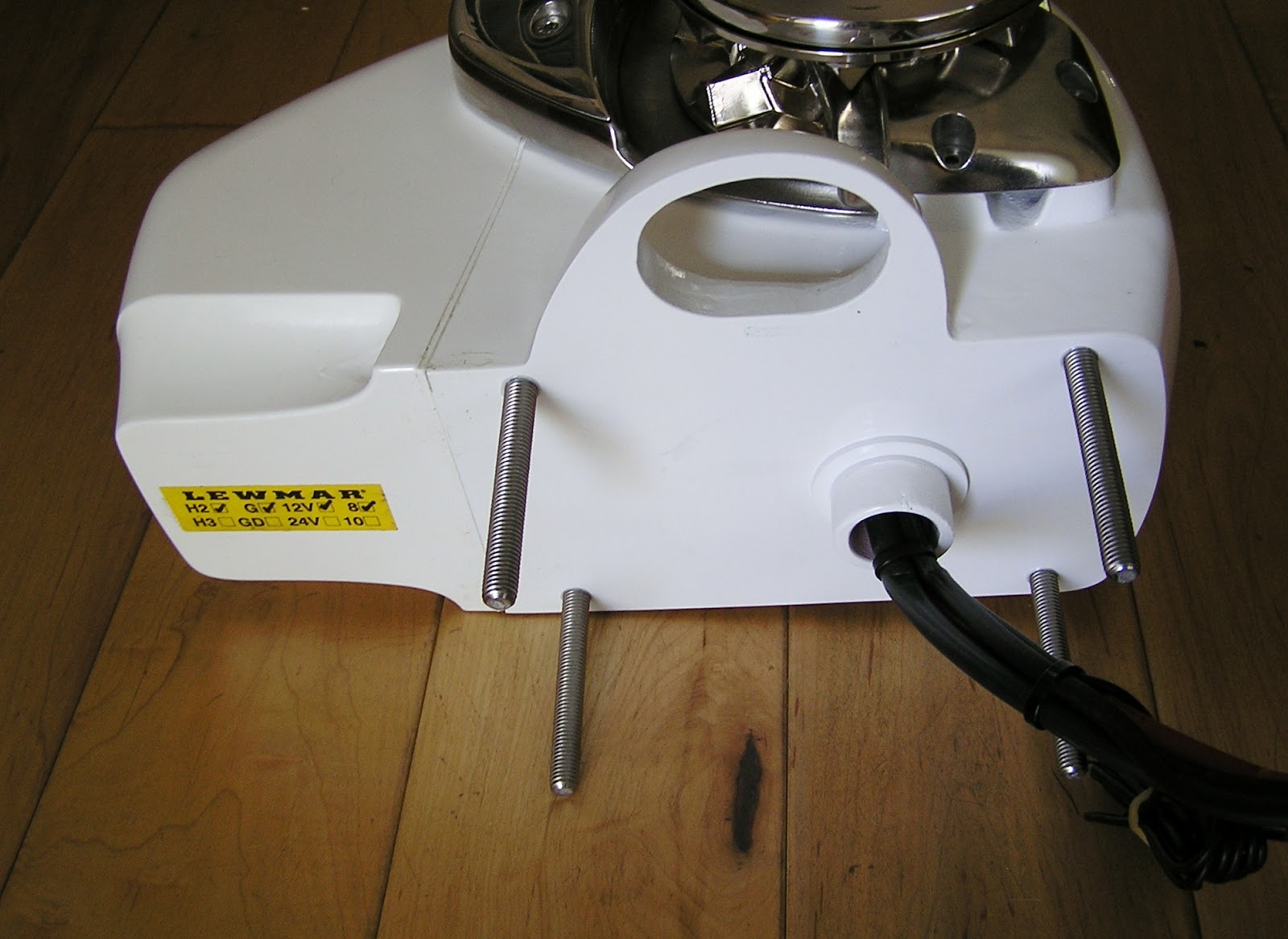 |
| This is what the base of the windlass look like. The housing that holds the gypsy and mounting studs is cast aluminum and the back cover, where the Lewmar sticker is located is composite material. |
 |
| Windlass with the gasket installed. |
 |
| Woody checks the fit of the new base plate on the windlass. |
After making sure the base and windlass fit together, it was time to mount the base plate into the anchor locker. I applied a bead of 3M 4000 around the perimeter and the holes, carefully pressed it into position and allowed it to cure.
 |
| Base plate is bonded in place with 3M semi-permanent adhesive. |
.jpg) |
| Windlass installed. |
Friday, 30 November 2012
Tartan 4000 Review
 |
| A progressive cruiser from a venerable builder |
Tartan Yachts is a time honored marque in yachting. The Tartan 37 and 41 set high standards for sailing yachts back in the 1970's and '80's. In more recent years the company has been buffeted by the economic storms we've all had to weather lately and I'm glad to see that they appear to be surviving, and perhaps even thriving under new ownership. The 4000 is their latest offering in the forty foot range. As you may know, Sailing World Magazine's panel of experts named it 2012 Boat of the Year, so I think it's worthwhile to take a good look at the boat.
Like all the recent Tartans, the 4000 was designed by Tim Jackett to be a wholesome and well appointed cruiser/racer, with the emphasis, in my opinion, on cruiser. Starting with the profile view of the boat I must say it is refreshing to see a new boat that hasn't been pushed to the far edges of the design envelope in pursuit of interior volume. The sheer is elegantly sprung and there is a nice aesthetic balance between the rake of the stem and the slope of the transom. Below the waterline the hull is relatively deep amidships and fairs into finer waterlines aft than we see in the newer boats from Europe. That raked stem has practical value beyond aesthetics. Cruising boats with plumb stems invariably accumulate scrapes and marks around the bow from the anchor chain or rode unless they have fairly long bow planks. Tartan refers to the keel as a 'beavertail'. It looks like a squished bulb to me, which is fine. It gets the weight low without excessive draft and should provide good stability for this well balanced boat.
 |
| The bulb is different looking, but it does get the lead down where you want it. |
The Tartan 4000 is propelled by an interesting sailplan that they call a 'Cruise Control Rig' or CCR for short. The mast is carbon fiber as is the boom, which is V-shaped to capture the mainsail when it is doused, eliminating the need for a canvas stackpack. That's a nice arrangement that I think will work well. The boat is rigged with double headsails on roller furlers. The forward one is a genoa and just a few inches aft of it is an inner forestay that carries a small working jib that sheets to a thwartships track just forward of the mast, making it self tacking. The idea is that in light air you'll use the genoa and when the breeze is up you'll switch to the working jib. For cruising, this arrangement might be okay as long as you remember that when sailing under the genoa, it has to be rolled almost all the way in whenever you tack. On the other had, when sailing under the working jib, that rolled up genoa is right in front of its leading edge, spoiling airflow and compromising its effectiveness. I think a better solution would be a single headstay with a well made foam luffed 140% genoa on a reefable furler. You would save the weight and cost of the second furler and have equal or better all around performance.
 |
| Tartan 4000 Cruise Control Rig |
In the profile view of this boat it's hard to fault the nice lines in of the deck. It's relatively low and well proportioned, with good clearances along the side decks. I've given up on criticizing mid-boom sheeting since my own boat is rigged that way. It's not optimal from a sailing perspective but it makes other things work better, so I grudgingly accept it. The cockpit on the T4000 is really well done. Halyards and control lines are led to a pair of winches on the cabin top and the coamings are wide enough to sit on. Notice in the photo below that the mainsheet traveler is mounted on the cockpit sole, which is a practical thing to do. It might take a bit of getting used to, but it opens up the cockpit and offers much better sail control than the standard mid-boom unit. The boat has twin wheels mounted on nicely designed carbon pedestals. The photos also show that the hull is quite beamy aft, but there is considerable flair in the aft sections of the hull. I think this is a nice compromise that will reward this boat with good sailing manners in a breeze while still allowing for plenty of room in the cockpit.
 |
| Nice cockpit arrangement. Cruisers will miss having a swimstep built into the transom. |
The accommodations in this boat are a pleasant surprise. The layout is thoroughly modern, with a queen-size berth in the forward cabin and strategically angled bulkheads in the main salon. The galley is large and offers plenty of counter space and storage. The nav station is also large and well designed, and just aft of it is a good sized quarter-cabin. All of these spaces work well and the only missing item is a good sea berth. Aboard the Finisterra I've designed a lee-board to fit in the quarter cabin to make a snug berth for offshore passages and the same could be done with this boat. I think the designer was able to incorporate the nice open spaces into the boat because it has only one head. Personally, I think one head is enough for a cruising couple with occasional guests. Aboard the T 4000, they weren't content with building a nice spacious and practical head, they incorporated a circular door for the shower. It may be cute as a bug's ear, but I prefer to eschew such gimmicky features that are likely to give trouble at some point.
 |
| Nice layout and solid wood joinery make for pleasant living aboard |
I really do like the nice solid wood joinery in this boat. It is a refreshing departure from the IKEA-like styling of the new European inspired boats I've been looking at lately. I saw one of these boats at a recent boat show and admired the quality of the furnishings. The engine is a 55shp Volvo with a saildrive located under the companionway. That many horses will push the 4000 along at hull speed in almost any conditions. Back in my boatbuilding days we installed a good many saildrives, mostly Yanmars, and they work very well especially on racing yachts. But I personally prefer the trusty shaft and strut type for long distance cruising. I've seen more than a few boats having saildrives replaced in inconvenient harbors.
 |
| Traditional wood joinery makes for very pleasant accommodations |
The Tartan 4000 looks like a sweet ride for local cruising and club racing, and it could easily be optimized for offshore passagemaking. It has some interesting features such a cast and polished fairleads for the mooring cleats that add a touch of class . My guess is that most of the time you'll bypass them, but they sure are pretty. I checked PHRF numbers for this boat and it looks like the rating is going to settle in the 72-84 range, which is quite respectable for this boat. I'm sure the good looks, build quality and BOTY award will generate lots of attention for this boat. It's definitely worth a look.
Wednesday, 21 November 2012
Finisterra Update
In the last couple of months we've been sailing the boat quite a bit. The stackpack system works well. It's different from typical systems in that when we're sailing it can be rolled up and secured along the boom instead of staying deployed. It's a bit more work to roll it up but I much prefer the sail unfettered by the bag and lazy jacks.
Awhile back I mentioned that the autopilot was not working properly. After searching the Internet for ideas on how to fix it, I removed the linear drive and rebuilt it, then reinstalled it, confident that I'd solved the problem. But I was wrong. So I've ordered a new drive which should arrive next week.
The boat came with funky pleated cloth curtains on all the portlights. I suppose they're stylish in a 1990's sort of way, but they are eight years old and at the end of their useful life. We really liked the OceanAir shades we had on the Honcho so we ordered a set from Defender and installed them last week. These shades block out 100% of the sunlight and are good looking.
One thing I've wanted to change since we got the boat was to upgrade the ground tackle system. The original equipment included a 40 LB Bruce anchor, 40 feet of 3/8" BBB chain and 150 feet of nylon rode. The new system includes a 55 LB Rocna anchor, 200 feet of 5/16" G40 chain and 150 feet of nylon rode. This requires changing the chain gypsy on the windlass. To do that, I had to remove the windlass. This is a simple matter of four bolts. When I got it out of the boat I discovered a lot of corrosion around the base of the unit. I've noticed that the shelf in the anchor locker where the windlass is mounted is often wet, either with seawater or fresh, so it's no wonder the aluminum housing of the windlass is corroded. When I re-install the unit I'll make a mounting plate out of 1/2" StarBoard to raise it up so that it never sits in water.
My winter project is to go through the exterior canvas on the boat. I'll lower the dodger by an inch or two, make some changes to the bimini and have side curtains made for it. I'll also set it up to mount solar panels to it.
 |
| Slick stackpack contains the full battened mainsail |
 |
The boat came with funky pleated cloth curtains on all the portlights. I suppose they're stylish in a 1990's sort of way, but they are eight years old and at the end of their useful life. We really liked the OceanAir shades we had on the Honcho so we ordered a set from Defender and installed them last week. These shades block out 100% of the sunlight and are good looking.
One thing I've wanted to change since we got the boat was to upgrade the ground tackle system. The original equipment included a 40 LB Bruce anchor, 40 feet of 3/8" BBB chain and 150 feet of nylon rode. The new system includes a 55 LB Rocna anchor, 200 feet of 5/16" G40 chain and 150 feet of nylon rode. This requires changing the chain gypsy on the windlass. To do that, I had to remove the windlass. This is a simple matter of four bolts. When I got it out of the boat I discovered a lot of corrosion around the base of the unit. I've noticed that the shelf in the anchor locker where the windlass is mounted is often wet, either with seawater or fresh, so it's no wonder the aluminum housing of the windlass is corroded. When I re-install the unit I'll make a mounting plate out of 1/2" StarBoard to raise it up so that it never sits in water.
My winter project is to go through the exterior canvas on the boat. I'll lower the dodger by an inch or two, make some changes to the bimini and have side curtains made for it. I'll also set it up to mount solar panels to it.
Monday, 22 October 2012
Jeanneau Sun Odyssey 41 DS
 |
| DS 41: New Look from Jeanneau |
Recently I've been looking at the new Sun Odyssey DS line of cruising yachts and had a chance to go aboard one of these uniquely styled boats at a recent boat show. In reviewing this design I'll start with the overall proportions of the boat because we can learn a lot about a boat's sailing qualities just by assessing the juxtaposition of the keel, rig and hull volumes. Boats can be beautiful or not, but I think boats that perform well are always better looking than those that don't, regardless of dimensions and coefficients. In the profile view above, notice the relationships between the hull, keel and rig. The nearly vertical leading edge of the keel is slightly forward of the mast. On the deckplan you'll see that there is a jib traveler also just forward of the mast along with a pair of jib tracks just aft of it, with the shrouds led to chainplates that are located almost at the gunwales. All of this dictates that the 41DS will carry small headsails, while the mainsail shown in the photos is a good looking fully battened and lazy-jacked unit with lots of power. This arrangement looks to me like it will generate a good deal of weather helm, so it'll be interesting to take this boat out for a test sail.
 |
| Beamy and full ended, the DS 41 offers plenty of room below, but how does she sail? |
I think the DS 41's deck is a bold, even audacious, design. The height and bulk of cabin trunk is visually mitigated by the clever use of smoked plexiglass windows and molded-in steps aft. With the jib tracks mounted on the cabin top, side decks are uncluttered, making fore and aft movement easy. The cockpit coamings are an extension of the roofline of the cabin trunk, curving downward to a point just forward of the helm station. I leave it to you to judge the aesthetics of this design, but I will say that I found the slope of these coamings to be uncomfortable for sitting. Of course there are seats aplenty in the cockpit, but I still think the coamings should be more than just styling points. While I'm on the subject of the coamings I'll mention the winches. I appreciate that they are conveniently located for the helmsman, and that they are electric (at least on the boat I was aboard). But the location of them means that under sail, the helmsman is going to be very busy at times managing the sheets and other controls that are led to this pair of winches. Given their location, there is no good way to get any real leverage to pull on any of the lines that are led to them and the crew who jumps in to help will likely be a distraction for the helmsman. The mainsail is controlled by a German style sheet system without a traveler. We're seeing this arrangement on many new designs and I think it is an inexpensive alternative, but I prefer to have a traveler.
Twin wheels are really a requirement on the 41DS because of the very wide stern of this boat. They enable the helmsman to sit well outboard so he or she can see the jib teltales, and they have the added benefit of making access to the swim step easy. I really like the swiveling instrument pod on the aft end of the cockpit table. I'm not sure how far it swivels but I'd like it to go far enough so that I could sit in the cockpit and see all the data. The cockpit is large and will be a fun place to congregate when the boat is on the hook.
Going below, you can see the benefits of that buxom hull. The wide open spaces, light colors and natural light from the plethora of hatches and ports make the 41DS a very inviting boat. More so when at anchor than at sea.
 |
| Condo-like accommodations |
 |
| Large chart table, plenty of light and even a wine locker...very French. |
I like the large chart table. That enormous monitor can display all the ship's data, including navigation, radar, wind, etc. as well as movies. I like this new technology, but what's missing is a good sea berth. Forward of the main bulkhead is a private cabin with ensuite head, plenty of room and lots of light. Once again, this will be an inviting place to hang out when the boat is at anchor.
 |
| Dining table converts to coffee table. |
Subscribe to:
Posts (Atom)


.jpg)


