Friday, 30 August 2013
New Bottom
Finisterra was hauled out of the water the day before yesterday to get fresh bottom paint and have some other minor work done. This is the first time I've had a chance to inspect the bottom carefully and I was pleased to find it in generally good shape. The bottom paint is still in reasonably good condition except for a few small spots on the keel where the paint has been rubbed off. The painters will sand and prime those areas and she'll receive two coats of Pettit Trinidad before she goes back in the water next week.
A couple of observations regarding the design of the boat that are not apparent when she's in the water:
The keel is made of cast iron and weighs about 5,569 pounds. My rough calculations indicate that about 40% of its weight is in the bulb at the bottom of the keel. The bulb is about 16" wide at its thickest and fairs into a very thin fin section. I took some basic dimensions and discovered that the fin is about 3" thick at the thickest point with a chord length of 64", for a thickness ratio of .047 or 4.7%. The top 8 or 10 inches of the fin fair out to a beefy and wide hull/keel joint. So, if we disregard the bulb and the thickened area at the hull/keel joint, the actual lift generating part of the keel is about 36" high by 64" long, with a thickness ratio of 4.7% and an aspect ratio of .56. I won't go into a technical discussion of keel design here but I would love to hear the designer explain his reasoning behind these numbers. It would have been a simple matter to design a much more efficient keel using the same amount of material and draft for exactly the same amount of money, so I wonder what the designer was thinking when he or she designed it.
So what conditions would this keel work best under? Well, it'll never generate much lift on the upwind legs and it sports too much wetted surface and parasitic drag to be much good in light air. It will probably work best broad reaching and running in medium conditions. Our experience sailing the boat certainly bears that out. With all that said, if any of you B423 owners out there want to improve your boat's performance, swapping out the keel would be a quick and effective way to go.
How about the rudder? There have been times when we've pressed the boat pretty hard on a reach and the spade rudder has proven to be up to the task of steering her in a straight line. Of course the boat can be pushed hard enough to round up in a breeze but it gives plenty of warning and it rounds up in a predictable manner. There is nothing special about the shape of the rudder. It is a bit over-balanced for my taste, meaning that under power if you let go of the wheel, the rudder will slam hard over to port or starboard quickly. I'm not pleased by this, but the excess "balance" of the rudder makes helm loads pretty minimal when under sail. This means that you can sail the boat with little pressure on the wheel and the autopilot never has to work very hard under sail. I suppose this is a good trade-off, but I prefer a perfectly balanced helm. The rudder stock is vertical and rides in a set of bushings. From a purely hydrodynamic point of view, a vertical stock is more efficient than a radically angled one. In most boats the upper rudder bearing or bushing is mounted to the underside of the deck but Beneteau has chosen to build the entire rudder support system into the hull only. On my last boat, a Beneteau 36s7, this structure was made of a fiberglass cone about 36" high glassed to the hull with the upper bearing mounted at the top of it. It was a bit disconcerting to see the top of the cone moving around as the boat sailed in anything other than flat seas. Finisterra has a similar arrangement except that the cone has been replaced by a set of longitudinal and transverse bulkheads which appear to do a better job of resolving all the loads imparted by the rudder. At least I have not been able to see any movement of the assembly while underway. I can't say I'm a big fan of this method for securing the rudder stock but from a purely structural point of view it works. The main disadvantage is that this arrangement is heavy and takes up a lot of space.
The hull shape itself is very respectable. It's not a particularly beamy boat and the waterlines forward are finer than I expected, while the stern sections are fairly broad. the U-shaped sections forward are about what you'd expect and there is no doubt that the 423 will pound a bit when motoring into a head sea. Once again, I think that's a reasonable trade-off for good performance reaching and running.
I was glad to find minimal play in the rudder when I grabbed hold of it and pushed from side to side. My guesstimate is about 1/8 inch in each direction. Overall, I think the hull and appendages are in good shape for our upcoming voyage. The fresh bottom paint should last a couple of years in the tropics.
While the boat is out of the water I replaced the speed and depth sensors. Awhile back I bought a Tacktick T104 instrument package for the boat but have not been able to complete the installation of the system until the boat was hauled and I could change the sensors. Now we'll be able to use the Tackticks for speed, depth, wind, VMG, etc. By the way, out of curiosity I measured the thickness of the hull laminate in this area. Using dial calipers which I was just able to fit through the hole, it measured .66".
 |
| Beneteau 423 Deep Keel |
A couple of observations regarding the design of the boat that are not apparent when she's in the water:
The keel is made of cast iron and weighs about 5,569 pounds. My rough calculations indicate that about 40% of its weight is in the bulb at the bottom of the keel. The bulb is about 16" wide at its thickest and fairs into a very thin fin section. I took some basic dimensions and discovered that the fin is about 3" thick at the thickest point with a chord length of 64", for a thickness ratio of .047 or 4.7%. The top 8 or 10 inches of the fin fair out to a beefy and wide hull/keel joint. So, if we disregard the bulb and the thickened area at the hull/keel joint, the actual lift generating part of the keel is about 36" high by 64" long, with a thickness ratio of 4.7% and an aspect ratio of .56. I won't go into a technical discussion of keel design here but I would love to hear the designer explain his reasoning behind these numbers. It would have been a simple matter to design a much more efficient keel using the same amount of material and draft for exactly the same amount of money, so I wonder what the designer was thinking when he or she designed it.
 |
| Cast iron fin keel. |
 |
| Note how thin this keel is. Racing keels have thickness ratios roughly twice the 4.7% of this one. |
So what conditions would this keel work best under? Well, it'll never generate much lift on the upwind legs and it sports too much wetted surface and parasitic drag to be much good in light air. It will probably work best broad reaching and running in medium conditions. Our experience sailing the boat certainly bears that out. With all that said, if any of you B423 owners out there want to improve your boat's performance, swapping out the keel would be a quick and effective way to go.
 |
How about the rudder? There have been times when we've pressed the boat pretty hard on a reach and the spade rudder has proven to be up to the task of steering her in a straight line. Of course the boat can be pushed hard enough to round up in a breeze but it gives plenty of warning and it rounds up in a predictable manner. There is nothing special about the shape of the rudder. It is a bit over-balanced for my taste, meaning that under power if you let go of the wheel, the rudder will slam hard over to port or starboard quickly. I'm not pleased by this, but the excess "balance" of the rudder makes helm loads pretty minimal when under sail. This means that you can sail the boat with little pressure on the wheel and the autopilot never has to work very hard under sail. I suppose this is a good trade-off, but I prefer a perfectly balanced helm. The rudder stock is vertical and rides in a set of bushings. From a purely hydrodynamic point of view, a vertical stock is more efficient than a radically angled one. In most boats the upper rudder bearing or bushing is mounted to the underside of the deck but Beneteau has chosen to build the entire rudder support system into the hull only. On my last boat, a Beneteau 36s7, this structure was made of a fiberglass cone about 36" high glassed to the hull with the upper bearing mounted at the top of it. It was a bit disconcerting to see the top of the cone moving around as the boat sailed in anything other than flat seas. Finisterra has a similar arrangement except that the cone has been replaced by a set of longitudinal and transverse bulkheads which appear to do a better job of resolving all the loads imparted by the rudder. At least I have not been able to see any movement of the assembly while underway. I can't say I'm a big fan of this method for securing the rudder stock but from a purely structural point of view it works. The main disadvantage is that this arrangement is heavy and takes up a lot of space.
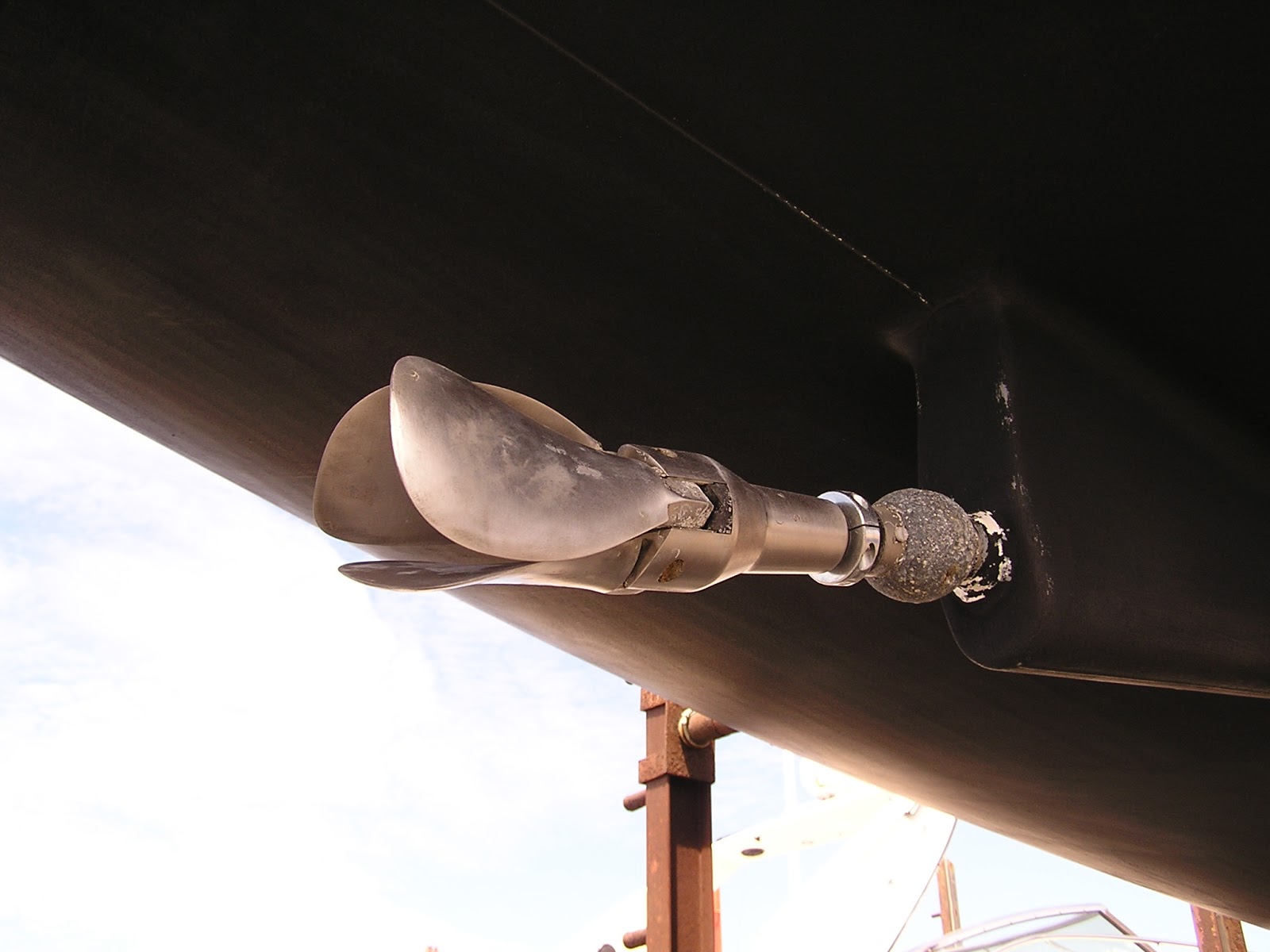 |
| Slipstream Stainless Steel Propeller |
 |
| Three blade folding prop is a vast improvement over the standard fixed prop. Notice the small collar type zinc. In our harbor these things need replacement about every six weeks. |
The hull shape itself is very respectable. It's not a particularly beamy boat and the waterlines forward are finer than I expected, while the stern sections are fairly broad. the U-shaped sections forward are about what you'd expect and there is no doubt that the 423 will pound a bit when motoring into a head sea. Once again, I think that's a reasonable trade-off for good performance reaching and running.
I was glad to find minimal play in the rudder when I grabbed hold of it and pushed from side to side. My guesstimate is about 1/8 inch in each direction. Overall, I think the hull and appendages are in good shape for our upcoming voyage. The fresh bottom paint should last a couple of years in the tropics.
 |
| Mounting the instruments in the cockpit required moving the rope hangers outboard. |
 |
| I mounted instrument brackets in the companionway too. I plan to build a removable seat that will fit in the companionway recess. It's a perfect place to be on cold or rainy watches. |
While the boat is out of the water I replaced the speed and depth sensors. Awhile back I bought a Tacktick T104 instrument package for the boat but have not been able to complete the installation of the system until the boat was hauled and I could change the sensors. Now we'll be able to use the Tackticks for speed, depth, wind, VMG, etc. By the way, out of curiosity I measured the thickness of the hull laminate in this area. Using dial calipers which I was just able to fit through the hole, it measured .66".

Sunday, 11 August 2013
Cockpit Table
I've been busy with work during the month of July so getting things done on the boat has been a challenge. But I did finally finish the new cockpit table and get the Garmin GPS installed. We also have a new 120% genoa aboard, but haven't set it up on the furler yet. Lastly we took the liferaft and MOM unit in for servicing.
The reason for the new cockpit table is that the original one took up too much space and we got tired of it being in the way. The new arrangement works much better for actually sailing the boat and provides a place for the new GPS.
The process began with removal of the original table. The photo below shows the standard arrangement for the B423. You can see that it pretty much fills up the cockpit forward of the steering pedestal. It is fitted with large drop-leaves that make for a very spacious dining table when they are deployed and for many B423 owners it's a good arrangement.
Removing the table reveals the spaciousness of the cockpit. I filled in the holes left by the mounting bolts. Later I installed a teak foot rest which concealed them. The table legs are nicely made of stainless steel and are plenty strong so I kept them for use on the new table.
The next step was to mock up the new table. I wanted it to be smaller than the original table, incorporate the new GPS and provide solid hand-holds. I took a template off the forward side of the pedestal and entered those dimensions into the computer because I wanted the new table to follow the contours of the pedestal. Then I played around with different shapes until I had something that looked like it would work. I made a mockup out of particle board and check fitted it.
The new shape looked good, but the original table leg assembly was not tall enough. I wanted the table to be high enough that we could see the new GPS even when standing at the wheel. So while the leg assembly was in the shop getting modified I laminated up a mahogany riser and fabricated the table itself out of 3/4" StarBoard.
With the GPS mounted high enough for good visibility from the helm, it was too high to be convenient when sitting in the forward part of the cockpit, which is why I incorporated a pedestal that can be adjusted higher or lower and swivel for good visibility from anywhere in the cockpit. When we're at sea, we almost never stand or sit at the helm. When you're on watch alone, the autopilot will always do a better job of steering the boat than a human over the span of an entire watch. The best place to stand watch is in the shelter of the dodger. On the Beneteau 423 that presents a problem because all of the instrumentation and controls are on the "dashboard" at the helm. The new GPS solves the navigational aspect of the problem and it will display AIS information as well. The handheld remote for the autopilot substitutes for the controller at the helm. The new TackTick sailing instruments are wireless and the displays can be located anywhere. So with this system in place we can navigate and control the boat from the most comfortable spot in the cockpit. This gets real important when you're punching into a head sea on the midnight watch and you're the only person on deck for three hours on a windy and moonless night.
Once the unit was installed we had to check fit the drink holders. They worked like a champ! I have been planning to add a fold-down dining table which would be attached to table leg assembly but for now, we're pretty pleased with the current arrangement.
The Rescue Pod
Finisterra has a Switlik Rescue Pod for a liferaft, which is fine for coastal cruising in the temperate and tropical regions where the Finisterra will be traveling. It was time for a checkup so I took it to Avalon Rafts in Wilmington, California. Everyone who owns a raft or races offshore has taken a Safety At Sea course and seen raft deployment demonstrations, so you have a general idea of how they work and how they are equipped. But few of us have deployed our own raft, so we hung around and went through every detail of our little pod. It was something of an eye opener to see exactly how it works, what happens when things go wrong, and what the equipment bag really has in it. It has caused me to revise the equipment and supplies we carry in our ditch bag and I feel a lot more prepared in case we ever have to deploy the raft in a real emergency. If you plan to do any truly offshore work, one look at the Pod when it's deployed will convince you to opt for a real liferaft.
The Pod is, as you can see in the photos, basically a flat disc. That means that in has a 50% chance of inflating upside down. It has a righting line across the bottom, so it can be righted, but if you have a Pod, keep in mind that the first thing you may be required to do once you've launched it, is to get in the water and pull the thing upright. It looked pretty easy in the comfort of Avalon's shop. It might be a different story in 15 foot seas and 40 knots of wind.
I snapped the photos below with my phone so they are not very good quality, but you can see fairly well what the rescue pod is like.
The person standing in the background provides a good indication of the size of the Pod. This is a single chamber raft, which means that if it is punctured, it turns into a large trash bag pretty quickly. So be sure that you throw it clear of any sharp objects and try not to accidentally stab it while getting aboard. The unit comes with a repair kit, suitable for fixing two holes. Unfortunately the instructions are printed on a little piece of paper and carefully packaged with the kit in a small plastic bag. So be sure that when you do get that puncture, you're in a clean, dry place and have plenty of time and good lighting so you can read the instructions, which call for cutting the hole large enough to slip one part of the "clamshell" inside the the air chamber then clamping the other half to it. Stay calm while the air is whistling out of the hole and you're reading those instructions.
I'll post our revised ditch bag equipment list in another day or two.
The reason for the new cockpit table is that the original one took up too much space and we got tired of it being in the way. The new arrangement works much better for actually sailing the boat and provides a place for the new GPS.
The process began with removal of the original table. The photo below shows the standard arrangement for the B423. You can see that it pretty much fills up the cockpit forward of the steering pedestal. It is fitted with large drop-leaves that make for a very spacious dining table when they are deployed and for many B423 owners it's a good arrangement.
 |
| The lid fits loosely on the table and encloses a deep stowage bin. Notice the slip pin hinges for the drop-leaves. |
 |
| Plenty of room with the table removed |
Removing the table reveals the spaciousness of the cockpit. I filled in the holes left by the mounting bolts. Later I installed a teak foot rest which concealed them. The table legs are nicely made of stainless steel and are plenty strong so I kept them for use on the new table.
 |
| Table base incorporates a solid, if slippery footrest. The blue tape covers the forward hinge which had an uncanny ability to snag clothing. |
The next step was to mock up the new table. I wanted it to be smaller than the original table, incorporate the new GPS and provide solid hand-holds. I took a template off the forward side of the pedestal and entered those dimensions into the computer because I wanted the new table to follow the contours of the pedestal. Then I played around with different shapes until I had something that looked like it would work. I made a mockup out of particle board and check fitted it.
 |
| Particle board mockup. |
 |
The new shape looked good, but the original table leg assembly was not tall enough. I wanted the table to be high enough that we could see the new GPS even when standing at the wheel. So while the leg assembly was in the shop getting modified I laminated up a mahogany riser and fabricated the table itself out of 3/4" StarBoard.
 |
| The mahogany riser puts the table at a convenient height. The post that the GPS is mounted on can be adjusted for height and it swivels. The cable is routed down through the post and fed into the starboard table leg. From there it passes through the deck and into the aft cabin. |
With the GPS mounted high enough for good visibility from the helm, it was too high to be convenient when sitting in the forward part of the cockpit, which is why I incorporated a pedestal that can be adjusted higher or lower and swivel for good visibility from anywhere in the cockpit. When we're at sea, we almost never stand or sit at the helm. When you're on watch alone, the autopilot will always do a better job of steering the boat than a human over the span of an entire watch. The best place to stand watch is in the shelter of the dodger. On the Beneteau 423 that presents a problem because all of the instrumentation and controls are on the "dashboard" at the helm. The new GPS solves the navigational aspect of the problem and it will display AIS information as well. The handheld remote for the autopilot substitutes for the controller at the helm. The new TackTick sailing instruments are wireless and the displays can be located anywhere. So with this system in place we can navigate and control the boat from the most comfortable spot in the cockpit. This gets real important when you're punching into a head sea on the midnight watch and you're the only person on deck for three hours on a windy and moonless night.
 |
| On the left is a 2011 Santa Margherita Pinot Grigio, to the right is a 2009 Cakebread Cabernet. |
Once the unit was installed we had to check fit the drink holders. They worked like a champ! I have been planning to add a fold-down dining table which would be attached to table leg assembly but for now, we're pretty pleased with the current arrangement.
The Rescue Pod
 |
| Switlik Rescue Pod 4 Switlik refers to it as an "Emergency Floatation System" rated for 4 people. It would be extremely cozy for four, but reasonable for two. |
Finisterra has a Switlik Rescue Pod for a liferaft, which is fine for coastal cruising in the temperate and tropical regions where the Finisterra will be traveling. It was time for a checkup so I took it to Avalon Rafts in Wilmington, California. Everyone who owns a raft or races offshore has taken a Safety At Sea course and seen raft deployment demonstrations, so you have a general idea of how they work and how they are equipped. But few of us have deployed our own raft, so we hung around and went through every detail of our little pod. It was something of an eye opener to see exactly how it works, what happens when things go wrong, and what the equipment bag really has in it. It has caused me to revise the equipment and supplies we carry in our ditch bag and I feel a lot more prepared in case we ever have to deploy the raft in a real emergency. If you plan to do any truly offshore work, one look at the Pod when it's deployed will convince you to opt for a real liferaft.
The Pod is, as you can see in the photos, basically a flat disc. That means that in has a 50% chance of inflating upside down. It has a righting line across the bottom, so it can be righted, but if you have a Pod, keep in mind that the first thing you may be required to do once you've launched it, is to get in the water and pull the thing upright. It looked pretty easy in the comfort of Avalon's shop. It might be a different story in 15 foot seas and 40 knots of wind.
I snapped the photos below with my phone so they are not very good quality, but you can see fairly well what the rescue pod is like.
 |
| This is how the raft looks after it's hit the water and inflated. The CO2 canister is in the background. It normally remains attached to the raft. The pressure relief valve is the donut shaped part in the foreground. The drogue or sea anchor is the white thing on the left. Equipment visible inside the raft is stored in the equipment bag. |
The person standing in the background provides a good indication of the size of the Pod. This is a single chamber raft, which means that if it is punctured, it turns into a large trash bag pretty quickly. So be sure that you throw it clear of any sharp objects and try not to accidentally stab it while getting aboard. The unit comes with a repair kit, suitable for fixing two holes. Unfortunately the instructions are printed on a little piece of paper and carefully packaged with the kit in a small plastic bag. So be sure that when you do get that puncture, you're in a clean, dry place and have plenty of time and good lighting so you can read the instructions, which call for cutting the hole large enough to slip one part of the "clamshell" inside the the air chamber then clamping the other half to it. Stay calm while the air is whistling out of the hole and you're reading those instructions.
 |
| Standard rescue pod equipment include a surprisingly effective manual pump, combination strobe and flashlight, puncture repair kit (in the plastic bag), and a relief valve cap (the white thing below the repair kit). |
Tuesday, 9 July 2013
Transpac Village Walkabout
I spent some time working on the boat last week, mostly routine maintenance items, but also on the new cockpit table, which is coming along nicely. I'll post some photos in the next day or two. Anyway, after a couple of hours of work on a particularly beautiful afternoon we decided to have lunch at Tequila Jack's, which is about a ten minute walk from the boat. While sitting in the patio of the place, dining on fish tacos and ice cold Pacificos, we noticed that "Transpac Village" was beginning to fill up with boats that are doing the upcoming Transpac Race, so we decided to wander over and have a look at the latest developments. It turned out to be an interesting stroll, with an extraordinary variety of boats in the marina, all in different states of readiness. They ranged from the venerable old Sparkman and Stephens designed "Dorade" to the ultra quick ORMA trimaran, "LendingClub", with lots of interesting boats between these two ends of the racing spectrum. While the boats we observed were just a small fraction of the fleet, it was interesting to see all the variety and to get a really nice perspective on the evolution of racing yacht design over the last 80 years.

Here is a diagram of a Dorade Box. These days most people don't know why cowl vents are mounted on boxes. Air and spray, and sometimes green water, enter the cowl vent. The water drains away through scuppers in the box and the air is drawn into the boat.
On the next gangway we spotted the Santa Cruz 50, "Chasch Mer". This boat is hull number one of the famous "Cruz 50's". Her narrow beam, "V" shaped hull sections, and ultra light weight (for her era) are the embodiment of her designer, Bill Lee's mantra of "Fast is Fun". While far off the pace of more recent 50 foot designs, Chasch Mer will provide her crew with an exciting, if Spartan ride to Honolulu.
Further down the gangway we spotted a beautifully maintained Santa Cruz 52. This boat does not share the same design pedigree as the 50's and 70's. It was designed by Bob Smith and is offers similar performance to the Cruz 50, but with very civilized accommodations. The Santa Cruz 52 is a classic.
The next three boats are all variations on the Transpac 52 theme, with an IRC twist. Meanie is the ex Vela Veloce, which was built for the late Dick Oland in 2009. Officially, it is a Southern Cross 52, not a TP52. The most visible difference between the two is the requirement for more accommodations and comfort in the SC 52. Do not be fooled by the concessions to cruising comfort, this boat is extremely quick and I doubt that you'll get your mother in law to do the runners.
Next to Meanie on the gangway was the Humphreys 54, Bengal 7. Launched in 2010 as Oystercatcher XXVIII, this yacht can easily be mistaken for a TP52. Bengal 7 is now owned by Yoshi Murase and handled by an all Japanese crew.
I would call Bengal 7 a pure IRC boat. With its hydraulic keel lifting machinery and slightly more accommodating interior, it is a bit heavier for its length than a state of the art TP 52. You can see a definite evolution in the design of the cockpit, compared to the slightly older Meanie, and truly vast differences from all out racers of yesteryear such as the Santa Cruz 50.
Beecom was tied up on the same dock as Meanie and Bengal 7 so it gave us a unique view of recent trends in race boat design. Beecom was launched in 2011 and is a true Transpac 52. This development class has evolved quickly over the last decade and I get the sense that it is stabilizing a bit, so this boat provides a fairly up to date perspective of the class. Unfortunately I had only my I-phone with me the day I took these photos so they are not as crisp as I would have liked. But if you look closely you can see the chine in the hull that runs from about station 3 to the transom.
This boat was designed by Rolf Vrolijk and built by McConaghy. I am particularly impressed by the clean lines and simplicity of design here. You can also see in this photo above the pronounced chine. If you're a regular reader of this blog, you know I've been mildly critical of racer/cruisers with chines. Well, here is a case where they really do make a difference. Once cracked off, this boat will almost always travel at more than its displacement hull speed.
Notice the hull shape at the sheer. It fairs from a fine bow to virtually straight sides aft. High performance sailboat hulls are beginning to look a bit like powerboat hulls. I liked this boat best of all the ones we saw in the Transpac Village that day.
 |
| Designed by Olin Stephens and launched in 1930, Dorade was a revolutionary racing yacht in her day. Notice the tall cowl vents. They sit atop boxes which let fresh air into the boat while keeping water out. Dorade was the first boat ever to have such boxes so they became known as "Dorade Boxes" and are found on nearly every offshore cruising boat built since then. My 2005 Beneteau is fitted with Dorade Boxes. I love this simple, elegant solution, but vents are not what made this lovely yacht famous. It's her race record. Imagine sailing this beauty down the Molokai channel under a full moon with main and mizzen spinnakers set. |
 |
| Santa Cruz 50 Notice the wood cabin trunk. Later 50's had molded glass decks. This 30 year old design won't compete with today's fifty footers, but it can still deliver an exhilarating ride. |
 |
| Speed & Comfort A true dual purpose boat, the SC 52 is a nearly ideal racer/cruiser. |
Further down the gangway we spotted a beautifully maintained Santa Cruz 52. This boat does not share the same design pedigree as the 50's and 70's. It was designed by Bob Smith and is offers similar performance to the Cruz 50, but with very civilized accommodations. The Santa Cruz 52 is a classic.
 |
| Southern Cross 52 Meanie, the former Vela Veloce shows her somewhat cruising-friendly cockpit. Notice the seats at the forward end of the cockpit. The boat also boasts more accommodations below than you would find on a TP 52. |
 |
| A closer look at Meanie. In this view you can see the seats at the forward end of the cockpit. In the foreground note the powerful running backstays. |
The next three boats are all variations on the Transpac 52 theme, with an IRC twist. Meanie is the ex Vela Veloce, which was built for the late Dick Oland in 2009. Officially, it is a Southern Cross 52, not a TP52. The most visible difference between the two is the requirement for more accommodations and comfort in the SC 52. Do not be fooled by the concessions to cruising comfort, this boat is extremely quick and I doubt that you'll get your mother in law to do the runners.
 |
| Humphreys 54 Bengal 7 features a lifting keel, reducing draft from about 12 feet to a mere 8'-2". |
Next to Meanie on the gangway was the Humphreys 54, Bengal 7. Launched in 2010 as Oystercatcher XXVIII, this yacht can easily be mistaken for a TP52. Bengal 7 is now owned by Yoshi Murase and handled by an all Japanese crew.
 |
| Bengal 7, in Oystercatcher livery, at speed. |
 |
| Closeup of Bengal 7/Oystercatcher's cockpit. Notice the beefy running backstays, wide open space for the crew and the unsupported deck at the transom. It appears that the mainsheet runs directly from the traveler to a pair of cockpit winches. This is lighter and more efficient than the popular Admirals Cup system seen on many racers. |
I would call Bengal 7 a pure IRC boat. With its hydraulic keel lifting machinery and slightly more accommodating interior, it is a bit heavier for its length than a state of the art TP 52. You can see a definite evolution in the design of the cockpit, compared to the slightly older Meanie, and truly vast differences from all out racers of yesteryear such as the Santa Cruz 50.
 |
| Beecom: A modern TP 52. Notice the contours of the cabin trunk, and the companionway dodger. That little bit of canvas will be much appreciated on the delivery back to the mainland. |
Beecom was tied up on the same dock as Meanie and Bengal 7 so it gave us a unique view of recent trends in race boat design. Beecom was launched in 2011 and is a true Transpac 52. This development class has evolved quickly over the last decade and I get the sense that it is stabilizing a bit, so this boat provides a fairly up to date perspective of the class. Unfortunately I had only my I-phone with me the day I took these photos so they are not as crisp as I would have liked. But if you look closely you can see the chine in the hull that runs from about station 3 to the transom.
 |
| Clean, simple lines in Beecom's cockpit. Notice the short mainsheet traveler and absence of deck hardware. Like Bengal, the mainsheet is simply run to a pair of cockpit winches. |
This boat was designed by Rolf Vrolijk and built by McConaghy. I am particularly impressed by the clean lines and simplicity of design here. You can also see in this photo above the pronounced chine. If you're a regular reader of this blog, you know I've been mildly critical of racer/cruisers with chines. Well, here is a case where they really do make a difference. Once cracked off, this boat will almost always travel at more than its displacement hull speed.
 |
| Can you spot the jib tracks? You'll have to look closely. This photo also provides a visual comparison of Beecom to the cruisier Southern Cross 52, Meanie, tied up next to it. |
Notice the hull shape at the sheer. It fairs from a fine bow to virtually straight sides aft. High performance sailboat hulls are beginning to look a bit like powerboat hulls. I liked this boat best of all the ones we saw in the Transpac Village that day.
Sunday, 23 June 2013
Timing is Everything
I've been installing the Single Sideband radio over the last couple of weekends. It's not a small job to find suitable locations for the control head and speaker, receiver and antenna tuner, then get all the wiring done in a seaman-like manner mainly because space for these items is very much at a premium. It also turned out to be a bigger challenge than I expected to get the copper foil for the ground plane installed from the antenna tuner to the keel. But everything is installed and wired except for the connections to the batteries, which I will not do until we replace the lead acid batteries with AGM's in a couple of weeks.
While that work is being done, we're also varnishing the cap rails. I really didn't want to go down that road but the teak was at the point where it had to be done, or else. So we got them well sanded and two coats on, with three or four more to come. I am resigned to the fact that they'll need a coat every six months or so.
Anyway, yesterday I went to pump some water through the aft head, which I do every time we arrive at the boat, and it wouldn't go. I checked the thru-hull valves, both intake and discharge were open and functional. Then I poured fresh water into the bowl and pumped it through, and it was absolutely normal. So I knew the problem was on the intake side, and I double checked the ball valve and checked outside the boat to make sure there wasn't a plastic bag or something blocking the intake thru-hull. Nope, all looked good. So the next step was to shut the valve and pull the intake hose off and check for a blockage there. I pulled it off the ball valve, expecting to find some seaweed or other flotsam, but it was clean, so I tried pumping again and it still wouldn't go. But I knew the problem was somewhere between the ball valve and the pump so I disconnected the other end of the hose, where it connects to the head pump and found the problem. It was a fish stuck tail-first in the intake of the head. The poor duffer was in up to his gills and jammed pretty tight in the hole. So I pulled him out and Lisa threw him back in the water, where he flapped his flippers feebly before sinking out of sight. After I put everything back together we were sitting in the cockpit speculating on how bad timing can ruin a fish's day. He must have thought he'd found a really neat little hidey hole and backed himself into it, where he was enjoying life and watching the world go by out his front door. Imagine his surprise and consternation when I pumped the head and he found himself headed bassackwards up the intake hose to the head, where he jammed like a cork in a bottle. I was astonished that he was still alive and I bet he was glad to see me, but my guess is that he was pretty banged up and probably didn't make it. Talk about being in the wrong place at the wrong time!
While that work is being done, we're also varnishing the cap rails. I really didn't want to go down that road but the teak was at the point where it had to be done, or else. So we got them well sanded and two coats on, with three or four more to come. I am resigned to the fact that they'll need a coat every six months or so.
Anyway, yesterday I went to pump some water through the aft head, which I do every time we arrive at the boat, and it wouldn't go. I checked the thru-hull valves, both intake and discharge were open and functional. Then I poured fresh water into the bowl and pumped it through, and it was absolutely normal. So I knew the problem was on the intake side, and I double checked the ball valve and checked outside the boat to make sure there wasn't a plastic bag or something blocking the intake thru-hull. Nope, all looked good. So the next step was to shut the valve and pull the intake hose off and check for a blockage there. I pulled it off the ball valve, expecting to find some seaweed or other flotsam, but it was clean, so I tried pumping again and it still wouldn't go. But I knew the problem was somewhere between the ball valve and the pump so I disconnected the other end of the hose, where it connects to the head pump and found the problem. It was a fish stuck tail-first in the intake of the head. The poor duffer was in up to his gills and jammed pretty tight in the hole. So I pulled him out and Lisa threw him back in the water, where he flapped his flippers feebly before sinking out of sight. After I put everything back together we were sitting in the cockpit speculating on how bad timing can ruin a fish's day. He must have thought he'd found a really neat little hidey hole and backed himself into it, where he was enjoying life and watching the world go by out his front door. Imagine his surprise and consternation when I pumped the head and he found himself headed bassackwards up the intake hose to the head, where he jammed like a cork in a bottle. I was astonished that he was still alive and I bet he was glad to see me, but my guess is that he was pretty banged up and probably didn't make it. Talk about being in the wrong place at the wrong time!
Friday, 21 June 2013
Elan 400 Review
Here is an interesting new yacht from a British designer, Rob Humphreys, and Slovenia based Elan Yachts. The Elan 400 is their latest collaboration and it is indeed a unique boat. It is a racer/cruiser with twin rudders, hard chines and a very distinctive look. It's a look that I find visually quite attractive.
Let's start by studying the hull. In the plan view, notice that it's rather full in the bow at the deck level, fairing into a moderate beam of 12.69 feet. It carries that beam all the way aft where we find hard chines and a near vertical transom. At 16,500 pounds displacement the Elan 400 has a displacement/length ratio of 141. This is not much lighter than my unabashedly cruisey Beneteau 423, which has a D/L ratio 154. But coupled with a sail area/displacement ratio of 21.1, the Elan will be much quicker in all conditions than my slightly underpowered Beneteau, which has a SA/D of only about 16.0. With these data points, it's clear that the Elan is a pretty sporty ride, but what about those chines and the twin rudders? Do they offer any meaningful advantages or are they there merely for style? Starting with the chines, I would say that they do little, if anything, for performance. Don't get me wrong, chines have been shown to enhance performance on sailboats. But in my opinion they only make a difference when a boat is in planing mode, which won't be very often for the Elan. I should point out that the Humphreys firm has designed at least one VO70 with chines, and I am certain they make a critical performance difference on such a light and powerful boat. But the 400 is a family style racer/cruiser and I think the chines are there more for style than planing performance. There is nothing wrong with this, they add visual interest and certainly don't take away any performance potential.
What about the twin rudders? Once again, on a VO70 they make a lot of sense. But does that translate to a racer/cruiser like the Elan 400? It would be very interesting to compare a single ruddered 400 with a twin ruddered version. I have no data to support my opinion, but my gut feeling is that in most conditions that average people sail in, the single ruddered boat would perform as well or better than her twin ruddered sister. Here in southern California, we have lots of kelp and I can foresee plenty of fiddling around with a kelp stick and a fair amount of strong language as a racing crew struggles with kelp on our local offshore races. When I think of the added weight, drag and cost of a twin wheel-twin rudder arrangement, I would demand a meaningful improvement in performance from the two rudders and I just don't think it's there in typical conditions on a boat of this type. With all that said, I'd love to go for a ride on one of these boats.
Moving on to the deck, I'm impressed with the innovative features incorporated into it. The transom is wide open, with a seat panel spanning it. This panel is removable and doubles as a gangplank, complete with wheels on the shoreside end, for when you're Med moored in Monte Carlo. The transom also has a drop-down panel making it into a water-level swim step with boarding ladder and transom shower.
The cockpit itself is very well laid out for a racing crew, with plenty of room to move and ergonomically sensible access to winches, etc. The twin wheels are mounted on fairly lethal looking pedestals and give the helmsman a great view. The general arrangement is typical of the modern racer/cruiser, with short seats forward and wide open space aft. The traveler is mounted on the cockpit sole, which I think is the best place for it and the halyard winches are on the cabin top where they should be. The designers have incorporated a number of tricky features into this area. There is a cleverly designed dining table that retracts into the cockpit sole, retractable footrests for the helmsman, and a recess near the transom for the life raft. Add covered bins for sheets and a retractable companionway hatch board and you've got a pretty busy cockpit. Yet it looks clean and elegant!
The rest of the deck is fairly conventional with a low and aesthetically pleasing cabin trunk, jib tracks mounted close inboard and an anchor windlass and locker forward. The boat is equipped with inhauls for the jib, which is an indicator of how serious Elan is about racing performance. Your average cruising sailor wouldn't know what to do with them.
Elan offers the 400 with either two or three cabins. I chose the two cabin version mainly because I prefer to have a dedicated nav station instead of a fold-away chart desk. I think those things look great at boat shows but are not particularly useful. Of course if you're sailing is limited to local waters you have little need for a dedicated chart table and the space would be better used for other purposes.
The accommodations plan incorporates a good sized forward cabin with a V-berth, seats and storage lockers. Elan thoughtfully refrained from pushing the berth too far forward so the foot of the bunk is reasonably wide. As in the rest of the boat, there is a plethora of locker doors that conceal lots of fairly small shelves. In spite of all those doors, it looks like usable storage space is somewhat limited. This is because the builder has pushed the lockers well outboard, making them quite shallow, The trade-off is the visual sensation of bright, wide open space below. I think this is perfectly acceptable given that the Elan 400 is not intended for living aboard or long offshore passagemaking.
Given the intended purpose of the boat, the galley is adequate, although you may wish for a bit more storage space here. The aft stateroom is quite large and comfortable looking. The hard chines may contribute to the extra space here, or it could just be that the transom on the 400 is in the neighborhood of eleven feet wide.
Overall, there is much to like about the Elan 400. The tall rig with non overlapping headsails provides lots of horsepower. The twin rudders should provide precise steering and the deep keel will keep the boat on its feet. As I mentioned before, to my eye this is a pretty boat that has excellent performance potential. While the squared off trapezoid shape deadlights in the hull could have been more artfully designed I expect the Elan 400 to turn heads wherever she goes. I took all the photos shown here from Elan's excellent web site and I invite you to visit www.elan-yachts.com to learn more about this interesting boat.
 |
| Elan 400: Slovenian Speedster |
Let's start by studying the hull. In the plan view, notice that it's rather full in the bow at the deck level, fairing into a moderate beam of 12.69 feet. It carries that beam all the way aft where we find hard chines and a near vertical transom. At 16,500 pounds displacement the Elan 400 has a displacement/length ratio of 141. This is not much lighter than my unabashedly cruisey Beneteau 423, which has a D/L ratio 154. But coupled with a sail area/displacement ratio of 21.1, the Elan will be much quicker in all conditions than my slightly underpowered Beneteau, which has a SA/D of only about 16.0. With these data points, it's clear that the Elan is a pretty sporty ride, but what about those chines and the twin rudders? Do they offer any meaningful advantages or are they there merely for style? Starting with the chines, I would say that they do little, if anything, for performance. Don't get me wrong, chines have been shown to enhance performance on sailboats. But in my opinion they only make a difference when a boat is in planing mode, which won't be very often for the Elan. I should point out that the Humphreys firm has designed at least one VO70 with chines, and I am certain they make a critical performance difference on such a light and powerful boat. But the 400 is a family style racer/cruiser and I think the chines are there more for style than planing performance. There is nothing wrong with this, they add visual interest and certainly don't take away any performance potential.
 |
| Humphreys VO70 at speed. Notice the chine at work, and the weather rudder almost completely out of the water. |
What about the twin rudders? Once again, on a VO70 they make a lot of sense. But does that translate to a racer/cruiser like the Elan 400? It would be very interesting to compare a single ruddered 400 with a twin ruddered version. I have no data to support my opinion, but my gut feeling is that in most conditions that average people sail in, the single ruddered boat would perform as well or better than her twin ruddered sister. Here in southern California, we have lots of kelp and I can foresee plenty of fiddling around with a kelp stick and a fair amount of strong language as a racing crew struggles with kelp on our local offshore races. When I think of the added weight, drag and cost of a twin wheel-twin rudder arrangement, I would demand a meaningful improvement in performance from the two rudders and I just don't think it's there in typical conditions on a boat of this type. With all that said, I'd love to go for a ride on one of these boats.
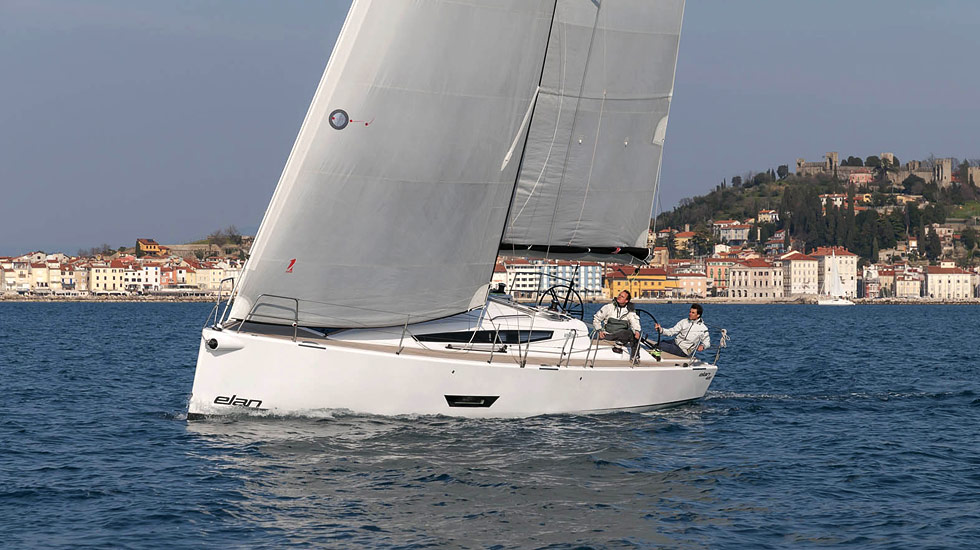 |
| With its powerful hull, bow pole, non-overlapping jib and svelte cabin trunk, the Elan 400 is a sporty looking ride. |
Moving on to the deck, I'm impressed with the innovative features incorporated into it. The transom is wide open, with a seat panel spanning it. This panel is removable and doubles as a gangplank, complete with wheels on the shoreside end, for when you're Med moored in Monte Carlo. The transom also has a drop-down panel making it into a water-level swim step with boarding ladder and transom shower.
 |
| The cockpit is beautifully laid out for racing. |
The cockpit itself is very well laid out for a racing crew, with plenty of room to move and ergonomically sensible access to winches, etc. The twin wheels are mounted on fairly lethal looking pedestals and give the helmsman a great view. The general arrangement is typical of the modern racer/cruiser, with short seats forward and wide open space aft. The traveler is mounted on the cockpit sole, which I think is the best place for it and the halyard winches are on the cabin top where they should be. The designers have incorporated a number of tricky features into this area. There is a cleverly designed dining table that retracts into the cockpit sole, retractable footrests for the helmsman, and a recess near the transom for the life raft. Add covered bins for sheets and a retractable companionway hatch board and you've got a pretty busy cockpit. Yet it looks clean and elegant!
 |
| Beautifully detailed deck |
The rest of the deck is fairly conventional with a low and aesthetically pleasing cabin trunk, jib tracks mounted close inboard and an anchor windlass and locker forward. The boat is equipped with inhauls for the jib, which is an indicator of how serious Elan is about racing performance. Your average cruising sailor wouldn't know what to do with them.
Elan offers the 400 with either two or three cabins. I chose the two cabin version mainly because I prefer to have a dedicated nav station instead of a fold-away chart desk. I think those things look great at boat shows but are not particularly useful. Of course if you're sailing is limited to local waters you have little need for a dedicated chart table and the space would be better used for other purposes.
 |
| Sensible layout for casual racing and weekends at the island. |
The accommodations plan incorporates a good sized forward cabin with a V-berth, seats and storage lockers. Elan thoughtfully refrained from pushing the berth too far forward so the foot of the bunk is reasonably wide. As in the rest of the boat, there is a plethora of locker doors that conceal lots of fairly small shelves. In spite of all those doors, it looks like usable storage space is somewhat limited. This is because the builder has pushed the lockers well outboard, making them quite shallow, The trade-off is the visual sensation of bright, wide open space below. I think this is perfectly acceptable given that the Elan 400 is not intended for living aboard or long offshore passagemaking.
 |
| In the three cabin version, the chart table folds away to make a full length settee on the port side of the salon. |
Given the intended purpose of the boat, the galley is adequate, although you may wish for a bit more storage space here. The aft stateroom is quite large and comfortable looking. The hard chines may contribute to the extra space here, or it could just be that the transom on the 400 is in the neighborhood of eleven feet wide.
 |
| The 400 looks fast. |
Overall, there is much to like about the Elan 400. The tall rig with non overlapping headsails provides lots of horsepower. The twin rudders should provide precise steering and the deep keel will keep the boat on its feet. As I mentioned before, to my eye this is a pretty boat that has excellent performance potential. While the squared off trapezoid shape deadlights in the hull could have been more artfully designed I expect the Elan 400 to turn heads wherever she goes. I took all the photos shown here from Elan's excellent web site and I invite you to visit www.elan-yachts.com to learn more about this interesting boat.
Tuesday, 4 June 2013
The State of the Sport
 |
| Oracle on its foils. A new level of sailing performance |
I've been thinking lately about the state of the sailing industry in the US, and, frankly, it's not pretty for the designers or the builders. Since the "Great Recession" there has been a decline in yacht design activity in this country. With a few exceptions, most of the designers I know are struggling to find commissions and many builders of custom and semi-custom yachts have diversified into powerboats or other products, or simply shut their doors. Is this the natural ebb and flow of business cycles, or are there other forces at work? It may be a matter of business cycles but I think there is more to it than that. It's pretty clear that the recession took a lot of money out of the sailing industry, which is to be expected since many people have been understandably more focused on their economic survival than new boats.
 |
| International Laser at speed |
Another factor is the way people spend their most precious commodity, leisure time. Sailing is time consuming compared to other sports that compete for your recreation time. Golf is a good example. You can go play a round of golf on a Saturday morning and be home in time for brunch. You drop your clubs in the garage and you're ready to spend the rest of the day doing other things. Sailing, on the other hand, is pretty much an all-day affair. If you just want to go out for a couple of hours, you head down to the boat, spend a half hour getting it ready, then push off from the dock and, if you're lucky, there is a breeze and you go out and enjoy sailing for a couple of hours. But who wants to sail for just a couple of hours on a Saturday? Instead you spend the day on the water, enjoy the hell out of it, then get back to the dock around four in the afternoon. Then you spend an hour folding sails, hosing down the boat, etc. and perhaps have a cold beverage and watch the sunset. Sounds like a good day to me. But for many, that doesn't work because they always have so many other things to do. Further, in many families not everyone involved in the decision-making process is as enamored of sailing as we are, so compromises must be made. Soccer, baseball, lacrosse, tennis, golf, riding, biking, hiking, surfing, etc. all compete for their time and interest, and most of those sports are less work, less expensive and less time consuming than sailing, so it's no wonder the sailing industry is struggling.
Another interesting symptom of the sailing malaise is the average age of the people you find out on the race course on any given weekend. It's been going up. Of course there are younger people coming into the sport and I am pleased to see the vibrant junior programs of the yacht clubs in my town. Still, the geezer-to-young buck ratio at my yacht club appears to be on the rise. Among the ranks of the cruisers, both local and long distance, the average age also seems to be on the increase. I guess it's all part of that 70 is the new 60 paradigm.
 |
| A Hans Christian 38 drives to weather |
With all of these forces at work, there seems to be a lot of hand wringing over the changing sociological and economic landscape in the sport of sailing. Declining sales, declining demographics, fewer boats on the starting lines, danger and death at the Americas Cup...Yikes, it's enough to make you trade your boat shoes for golf shoes.
For some this is a catastrophe. My God, our beloved sport is shrinking! What shall we do? Well, I have a couple of recommendations. First take a deep breath and relax. So what if our sport is shrinking? It'll find some point of equilibrium, some point where it's in balance with all the other forces that work on our leisure time, our psyches, and our multifarious commitments. Second, remember that you enjoy the sport. Remember that there are thousands of us out there enjoying our time on the water. If you're in the recreational boating industry, think about building the quality of the sailing experience instead of the quantity. Take your family and friends out sailing and don't worry that some or maybe even most of them don't connect with the absolute pleasure we derive from it. I'll wager that there is someone who has encouraged you to try something new, mountain climbing, horseback riding or whatever, that just didn't work for you. Those sports are no poorer because you didn't go out and buy a new Stetson or ice ax. And our sport is no poorer because someone came, saw... and decided they'd rather be on a mountain trail.
 |
| Left Coast Dart headed your way |
Frankly, I'm not the least bit disappointed that our sport is in something of a decline. Here in California, in the last year or so we've lost eleven people in yacht racing accidents. The jury is still out on the death of Andy Simpson, the crewman who died when the Swedish Americas Cup catamaran capsized, but the other deaths can be attributed to operator error. So either we need to improve the skills and knowledge of the folks that are already out sailing, or we might be better off if people who don't have those skills took up a different sport, or got the necessary training before heading offshore. Sailing is a lovely sport, pastime, and lifestyle, but it's not for everyone so let's just relax and enjoy it. We can and should welcome anyone who joins in, and we need not be concerned when people don't get it and prefer other things. Sailing and the sailing industry will survive and thrive in its own way, its own time and at its own level.
Tuesday, 5 March 2013
Finisterra's New Canvas

The dodger and bimini on The Cat's Meow were a faded shade of green and were at the end of their useful life when we bought the boat. I like the color green, and I like cats. But I can't say I like green cats or green dodgers, so the day we bought her we knew we'd soon replace the green with new cadet gray canvas. The job is just about complete and we are quite pleased with it.
 |
| New Dodger |
It's always an interesting experience to design a dodger for a boat. In this case, the stainless steel framework was already installed and was in good condition. The challenge was to use the existing frame to redesign the dodger so it meets our specific needs. I like to be able to see over the dodger from the helm and Lisa doesn't like to have to duck under it. Since I'm about seven inches taller than her I was able to adjust the height to accommodate us perfectly. This involved lowering it about three inches by cutting a little off the frames and adjusting the angles of them a bit.
I think most of the dodgers I see around my marina are too tall and clunky looking, which is surprising since virtually all dodgers are custom made. I am also of the opinion that most of the time, the person who designs the dodger gives little consideration to the aesthetic effect of the dodger on the overall look of the boat. I understand that their primary purpose is to provide protection from wind and spray but I'm not prepared to sacrifice style for the minimal added protection of a taller dodger. So, perfectionist that I am, I took dimensions and photographs and made CAD drawings of the whole thing superimposed on the profile of the boat and puttered around with it until I was satisfied with it. Then I adjusted the angles of the frames this way and that until I had it all just so. When all that was done, I passed this information on to Dan at Harbor Custom Canvas in Long Beach and he, being a master dodger builder, converted it into reality. We had them build the dodger on our last boat and found their workmanship and service to be excellent in all respects then, and they did another outstanding job on the Finisterra.
 |
| Lots of Strataglass for good visibility, a full length grab rail and a zippered roll-up section amidships |
 |
| New bimini |
We had snaps fitted to the sides and back, and a zipper on the forward side. These are for side curtains and a filler piece that connects the dodger to the bimini and provides shade over the entire cockpit. The side curtains will be made of polypropylene mesh and will attach to the top rails of the pulpits and lifelines. The mesh is fairly see-through and lets the breeze pass through as well.
 |
| This view gives a sense of the proportions of the dodger and bimini |
 |
| Dodger + filler + bimini = comfortable cockpit |
Subscribe to:
Posts (Atom)


.jpg)


