Monday, 13 January 2014
San Diego to Ensenada
We were in San Diego for six days, mostly socializing with friends, provisioning and doing a few minor projects on the boat. We were graciously hosted by our friends at Southwestern Yacht Club for four days, then we moved over to San Diego YC. On Sunday, January 12th, we departed SDYC at 0645 with our good friends Tom and Mary Ellen aboard for what turned out to be a quick ride to Ensenada.
The fog was thick as we motored slowly down the channel toward open water. By 1000 it was beginning to lift a bit and a very light breeze sprang up out of the northwest. A bit before noon we crossed the border into Mexico and hoisted the Mexican flag. Shortly after that we were approached by a Mexican patrol boat and ordered to heave to. With all of the controversy over foreign boats in Mexican waters, we didn't know quite what to expect as we drew alongside the dangerous looking patrol boat, which was manned by ten or twelve well armed sailors and immigration officers. They ordered us to present our papers and after a quick review of them, they handed them back and wished us a good voyage as we pulled away from their boat. It is my policy to be friendly and cooperative with the Mexican authorities and it turned out to be a very friendly encounter on all sides.
It stayed fairly cold all day. The wind began to build in the afternoon and by 1400 it was around 20 knots and coming straight over the transom as we passed the big LNG terminal on the northwest corner of Todos Santos Bay. We had unrolled the jib earlier to help steady the boat in the light air and lumpy swells, and with the knotmeter hitting 10's we sailed dead downwind the last few miles under the jib alone toward the harbor mouth, which we entered a few minutes after 1500. Finisterra was secured to her berth in Cruiseport Marina a short while later and by 1600 we were enjoying a cold beverage in the cabin.
That evening Tom's friend, Juan Hussong drove us to his restaurant, Sano's, which overlooks the bay near the Coral Hotel and Marina. There we had a splendid steak dinner and enjoyed Juan's stories of his life as a fisherman, boatbuilder and restauranteur.
The next morning we went to the Port Captain's office and officially entered the beautiful country of Mexico. By coincidence, one of the officers who had been on the patrol boat the day before came into the office and greeted us with a friendly smile. Once all the paperwork was done, passports stamped, fishing licenses and import permit secured, it was lunchtime and we walked a few blocks to the Mahi Mahi restaurant for tacos and beer. After lunch we said goodbye to Tom and Mary Ellen, who had to catch a bus back to San Diego, and walked back to the boat, stopping along the way at the Telcel store to set up our Mexican phones and internet access.
It turned out to be a beautiful, balmy afternoon. We washed down the boat, took long luxurious showers and, with sundowners in hand, walked the docks in the marina checking out the boats. Many were unfamiliar, but some we knew from the last time we were here. One interesting boat was Nereida, the boat that Jeanne Socrates recently sailed nonstop around the world.
Tomorrow we're headed inland to do some wine tasting in the Guadalupe Valley.

Thursday, 9 January 2014
Long Beach to San Diego
 |
| Sunset in Dana Point. |
The day finally arrived when we gave up our much coveted berth in Alamitos Bay and began our journey south to warmer climes and new adventures. January 3rd, the day of our departure, dawned cold, damp and foggy and we felt our way out of the harbor using GPS and Radar because visibility was down to about 150 feet. By 1100 it began to burn off as we motored down the coast to Newport Beach in zero wind. By the time we tied up at the guest dock at American Legion YC, it was sunny and beginning to warm up nicely. We spent a couple of days there, finishing up a few little projects on the boat but mostly socializing with friends. On the 5th, we departed from Newport Beach under balmy skies and, yet again, no wind. In about three hours we had the hook down in the west basin at Dana Point Harbor.
 |
| Gray whale headed south off Point Loma. |
 |
| Off Camp Pendleton the Ospreys were at work |

 |
| Sunrise off San Clemente. |
We departed Dana Point at 0530 on January 6th and after a pleasant sail in very light air, arrived at Southwestern YC in San Diego harbor at 1500. On the way we spotted some Humpback whales about a quarter mile off the starboard bow, and a few minutes later a couple of Grays forty yards off the port beam.
We'll stay here in San Diego a few days to socialize with friends and make final preparations for Mexico
Wednesday, 18 December 2013
Three Days in Avalon
We've had abnormally cold weather here in southern California in the last month so when the forecast changed to unseasonably warm conditions for the next few days we decided to head for Catalina. Departing Long Beach around 11:30 on Sunday, December 15th, we had a light northwesterly breeze for the entire passage. About mid-channel we broke out the flare gun and fired off some expired rounds for target practice. It's a fun way to get rid of old pyrotechnics and gives the crew a chance to get familiar with them. Though we usually stay at Two Harbors or Emerald Bay, this time we chose Avalon because at this time of year the island is nearly deserted of tourists and it's a perfect time to visit this quaint town. We picked up a mooring on the west side of the small harbor and got the boat squared away just in time to relax in the cockpit and enjoy a spectacular sunset.
The boat is nearly ready to head for Mexico so the dinghy and liferaft as well as the deck bags are all lashed in place. Over the next few weeks we'll make final preparations and provision for the first leg of the journey south which will take us first to San Diego, then Ensenada, Turtle Bay, Mag Bay, and on to San Jose Del Cabo at the tip of Baja California.
The next day we went ashore early and wandered around town a bit. The atmosphere was more like a country village than the bustling tourist destination it is in the summer. It was a beautiful warm morning and we hiked up to the Botanical Gardens a mile or so behind the town. Our route took us up Avalon Canyon Road and along the way we passed the golf course. I was surprised to see that the horse stables that had stood for years next to the course had been bulldozed. I wonder what they'll replace them with.
By midday we were back in town and played a round of miniature golf before heading back to the boat. I love playing there and we do it every time we're in town. The course is basically a botanical garden with greens. It's a tranquil place with lots of hummingbirds and other flora and fauna...much better than an amusement park setting. Back aboard Finisterra, we relaxed and prepared for another beautiful sunset and moonrise.
The next day we took advantage of free tickets for a Humvee tour into the back country between Avalon and Little Harbor. The tickets were courtesy of the West End Cruising Club which we had joined a year or two back. I was eager to take this tour because it's the only way, besides walking, to see the interior of this end of the island. The Island Conservancy, which manages about 90% of Catalina imposes strict limits on travel in this area. Our route took us up to the airport, which is located on a high point in the middle of the island, then across to Little Harbor and Ben Weston beach, and returned to Avalon via Cape Canyon Road.
By 0800 a cruise ship had anchored off Avalon and the shore boat fleet was busy shuttling tourists ashore so it was a good time to head for the hills, no pun intended. This is a weekly port call for the Carnival Inspiration which also calls at Ensenada and its home port of Long Beach. The ship will depart for Ensenada at 1700 and the town will revert back to quiet village mode until next Tuesday when the ship will arrive again.
After we passed the airport the road turned to rough dirt and gravel so it was a bouncy ride past Rancho Escondido and on down to Little Harbor. The rancho, owned by the Catalina Island Company (the Wrigley family) has been converted from a horse ranch to a vineyard enterprise. They grow chardonnay, zinfandel and pinot noir grapes that are shipped to the Rusack Winery in the Santa Ynez Valley by air. There they are made into fine wines. We missed an opportunity to taste them, but learned that they are available at one of the restaurants in Avalon. We did have a fine meal at another new restaurant in town, the Bluewater, which also has quite a respectable wine list.
From the vineyard of El Rancho Escondido we drove down to a point overlooking Little Harbor. It looks like it's wide open to a southwesterly swell, but there is a protective reef that makes it a reasonably secure place to anchor most of the time. It was deserted on this day, but in the summer there are usually three or four boats anchored bow and stern in this tiny cove.
From Little harbor we turned inland again and drove up Cape Canyon road. We passed the old abandoned coach house which was once a stopover for horse drawn coaches, then we stopped at the eagle sanctuary. Right now there is only a single Bald eagle and a Golden eagle in residence. This is a good thing, since the Bald eagles that live on the island are all healthy. The Bald eagle that lives at the sanctuary was permanently injured several years ago and cannot survive in the wild. The Golden eagle is the last of the breed to live on Catalina. They are not native to the island and now that there is a healthy population of Balds, they are able to keep the Goldens from reestablishing themselves on the island.
From Cape Canyon we drove up the dirt road to Blackjack peak. From there we rejoined the Airport road and returned to Avalon. I'm not a big fan of guided tours, but this one was fascinating. If you like back country touring you'll enjoy this one.
Wednesday dawned cold and blustery and it was time to get back across the channel before a predicted storm arrived, so we dropped the mooring and got shot out of Avalon harbor by a strong wind coming down the canyon. As the day wore on, however, the wind lightened and shifted around to a westerly direction and we had a delightful sail on a close reach back to Long Beach.

 |
| Finisterra in Avalon |
 |
| Avalon looks festive as the sun sets behind the hills. |
By midday we were back in town and played a round of miniature golf before heading back to the boat. I love playing there and we do it every time we're in town. The course is basically a botanical garden with greens. It's a tranquil place with lots of hummingbirds and other flora and fauna...much better than an amusement park setting. Back aboard Finisterra, we relaxed and prepared for another beautiful sunset and moonrise.
 |
| With the mainland in the distance, the moon peeks from behind a cloud bank. |
 |
| For a few moments the moonrise looked like a sunset. |
The next day we took advantage of free tickets for a Humvee tour into the back country between Avalon and Little Harbor. The tickets were courtesy of the West End Cruising Club which we had joined a year or two back. I was eager to take this tour because it's the only way, besides walking, to see the interior of this end of the island. The Island Conservancy, which manages about 90% of Catalina imposes strict limits on travel in this area. Our route took us up to the airport, which is located on a high point in the middle of the island, then across to Little Harbor and Ben Weston beach, and returned to Avalon via Cape Canyon Road.
 |
| The Carnival Inspiration |
By 0800 a cruise ship had anchored off Avalon and the shore boat fleet was busy shuttling tourists ashore so it was a good time to head for the hills, no pun intended. This is a weekly port call for the Carnival Inspiration which also calls at Ensenada and its home port of Long Beach. The ship will depart for Ensenada at 1700 and the town will revert back to quiet village mode until next Tuesday when the ship will arrive again.
 |
| The view from the airport road. |
 |
| Looking northwest from the airport road toward Long Point. |
 |
| Bison are plentiful in this part of the island. Unfortunately Catalina has been suffering from drought in the last couple of years and water is scarce. The Conservancy has been placing water tanks at many of the natural ponds where there is usually water for the wildlife. |
 |
| Female bison and their calves run in herds while bulls lead more solitary lives. This young bull is on his own. |
 |
| Later we caught up with this small herd. The trail on the left is the Transcatalina Trail which runs from Avalon to Parsons Landing and on to the west end of the Island. |
 |
El Rancho Escondido was formerly a horse ranch specializing in Arabians. |
 |
| It's hard to imagine a more idyllic spot to practice the vintner's art |
 |
| Little Harbor is the far cove. In the foreground is Sharks cove, which is one of the few places on the island that occasionally has ride-able surf. |
 |
| Cape Canyon Coach House |
 |
| Finisterra at her mooring. The squid were running inside the harbor, which brought the sea birds and seals in to feast on them all around the boat. |

Tuesday, 26 November 2013
Marlow Hunter 40 Review
Early last year I saw an article about the acquisition of Hunter Marine by Marlow Yachts. Like many sailboat builders during the Great Recession, Hunter found itself in some financial difficulty and was rescued by a stronger company. Sailboaters may not be familiar with the Marlow brand because it is a powerboat company. They build boats in Asia and market them globally. Marlow Yachts are widely respected and I think they will bring much more than a cash infusion to Hunter. Hunter's aging product line needed an update and I suspect that there was some Marlow influence in the design and production of their first new boat, the Marlow Hunter 40.

When I first saw the drawings of the MH40, I thought this boat had better be fast because it's not good looking. But a couple of months later I saw one on a mooring in Catalina and must say that the boat is indeed much prettier than the drawings indicate. From a purely aesthetic point of view, it is an exceptionally bold design statement with its powerboat-like hullform and sharply detailed deck. I think this boat blurs the line between power and sail by incorporating powerboat features into a sailboat. Only time will tell if this is the start of a new trend or not.
Beginning with the deck, it's hard to get past the knife-like window design. I think some will like it a lot and others might find it a bit too stylized. The cabin trunk itself is low and sleek, with the cockpit coamings integrated into the roof line. The cockpit is very large with twin wheels, a large dropleaf table amidships and a stainless steel arch that incorporates a bimini and mainsheet traveler. The transom incorporates a large trap door that folds out to make a swim or boarding platform. I'm not a fan of this arrangement and I've been told that Hunter will incorporate step into the transom so boarding from a dinghy won't be quite the challenge that this configuration presents.
Hunter is the only production cruising boat builder I know of that still uses the Bergstrom & Ridder rig. We've all seen Hunter boats with the diagonal shrouds that go both ways (diamond shrouds), and some with deck struts as well to support the rig. Properly done, the B&R rig is set up without a backstay which is how the MH 40 is built. This arrangement allows for a large mainsail but it also puts a lot of compression load on the mast, especially when flying a spinnaker. All of this is fine if the system is well engineered, and the fact that there are hundreds of Hunters sailing with this rig attests to the quality of this arrangement. With all that said, I still prefer a basic two or three spreader rig and a backstay for cruising. The MH40 can be ordered with a classic mainsail, but my guess is that the vast majority of these boats will be set up with a roller furling mainsail. Notice that the traveler is mounted on the bimini. It appears to me that Hunter, like some other sailboat manufacturers is trying to make the sailing of the boat as labor free as possible. I guess that's a good thing for many people but I like to sail, to trim my sails and to get the best out of them. That is certainly possible with this arrangement, but whenever I'm on a boat with the sail controls removed from where I think they ought to be, I feel distant from the actual sailing of the boat.
The hull of the MH40 takes the concept of chines to the point where there is little difference between the aft sections of this hull and those of a powerboat. This certainly makes for a lot of interior space aft and Hunter took full advantage of it to create a beautiful aft stateroom. With a displacement of 19,700 pounds and sail area of 910 square feet, the MH40 sports a D/L of 188 and a SA/D of 20. This is indicative of a moderately heavy boat with a fair amount of sail area. The keel options include a deep one of 6'-8" draft and a shoal version with 5'-2" draft. The boat should move well in light air and the hard chines will provide a good deal of initial stability as the breeze builds. On the other hand, the hull appears to be quite full in the bow and the chines give it more wetted surface than a more conventional design. I think the MH40 is going to be an excellent boat under power and I would opt for the largest engine they offer. There are more than a few builders these days that are pushing their products in this direction, and it makes sense for boat buyers who love the idea of sailing to their weekend destinations but are constrained by time deadlines.

Marlow Hunter offers the 40 in two and three stateroom configurations. You can see how those chines in the hull contribute to expansive accommodations aft. I'm impressed by the size of the aft cabins in both versions, but the single aft stateroom could be described as luxurious. The galley is large and there is adequate seating and living room in the main salon. The forward cabin is snug but adequate and everything is finished with Hunter's usual attention to detail.
Overall, I have to respect the bold styling of the Marlow Hunter 40 and I think there is definitely a market for a good coastal cruising sailboat that can provide reasonable sailing performance as well as a good turn of speed under power. These days people have precious little time for relaxing at their favorite cruising spot and the MH40 may be just the right combination for today's busy cruising family. It's good to see the Hunter name survive and I wish them all success with their new line of boats.
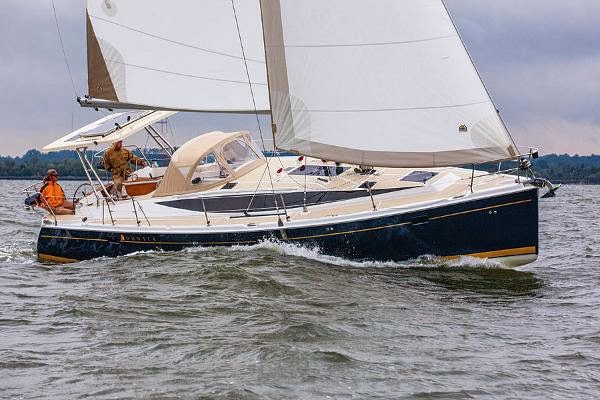
When I first saw the drawings of the MH40, I thought this boat had better be fast because it's not good looking. But a couple of months later I saw one on a mooring in Catalina and must say that the boat is indeed much prettier than the drawings indicate. From a purely aesthetic point of view, it is an exceptionally bold design statement with its powerboat-like hullform and sharply detailed deck. I think this boat blurs the line between power and sail by incorporating powerboat features into a sailboat. Only time will tell if this is the start of a new trend or not.
 |
| Spacious cockpit, massive transom and hardtop dominate the view from astern |
Beginning with the deck, it's hard to get past the knife-like window design. I think some will like it a lot and others might find it a bit too stylized. The cabin trunk itself is low and sleek, with the cockpit coamings integrated into the roof line. The cockpit is very large with twin wheels, a large dropleaf table amidships and a stainless steel arch that incorporates a bimini and mainsheet traveler. The transom incorporates a large trap door that folds out to make a swim or boarding platform. I'm not a fan of this arrangement and I've been told that Hunter will incorporate step into the transom so boarding from a dinghy won't be quite the challenge that this configuration presents.
Hunter is the only production cruising boat builder I know of that still uses the Bergstrom & Ridder rig. We've all seen Hunter boats with the diagonal shrouds that go both ways (diamond shrouds), and some with deck struts as well to support the rig. Properly done, the B&R rig is set up without a backstay which is how the MH 40 is built. This arrangement allows for a large mainsail but it also puts a lot of compression load on the mast, especially when flying a spinnaker. All of this is fine if the system is well engineered, and the fact that there are hundreds of Hunters sailing with this rig attests to the quality of this arrangement. With all that said, I still prefer a basic two or three spreader rig and a backstay for cruising. The MH40 can be ordered with a classic mainsail, but my guess is that the vast majority of these boats will be set up with a roller furling mainsail. Notice that the traveler is mounted on the bimini. It appears to me that Hunter, like some other sailboat manufacturers is trying to make the sailing of the boat as labor free as possible. I guess that's a good thing for many people but I like to sail, to trim my sails and to get the best out of them. That is certainly possible with this arrangement, but whenever I'm on a boat with the sail controls removed from where I think they ought to be, I feel distant from the actual sailing of the boat.
The hull of the MH40 takes the concept of chines to the point where there is little difference between the aft sections of this hull and those of a powerboat. This certainly makes for a lot of interior space aft and Hunter took full advantage of it to create a beautiful aft stateroom. With a displacement of 19,700 pounds and sail area of 910 square feet, the MH40 sports a D/L of 188 and a SA/D of 20. This is indicative of a moderately heavy boat with a fair amount of sail area. The keel options include a deep one of 6'-8" draft and a shoal version with 5'-2" draft. The boat should move well in light air and the hard chines will provide a good deal of initial stability as the breeze builds. On the other hand, the hull appears to be quite full in the bow and the chines give it more wetted surface than a more conventional design. I think the MH40 is going to be an excellent boat under power and I would opt for the largest engine they offer. There are more than a few builders these days that are pushing their products in this direction, and it makes sense for boat buyers who love the idea of sailing to their weekend destinations but are constrained by time deadlines.
 |
| Hard chines and massive wings on the keel. |

Marlow Hunter offers the 40 in two and three stateroom configurations. You can see how those chines in the hull contribute to expansive accommodations aft. I'm impressed by the size of the aft cabins in both versions, but the single aft stateroom could be described as luxurious. The galley is large and there is adequate seating and living room in the main salon. The forward cabin is snug but adequate and everything is finished with Hunter's usual attention to detail.
Overall, I have to respect the bold styling of the Marlow Hunter 40 and I think there is definitely a market for a good coastal cruising sailboat that can provide reasonable sailing performance as well as a good turn of speed under power. These days people have precious little time for relaxing at their favorite cruising spot and the MH40 may be just the right combination for today's busy cruising family. It's good to see the Hunter name survive and I wish them all success with their new line of boats.
Friday, 15 November 2013
Finisterra Update 11-15-13
Over the last couple of months I've been busy with mostly non-sailing issues but have found time for a few projects aboard Finisterra. In early October I made the decision to rewire the 12 volt system from the batteries to the main DC panel. The system worked OK as it was, but over the years the previous owner had added various extras to the boat and instead of routing them through the main DC panel or installing an auxiliary DC panel, he simply ran the leads directly to the batteries and used in-line fuses on an ad hoc basis. The result was battery terminals with multiple wires leading to individual components. To further complicate matters, the house bank had been connected to the starting battery in such a way that they could not be isolated from each other. In other words, we really only had one great big bank of batteries that included six 6V deep cycle AGM batteries and a single 12V AGM starting battery. Our solution was to bring in Peter Dugan of Pacific Marine Electric to sort it all out. Together we created a new wiring system from the batteries to the main switches and installed a new auxiliary DC panel. The result is a much cleaner wiring arrangement that enables us to isolate the starting battery and provides an auxiliary panel for all the extra equipment the previous owner and I have installed. In the process we got rid of about 50 pounds of heavy gauge battery cable and have a clean and understandable system, which makes me happy. Once the wiring was complete I fabricated a cover for the batteries so I could access the raw water pump without sitting directly on top of the battery terminals.
I also finished the installation of the solar panels. They are mounted on a stainless steel tube on the aft end of the bimini and secured in place with Magma barbecue mounting brackets. This way I can adjust them through a range of about 120 degrees to align them with the sun as needed. The Magma brackets make it easy to remove the panels if necessary.
One of the key elements of a good passage is having a snug, warm and secure place to sleep when you're off watch. Unfortunately Finisterra was not built with any good sea berths so I improvised with a lee board in the quarter berth. It's made of African Mahogany and slips into anodized aluminum brackets. It converts the king size quarter berth into a nice, snug sea berth.
Security is always an issue here in the States as well as abroad. To help keep ourselves and our gear safe, I installed a security system that incorporates sensors, called Pulsors, bonded to the underside of the deck and hatches in strategic locations. The Pulsors can detect slight fluctuations in the deck, such as from the weight of a person stepping aboard, and trigger the alarm. I'm not sure how well it'll work against the bad guys but I've scared myself a couple of times by not disarming it before climbing aboard.
Another project was to build a seat for the companionway. This is a nice place to be when you're on the midnight watch, or when you have a cockpit full of guests. On the night watches it is the warmest part of the cockpit and provides excellent protection from the elements, a good view forward and easy access to the sailing instruments. The autopilot remote and I-Pad are also within easy reach. Or we can turn around and face the cockpit, using a drop board for a back rest. It's made of teak and is secured in place with a couple of rigging pins.
I pondered whether to install an AIS system on Finisterra for a long time. After all, I've made many a long passage without it in the past, so do we really need it now? Well, yes we do. In some ways it beats radar for sorting out what other vessels are out there. It takes less power than a radar and we can display it wirelessly on our laptops, I-Pads, GPS and smart phones. I chose a Vesper XB8000, which includes a VHF receiver and transponder and dedicated GPS receiver. Installation was quick and easy, all I needed was to install the VHF and GPS antennas and provide 12V power to the unit. Because it works through its own WIFI network I was spared the expense and aggravation of wiring all our displays to it. I could have connected it to the masthead VHF antenna by installing an antenna splitter, but I like my systems to be stand-alone and autonomous from each other, so I mounted a separate antenna on the bimini.
The latest addition to the fleet is our new Hobie Mirage i9S inflatable kayak. I love this thing! We've tried several different types of kayaks in the past, both inflatable and rotomolded, and none really met our needs until we found the i9S. The average inflatable kayaks are slow, track poorly and are just no fun to paddle. The rotomolded unit we had for a while paddled fairly well and was certainly rugged enough, but it was a big, bulky thing. I really couldn't accept having such a thing strapped down on the foredeck or hanging from our lifelines, so I was thinking of not having a kayak at all, which wasn't a very good solution either. Then we found this little Hobie. Right from the start I liked the propulsion system better than a double bladed paddle. It uses leg power to drive a pair of fins so it sort of swims along, leaving your hands free to do more constructive things, such as fish, or sip a cocktail, or wave to admirers as you glide past them.
The boat comes with a paddle for emergencies, or if you want to go really fast you can pedal and paddle at the same time. But I found it to be perfect for relaxing jaunts around Alamitos Bay and I look forward to cruising it in far off places as well. The propulsion system is easy to install and comes with its own storage bag. The hull weighs about 45 pounds and fits neatly in the starboard cockpit locker when it's deflated.
 |
| Battery cover is elevated to clear the battery terminals. It's a good place to sit while changing the impeller on the raw water pump. Finisterra is equipped with six 6V deep cycle battery and a single 12V starting battery. |
I also finished the installation of the solar panels. They are mounted on a stainless steel tube on the aft end of the bimini and secured in place with Magma barbecue mounting brackets. This way I can adjust them through a range of about 120 degrees to align them with the sun as needed. The Magma brackets make it easy to remove the panels if necessary.
 |
| Three 50 watt solar panels. Having the ability to adjust them to face the sun as needed vastly improves their efficiency. Since all of our lighting is LED, the primary consumer of electricity is the refrigeration system. To augment the solar array we also carry a Honda genset. Notice the GAM single sideband antenna on the port backstay. |
 |
| Juice from the solar panels is routed through a GoPower charge controller mounted on the aft bulkhead in the quarter cabin. |
 |
| Nothing beats a good place to sleep when you're underway. |
 |
| Pulsors are about 3 inches long and can be mounted almost anywhere. |
 |
| The companionway sill on the B423 is high enough that it's easy to bark your shins when going below. This little seat makes that a thing of the past. |
 |
| I set the height of it so that a standard square boat cushion works perfectly for it. |
 |
| Vesper XB8000 wifi enabled AIS. receiver/transponder. Very cool! |
 |
| Pedal powered and quite civilized, the little Hobie has earned a place aboard Finisterra |
The boat comes with a paddle for emergencies, or if you want to go really fast you can pedal and paddle at the same time. But I found it to be perfect for relaxing jaunts around Alamitos Bay and I look forward to cruising it in far off places as well. The propulsion system is easy to install and comes with its own storage bag. The hull weighs about 45 pounds and fits neatly in the starboard cockpit locker when it's deflated.
Thursday, 14 November 2013
Lolita becomes Cinnamon Girl.
I am pleased to report that my little wooden boat, formerly called 'Lolita', has a new home in the San Francisco Bay area and a new name that I think fits perfectly. Her new owner, Mariellen Stern has given her fresh varnish and a bunch of other upgrades and she's now ready to race. Here are some photos from her days in Newport Beach:
I designed this boat way back in 1978 for a client that wanted a traditional looking boat for cold-molded construction. I could not bring myself to draw a full keel on it so we compromised with a shallow-ish fin keel and skeg-mounted rudder. Twenty years later I found her in a warehouse in Signal Hill in a sad state of disrepair and bought her on the spot. I brought her back to my shop and rebuilt her in my spare time. In doing so I deepened the keel and put a new spade rudder on her. A few years later my plans changed and I put her in storage while I focused on other projects and went cruising.
Fast forward to 2013, it was time to either refit her again or find a new home for her. Fortunately, last April Mariellen came into her life. She had known this boat many years ago and loves it as much as I have over the years. After several years in storage the varnish on the hull and cockpit was in rough shape, the bottom paint was gone and there were a few other issues that needed attention. I had always sailed the boat in southern California where the winds are relatively light and only raced it a few times so it was very simply rigged, but for sailing and racing in the San Francisco bay area, we thought some additions were necessary. These included a new 100% jib set on a roller furler, rigid vang and improved reefing system among others. Here are some photos of the work in progress:


.jpg) |
| Cinnamon Girl as she looked in 2007. |
 |
| Cinnamon Girl sports traditional lines above the waterline combined with a fast bottom. |
 |
| With her deep fin keel and spade rudder, Cinnamon Girl is deceptively quick. |
Fast forward to 2013, it was time to either refit her again or find a new home for her. Fortunately, last April Mariellen came into her life. She had known this boat many years ago and loves it as much as I have over the years. After several years in storage the varnish on the hull and cockpit was in rough shape, the bottom paint was gone and there were a few other issues that needed attention. I had always sailed the boat in southern California where the winds are relatively light and only raced it a few times so it was very simply rigged, but for sailing and racing in the San Francisco bay area, we thought some additions were necessary. These included a new 100% jib set on a roller furler, rigid vang and improved reefing system among others. Here are some photos of the work in progress:
 |
| Lolita survived the road trip from Costa Mesa to Richmond, CA |
 |
| Topsides are prepped for new finish . |
 |
| Several coats of Interlux Perfection are applied. The hull is made of cold molded fir and mahogany. |
 |
| Once the topsides were finished, fresh bottom paint was applied. |

 |
| With work on the hull completed, the boat was relaunched. The next step was to refinish the cockpit. |

 |
| It was no small job to refinish the cockpit. Notice the old style Barlow winches. |

 |
| Mariellen stands proudly with her new Cinnamon Girl |
 |
| Cinnamon Girl in her element. |
Saturday, 2 November 2013
America's Cup Observations
It's clear that the AC/72 boats represent the most significant advances in yacht racing in a generation. While small boats like the Moth have been foiling for years and other large multihulls have been using foils that are adjustable for cant and rake, the 72's are arguably the first to combine foils, wing masts and sophisticated foil control systems in in a truly competitive package. It is also important to note that there were no significant gear failures during the regatta. That is a testament to the highly developed design, engineering and testing programs of both teams. I think this bodes well for the future of the Cup competition. Once again, I have to confess that before the event I was among those who felt that this event could very well be a dismal failure. After witnessing the spectacular racing I changed my mind in this regard.
I watched every minute of the racing on TV and think it was extremely well presented. Journeyman sports announcer Todd Harris did good job in spite of having no real yacht racing experience. Sure, he made a few goofy comments but he also frequently acknowledged his lack of experience in the sport and didn't try to come across as an expert. I thought that was a refreshing departure from previous AC announcers. NBC relied on a cast of true sailing experts to deliver insightful commentary and I thought they all combined to deliver a quality sporting product.
What about the crews? Without access to the inner workings of each team we can only speculate on what occurred within them as the regatta progressed, but the indications are that the American team had not spent nearly as many hours on the water, in the boat they would race in the finals, as the Kiwis did. This became glaringly apparent when a Team Oracle crewman fell overboard before the start of the first race. Another interesting facet of the American team was the body language of two key members of their afterguard, John Kostecki and Tom Slingsby. We don't know what that interpersonal relationship was like but it was obvious that things improved when Kostecki was replaced by Ben Ainsley. This is not to take anything away from Kostecki as he has had a long and illustrious career as a professional sailor. But sometimes personalities don't mesh regardless of the skills and talents of the individuals and perhaps that's all there was to it. In any case, the shift from Kostecki to Ainsley made a significant difference and in my opinion was a key factor in Oracle's eventual victory.
It was compelling personal drama to see the juxtaposition of confidence in the two crews as Oracle began racking up wins against the Kiwis who came within a few puffs of wind of winning the event when race 13 was abandoned with the ENZ ahead with less than a mile to the finish line. When that race was re-sailed later in the day, the Americans began their improbable march to 9 points and the Cup. As the Kiwis suffered loss after loss their confidence was replaced first by concern, then worry and finally desperation. At the end of the event the strain and despair were evident on the faces of the ENZ team, especially that of Dean Barker, whose helmsmanship could not be faulted except on the starting line where he was frequently bested by Spithill. The Kiwis made few tactical errors and only one glaring boathandling error when they nearly capsized.
It was also interesting to see how the Americans continued to improve daily while the Kiwis seemed to remain constant in terms of boatspeed. I can only attribute that to the fact that Oracle was the faster boat and it took several races for the Americans to learn how to sail it to its optimum potential, while the Kiwis had the slower boat and couldn't get much more out of her.
In the aftermath of the event, Team Oracle accepted the challenge from an Australian group for the next America's Cup competition. We don't know what kind of boats that regatta will be sailed in, but given the spectacular racing we witnessed in AC XXXIV, I'm looking forward to some incredible technological advances and exciting racing in the event to come.
I watched every minute of the racing on TV and think it was extremely well presented. Journeyman sports announcer Todd Harris did good job in spite of having no real yacht racing experience. Sure, he made a few goofy comments but he also frequently acknowledged his lack of experience in the sport and didn't try to come across as an expert. I thought that was a refreshing departure from previous AC announcers. NBC relied on a cast of true sailing experts to deliver insightful commentary and I thought they all combined to deliver a quality sporting product.
What about the crews? Without access to the inner workings of each team we can only speculate on what occurred within them as the regatta progressed, but the indications are that the American team had not spent nearly as many hours on the water, in the boat they would race in the finals, as the Kiwis did. This became glaringly apparent when a Team Oracle crewman fell overboard before the start of the first race. Another interesting facet of the American team was the body language of two key members of their afterguard, John Kostecki and Tom Slingsby. We don't know what that interpersonal relationship was like but it was obvious that things improved when Kostecki was replaced by Ben Ainsley. This is not to take anything away from Kostecki as he has had a long and illustrious career as a professional sailor. But sometimes personalities don't mesh regardless of the skills and talents of the individuals and perhaps that's all there was to it. In any case, the shift from Kostecki to Ainsley made a significant difference and in my opinion was a key factor in Oracle's eventual victory.
It was compelling personal drama to see the juxtaposition of confidence in the two crews as Oracle began racking up wins against the Kiwis who came within a few puffs of wind of winning the event when race 13 was abandoned with the ENZ ahead with less than a mile to the finish line. When that race was re-sailed later in the day, the Americans began their improbable march to 9 points and the Cup. As the Kiwis suffered loss after loss their confidence was replaced first by concern, then worry and finally desperation. At the end of the event the strain and despair were evident on the faces of the ENZ team, especially that of Dean Barker, whose helmsmanship could not be faulted except on the starting line where he was frequently bested by Spithill. The Kiwis made few tactical errors and only one glaring boathandling error when they nearly capsized.
It was also interesting to see how the Americans continued to improve daily while the Kiwis seemed to remain constant in terms of boatspeed. I can only attribute that to the fact that Oracle was the faster boat and it took several races for the Americans to learn how to sail it to its optimum potential, while the Kiwis had the slower boat and couldn't get much more out of her.
In the aftermath of the event, Team Oracle accepted the challenge from an Australian group for the next America's Cup competition. We don't know what kind of boats that regatta will be sailed in, but given the spectacular racing we witnessed in AC XXXIV, I'm looking forward to some incredible technological advances and exciting racing in the event to come.
Subscribe to:
Posts (Atom)


.jpg)


