Thursday, 15 May 2014
Bahia de Concepcion
 |
| Finisterra at anchor off Posada de Concepcion |
We had a great time in the Bay. The first thing we did after getting the hook down was to head over to the TKT restaurant on Playa Santispac, where we met up with our old friend Senor Paloma. To get there from the boat is about a fifteen minute dinghy ride around Punta Posada to the beach at Santispac. The waves at the beach are usually nonexistent unless the wind blows out of the south. With a 20 mile fetch, they can get big enough to make the landing a bit dampish at times. The TKT is a palapa on the beach that serves excellent seafood and margaritas, and we had dinner there several times while we were anchored in the bay. Anyway, we were having dinner with Jerry (Sr. Paloma) and a couple of friends when we met up with the folks on a boat anchored not far from us, they in turn introduced us to another couple, Tom and Sylvia, who it turns out had sailed with us aboard Tivoli in the Banderas Bay Regatta three years ago. So for the next week or so, we did a lot of socializing, took care of some business at home and did a lot of exploring of beautiful Bahia de Concepcion. Tom and Sylvia own Cinnabar, the beautiful red Schumacher 52 that was anchored not far from Finisterra.
 |
| Superbly built and meticulously maintained. Cinnabar is a beautiful example of a high performance cruiser. |
Pelicans:
These are Brown Pelicans. They have a wingspan of six to eight feet and weigh up to twelve pounds.
 |
| Pelicans gather on the islands in Bahia de Concepcion to breed and hatch their young. |
 |
| Poetry in flight |
 |
| A pelican lifts off. |
 |
| Another comes in for a water landing. |
Osprey:
Ospreys are sometimes called fish hawks. They are different from the Pelicans, Frigates, Boobies and most other sea birds in that they capture prey with their talons instead of their beaks. Osprey have a wingspan of about six feet and weigh up to about 4.5 pounds.
 |
| A pair of Osprey survey their domain from a cactus on top of Isla Pitihaya inside Bahia de Concepcion. |

 |
| Lisa shot this photo of a young Osprey flapping its wings trying to fly while its mother stands by. |
 |
| Liftoff! |
 |
| Osprey guarding its nest. |
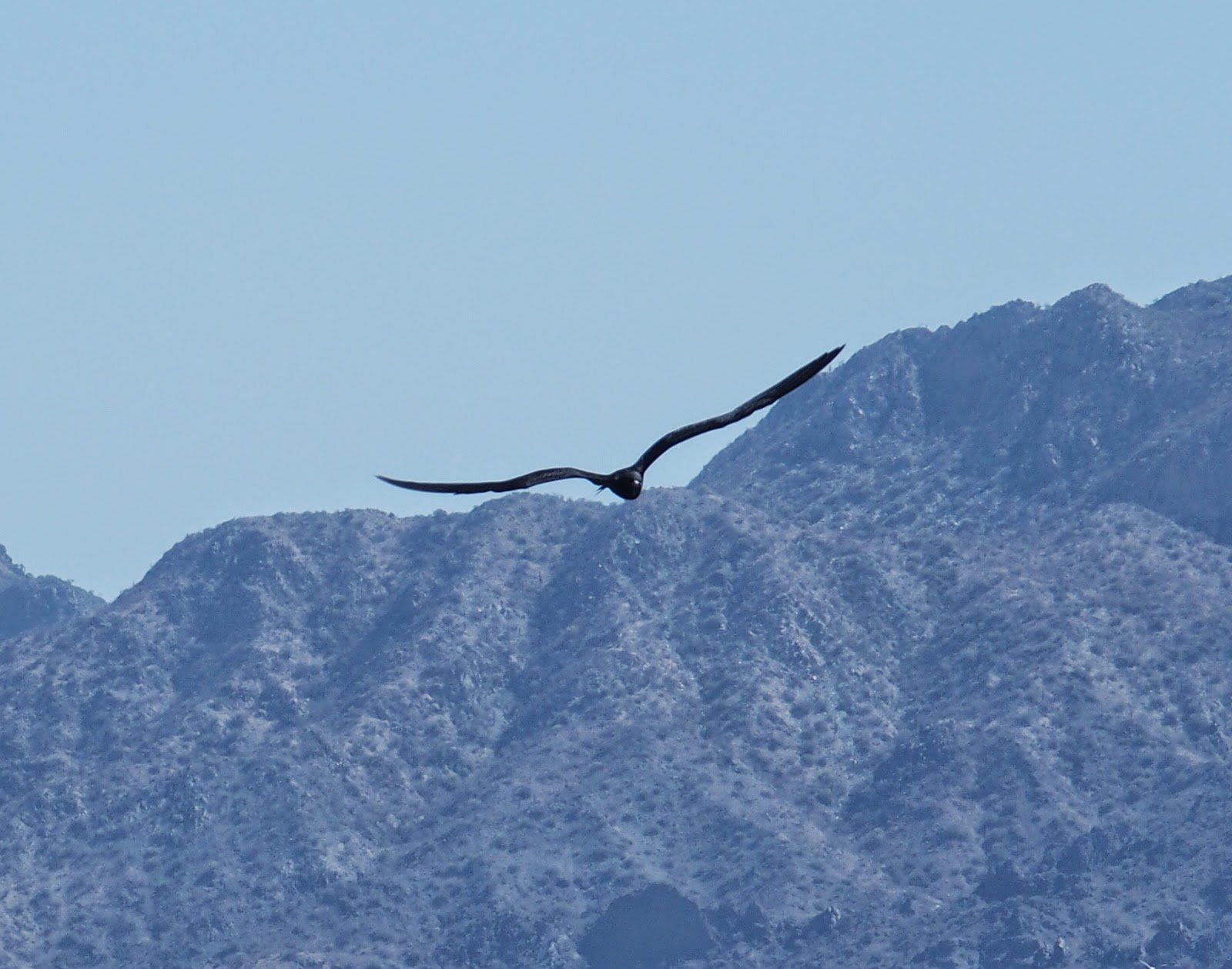
Frigates:
With a wingspan of almost seven and a half feet, Frigates weigh only about four pounds. They are incredibly agile fliers and often use their aerobatic skills to snatch prey from other birds in mid-flight. A Frigate will often swoop down on another bird from behind and snatch a fish dangling from its beak.


 |
| He looks a bit like a pirate to me. |
 |
 |
| On final approach. |

Saturday, 10 May 2014
La Paz to Bahia de Concepcion
 |
| Ensenada Grande with mainland Baja in the background. |
 |
| Sunset is a perfect time for a paddle in Ensenada Grande. |
 |
| I have no idea how these unusual rocks were formed but they are fascinating to explore. |
While there, we hiked up the hills behind the bay and explored the strange rock formations that line the north side of the bay. When we got restless we sailed north again toward the fishing village of San Evaristo on the mainland of Baja.
With a nice breeze out of the southeast, we had a pleasant sail for about twenty miles then about six miles from the anchorage, the wind died and we began to motor. We had been trolling all day without a bite, but about four miles out, the reel lit up and we caught a 20 pound dorado. This was our first fish of this kind and as soon as we got the anchor down in Evaristo I had the BBQ out and we had a fine meal of grilled dorado, wild rice and a fine bottle of pinot grigio, supplied by my friends at C1. Thanks guys! We spent a couple of days in Evaristo then departed for Puerto Los Gatos, about thirty miles up the Baja coast.
 |
| We caught him just in time for dinner. |
 |
| A dorado's beautiful colors quickly fade when they die. After giving him a couple of shots of rum this fellow relaxed and died peacefully. |
It was a beautiful starboard tack reach, with about 12 knots of wind out of the east under a hazy, somewhat overcast sky. I like the overcast because it provides some relief from the sun, which can be brutal here in the Sea. We approached Los Gatos from the southeast and saw a boat anchored in the far northern part of the bay, which is about half a mile wide. We anchored in the southern part of the bay, about as far from the other boat as we could get and were looking forward to a beautiful, quiet evening. But within an hour three other boats came into the bay and anchored close enough that we could hear them talking as they enjoyed their sundowners. A couple of them left early the next morning so we were able to explore this beautiful bay pretty much in peace and solitude. Different voyages have different flavors. The last time we were here, three years ago, we were delighted to have lots of friends from other boats around. This time, we have been inclined to seek the solitude of empty bays and quiet nights.
 |
| Our dinghy is a speck on the beach at Los Gatos. |
On Saturday, April 19th we got the anchor up early and headed for Bahia Agua Verde, about 13 miles north. With three knots of wind out of the southeast, there was no point in trying to sail, so we fired up the diesel and a couple hours later we anchored about a hundred yards off the beach in Agua Verde. Since it was the day before Easter Sunday, the beaches in the fairly large bay were crowded with Mexican vacationers here to celebrate the holiday. The next morning we hiked into the country behind the little settlement. Aside from fishing, the locals raise goats, pigs and a few cattle. There is a school and church, along with a couple of small tiendas and a restaurant or two, so Agua Verde, though it has no cell phone or internet service is fairly cosmopolitan compared to most other places in this part of Baja California.
Later in the day we raised the anchor and continued north 22 miles to Puerto Escondido. We arrived around 1700 and passed through the narrow channel into the lagoon that makes this place an excellent all weather port of refuge. The lagoon is over a mile long and half a mile wide and until recently had over a hundred moorings. Now there are only a few moorings left, and they don�t look well maintained. Ashore, things have declined from the last time we were here. There is still a boatyard with a Travelift and a floating dock and a few boats hauled out here, but the place is pretty desolate. The restaurant has closed down and so has the little tienda. Puerto Escondido should be a thriving community, but apparently there has been a lot of disagreement within the local business community and with the government which has had a bad effect on the village. We had hoped to stock up on fresh food and use the Internet here, but instead we spent one night in the lagoon tied to an iffy looking mooring and left the next morning for the town of Loreto, about 14 miles up the coast.
 |
| Puerto Escondido sunrise. Regardless of the business situation in the village, the scenery remains awe inspiring. |
There is a tiny harbor at Loreto but it is for the exclusive use of the local fishermen, so we anchored outside and took the dinghy into town where we had a nice meal at the Hotel La Mision, checked email and wandered around the town a bit before heading back out to the boat. While ashore we visited a unique museum of sorts, with the skeletons of whales and dolphins on display. Back aboard Finisterra, we spent a peaceful night anchored outside the harbor, then left early the next morning for Caleta San Juanico.
The distance from Loreto to San Juanico is about 27 miles and with scant wind, we motorsailed the entire distance, arriving in the early afternoon. There were four or five boats anchored in the north end of the bay and a couple more at the south end, so we chose a nice spot just off the beach in the middle part of the bay, anchoring in about 15 feet of water. With a light breeze coming out of the southeast and crystal clear water, the swimming was delightful. Later we grilled the last of the dorado I caught a week ago for dinner. The next morning we were underway early for the 50 mile passage to Bahia de Concepcion.
 |
| Caleta San Juanico is dotted with rocky islets. |
The wind blew out of the northwest, exactly the direction we wanted to go, so we motored toward Punta Concepcion until we were a few miles out. Then the wind shifted to northeast and piped up to about 20 knots and we had a fast sail around the point and about six miles down the bay. Then we furled the sails and picked our way through the pass between Punta Piedrita and tiny Isla Pitihaya, toward Playa Santispac. There were several boats already at anchor there, so we bore away toward the little cove at Posada de Conception where we anchored in about 20 feet of water in the lee of some tall bluffs which offered good protection from the strong northerlies that sometimes blow down the Sea of Cortez. Finisterra was to remain at anchor here for the next nine days.
Sunday, 13 April 2014
Mazatlan to La Paz
Our week in Mazatlan flew by ever so quickly. This was due in part to the repair project I spent some time on but mostly because whenever I wasn't working on the boat there was lots of fun to be had. One evening we did Mazatlan's version of PV's Southside Shuffle, only here there was a lot less art and more wine tasting. On a couple of days we simply strolled along the malecon and up the streets to the Plaza Machado in the heart of Old Mazatlan. Like all cities in Mexico, the public transportation system is excellent, with buses, taxis and other forms of transportation easily available. In La Cruz we often traveled by "collectivo" which is a small van with lots of seats, usually crammed full of people. It's not exactly fun, but they got us pretty much where we wanted to go very inexpensively. In Mazatlan they have a unique and much more fun mode of transportation called "Pulmonias". These are small open topped cars with air-cooled Volkswagen engines that are everywhere in this town. They are cheaper than a taxi, much less claustrophobic than a collectivo and simply fun to ride around in.
"Pulmonia" means pneumonia in Spanish. When these open cars first showed up in town back in the 1960's, the local taxi drivers were outraged and warned people not to ride in them because they would catch "pulmonia", so people started calling them Pulmonias and the name stuck.

 |
| Pulmonia. |
 |
| Iguanas are a fact of life in Mazatlan. Around the pool at El Cid they would gather around people who were eating and wait, with prehistoric patience for a handout. |
 |
In the past, whenever we've stayed in Mazatlan, it was at Marina Mazatlan. It's a nice place as marinas go, but we were very happy that we chose to stay at Marina EL Cid this time. It is connected to the El Cid resort, so it also has beautiful swimming pools, private beach, an excellent restaurant and a staff that is always eager to assist you with every little thing. We had a great time basking in the luxury of the place.
 |
| Looking east toward Isla Cerralvo in the predawn light. |
 |
| Just before the sun rose over the horizon a pod of dolphins passed by. |
 |
| Pelicans roosting on the rocks at Puerto Balandra |
After that week of luxury, and with the boat all put back together, it was time to say adios to Mazatlan and head for La Paz, the gateway to Sea of Cortez cruising grounds. So on April 8th, Finisterra cleared the breakwater under a sunny sky and an easy ten knot breeze out of the southwest, perfect for a close reach on port tack to the northern tip of Isla Cerralvo. But within half an hour the wind began to veer and before long we were headed north-northeast instead of our desired course of northwest. We sailed in this direction for about ten miles, basically skirting the coast north of Mazatlan, then tacked. This put us on a course about 40 degrees south of where we wanted to go, but by evening the wind had veered far enough that we were back on course on starboard tack in about 15 knots of wind. We sailed this way for the next 120 miles of the 230 mile passage. Then the wind disappeared and I started the engine. We motored the rest of the way in three to eight knots of breeze out of the northwest.
After passing Isla Cerralvo we were approaching the San Lorenzo channel, which separates mainland Baja from Isla Espiritu Santo around 0300. I slowed down to about four knots as we reached the entrance to the channel. It's fairly narrow and there was a lot of ship traffic passing through it, and I didn't want to arrive at our destination of Puerto Balandra in the dark. We transited the channel around 0700 and by 0800 we were anchored in the southwest corner of Balandra and settled back to enjoy a couple of days of snorkeling, sunning and just relaxing. It was hot during the daytime but at night the Coromuel wind showed up, bringing cool air in from the Pacific which lies not far to the west.
Our next stop was Marina Costa Baja, which lies at the entrance to the channel leading into the inner harbor at La Paz. This is a 5 star resort with a marina.

In a luxury marina full of large and very large mega yachts, Galeocerdo, a Wally 118' motor yacht stood out. It's like a Ferrari of boats, with a top speed of about 70 knots and a price tag of $30 million. With its dark, stealthy gray/green paint and styling reminiscent of an F-117, it looks kind of dangerous. I don't know why anyone would want to spend $30 million on a boat like this, but there you have it. Galeocerdo is the scientific name for Tiger Shark.
 |
| Pelican in La Paz |
After passing Isla Cerralvo we were approaching the San Lorenzo channel, which separates mainland Baja from Isla Espiritu Santo around 0300. I slowed down to about four knots as we reached the entrance to the channel. It's fairly narrow and there was a lot of ship traffic passing through it, and I didn't want to arrive at our destination of Puerto Balandra in the dark. We transited the channel around 0700 and by 0800 we were anchored in the southwest corner of Balandra and settled back to enjoy a couple of days of snorkeling, sunning and just relaxing. It was hot during the daytime but at night the Coromuel wind showed up, bringing cool air in from the Pacific which lies not far to the west.
 |
| Nesting gull |
Our next stop was Marina Costa Baja, which lies at the entrance to the channel leading into the inner harbor at La Paz. This is a 5 star resort with a marina.
 |
| "Galeocerdo" |
 |
| The bulwarks fold outward on both sides of the hull to provide more lounging space on deck. There are lots of videos of this boat on youtube. |
In a luxury marina full of large and very large mega yachts, Galeocerdo, a Wally 118' motor yacht stood out. It's like a Ferrari of boats, with a top speed of about 70 knots and a price tag of $30 million. With its dark, stealthy gray/green paint and styling reminiscent of an F-117, it looks kind of dangerous. I don't know why anyone would want to spend $30 million on a boat like this, but there you have it. Galeocerdo is the scientific name for Tiger Shark.
 |
| F117 |
Tomorrow we'll head north to some of the beautiful coves of Isla Espritu Santo and Isla Partida. This area is a UNESCO Biosphere Reserve. We're looking forward to some awesome scenery and snorkeling.
 |
| Isla Partida, on the left is separated from the larger Espiritu Santo by a narrow channel. We'll anchor in Ensenada Grande, the large cove near the left end of the islands. |
Sunday, 6 April 2014
Banderas Bay to Mazatlan
Finisterra finally sailed from La Cruz around 0900 on Sunday, March 30th bound for Mantanchen Bay and then Mazatlan. It was a beautiful morning with a light offshore wind early and the promise of a nice beam reach to Mantanchen in the afternoon. We motored out around Punta de Mita and turned northward in almost no wind, but by noon we had enough wind to sail. We hoisted the main and set the jib and settled down on the reach to Mantanchen in about 10 knots of wind. It was looking like a beautiful day-sail all the way.
Shortly after we got the sails set and trimmed, I heard a strange creaking noise coming from somewhere down below. This was a new noise, not the typical creaks that I was accustomed to. I searched around the boat in all the likely places that creaks might come from, but couldn't find the source of the noise until I opened the starboard lazarette hatch. When I looked down into the compartment I noticed that the bracket for the autopilot ram was moving back and forth in an unusual manner. Then I realized that the bulkhead was flexing and the joint where I assumed Beneteau had spliced or scarfed together two pieces of plywood to make the aft bulkhead was not a joint at all. It was not lapped or scarffed, or even glued together. Nope, Beneteau apparently saw fit to just butt the two pieces of plywood together without the benefit of any adhesive or mechanical fasteners. Then whoever installed the autopilot ram drilled the mounting holes less than a quarter inch of the edge of this imaginary joint. The bracket was mounted with massive 7/16" bolts and a stainless steel backing plate so it looked like a proper job, but looks can be deceiving.
By mid-afternoon we were gliding into Mantanchen Bay and got the anchor down in about eighteen feet of water three quarters of a mile from the beach, which I hoped was well beyond the range of the no-nos that live around here. Then we had a decision to make: We could go back roughly 50 miles to La Cruz or continue on to Mazatlan, another 130 miles north from here. After looking at the weather forecast we decided to press on to Mazatlan. The wind would be on the nose the entire distance but it would be light most of the way. We would be motoring into it and that would put the least stress on the wobbly bulkhead.
To put this little problem into perspective, we were in no danger and the worst that might have happened to us was that we might have to hand steer if the bulkhead failed completely, which was very unlikely. But it certainly annoyed me as a boatbuilder that the boat was built in this manner. And of course the problem needed to be fixed before we ran into any real weather, which is always a possibility in the Sea of Cortez.
The repair was easy enough. I went over to Marine Services Mazatlan, which is located in the shipyard next to Marina Mazatlan and had them cut out some plywood reinforcements that I bonded to both sides of the bulkhead with WEST epoxy. Once the epoxy cured it was a simple matter to reinstall the bracket and ram.
With the repair completed, we were able to spend some time around the pool at the marina and wander around the beautiful city of Mazatlan. In a few days we'll head northwest across the Sea of Cortez to La Paz.
+(2).jpg) |
| Mantanchen Bay sunset |
Shortly after we got the sails set and trimmed, I heard a strange creaking noise coming from somewhere down below. This was a new noise, not the typical creaks that I was accustomed to. I searched around the boat in all the likely places that creaks might come from, but couldn't find the source of the noise until I opened the starboard lazarette hatch. When I looked down into the compartment I noticed that the bracket for the autopilot ram was moving back and forth in an unusual manner. Then I realized that the bulkhead was flexing and the joint where I assumed Beneteau had spliced or scarfed together two pieces of plywood to make the aft bulkhead was not a joint at all. It was not lapped or scarffed, or even glued together. Nope, Beneteau apparently saw fit to just butt the two pieces of plywood together without the benefit of any adhesive or mechanical fasteners. Then whoever installed the autopilot ram drilled the mounting holes less than a quarter inch of the edge of this imaginary joint. The bracket was mounted with massive 7/16" bolts and a stainless steel backing plate so it looked like a proper job, but looks can be deceiving.
By mid-afternoon we were gliding into Mantanchen Bay and got the anchor down in about eighteen feet of water three quarters of a mile from the beach, which I hoped was well beyond the range of the no-nos that live around here. Then we had a decision to make: We could go back roughly 50 miles to La Cruz or continue on to Mazatlan, another 130 miles north from here. After looking at the weather forecast we decided to press on to Mazatlan. The wind would be on the nose the entire distance but it would be light most of the way. We would be motoring into it and that would put the least stress on the wobbly bulkhead.
.jpg) |
| Mountains behind Mazatlan at dawn. |
.jpg) |
| View from the aft side of the bulkhead. When I replaced the autopilot ram back in 2012 I assumed this joint was lapped but it's not. |
.jpg) |
| View from the forward side of the bulkhead. |
The repair was easy enough. I went over to Marine Services Mazatlan, which is located in the shipyard next to Marina Mazatlan and had them cut out some plywood reinforcements that I bonded to both sides of the bulkhead with WEST epoxy. Once the epoxy cured it was a simple matter to reinstall the bracket and ram.
.jpg) |
| Both sides of the bulkhead were sanded and prepped. |
.jpg) |
| Plywood reinforcements bonded in place. The screws were used to clamp everything together while the epoxy cured. |
.jpg) |
| Bracket and ram reinstalled and ready to go. |
Saturday, 5 April 2014
Road Trip: Patzcuaro and Chapala
We left Morelia around mid-morning on March 24th, headed toward Patzcuaro. We'd heard that the lake of the same name is a beautiful place, dotted with islands and that the town is something of a hangout for American and Canadian expats. We had also read about the recent trouble there but locals in Morelia told us that all of that is in the past, and the town has been peaceful since February.
We arrived in Patzcuaro around noon and discovered that the town isn't really built on the lakeshore and isn't quite as picturesque as we had expected. The place was crawling with Policia Federales, Policia Estado, Policia Transito and Policia Municipal though. No shortage of guns here.
After about 20 minutes in town we decided to head north along the eastern shore of Lake Patzcuaro in search of beautiful vistas and perhaps a margarita as well. We found the vistas but no margaritas. So we continued on to Lake Chapala another couple of hours up the road.
We stopped at a small settlement where there was a pier for panga-sized island ferrys and a few fishing boats. This was about halfway between the towns of Patzcuaro and Tzintzuntzan (pronounced zin-zoon-ZON, I like the name). Aside from these places, the countryside was farmland on the right and the coffee colored lake on the left. With that we left Lake Patzcuaro and headed northwest toward Laguna de Chapala.
Lake Chapala is Mexico's largest freshwater lake. It is about 50 miles long in the east-west direction and 8 miles wide in the north-south direction, and lies at an elevation of 5,000 feet above sea level. We headed toward the north shore of the lake with plans to stay in the town of Chapala and visit the neighboring town of Ajijic the next day.
We took the back way into town and were rewarded with several miles of rough cobblestone and dirt roads before we got into town but it was worth it to see the working farms up close as we bounced past. Chapala, with a population of about 45,000 is a good sized town and sports a beautiful lakefront malecon. We took rooms at the beautiful Hotel San Francisco, just across the street from the water's edge. After getting our bags stowed in our rooms we went out to the the hotel bar which is situated in a beautiful garden and ordered a pitcher of margaritas (Ed and I are still searching for the perfect one), but believe it or not, the hostess informed us that the hotel was out of tequila! So off we went downtown searching for a meal and a drink. We found what appeared to be a good restaurant and ordered dinner and a pitcher. The meal turned out to be mediocre at best, and we're still looking for a decent margarita.

This area has long been a haven for American and Canadian expats, with at least 15,000 of them living here. The weather is said to be among the best in the world and we were certainly blessed with beautiful, mild weather while we were there. One of Chapala's claims to fame is that the famous playwright Tennessee Williams set up shop here for a while in the late 1940's and banged out one of his most famous plays, "The Poker Night" from the shores of this beautiful lake. Never heard of "The Poker Night"? Neither have I, but somewhere along the way it was renamed "A Streetcar Named Desire".
Ajijic (pronounced ahi-HEEK), just a couple of miles down the road from Chapala, is the center of the expat community. The place is crawling with gringos, American stores, restaurants and other trappings of the US and Canada. The homes here are mostly beautiful places surrounded by high walls topped with electric fences or shards of glass embedded in the tops of them. I do not find electric fences attractive even if they are attached to beautiful handmade stone walls. We stopped at a waterfront hotel and were warmly greeted by the staff even though we had no intention of staying there. The place was beautiful and I was tempted to try one of their margaritas, but the sun wasn't nearly over the yardarm yet so instead we got back in the car and headed out on the last leg of our journey back to La Cruz.
We arrived back in La Cruz around 7:00pm and found Finisterra just as we left her. The next day we started getting ready for a quick passage to Mantanchen Bay and then to one of my favorite cities, Mazatlan.
We arrived in Patzcuaro around noon and discovered that the town isn't really built on the lakeshore and isn't quite as picturesque as we had expected. The place was crawling with Policia Federales, Policia Estado, Policia Transito and Policia Municipal though. No shortage of guns here.
After about 20 minutes in town we decided to head north along the eastern shore of Lake Patzcuaro in search of beautiful vistas and perhaps a margarita as well. We found the vistas but no margaritas. So we continued on to Lake Chapala another couple of hours up the road.
 |
| Isla de Jinitzio rises from the lake. It is topped by a 140 foot statue of Jose Maria Morelos, who was a hero in Mexico's fight for independence from Spain. You can climb a spiral staircase up the inside of the statue and look out over the lake from windows in the raised fist of the statue. |
 |
| Patzcuaro is said to be an upscale town, but here on the eastern shore of the lake there were few signs of wealth. This fisherman told me that things were bad now because the lake is low and the fishing's not good. |
 |
| Tools of the Patzcuaro fisherman's trade |
Lake Chapala is Mexico's largest freshwater lake. It is about 50 miles long in the east-west direction and 8 miles wide in the north-south direction, and lies at an elevation of 5,000 feet above sea level. We headed toward the north shore of the lake with plans to stay in the town of Chapala and visit the neighboring town of Ajijic the next day.
We took the back way into town and were rewarded with several miles of rough cobblestone and dirt roads before we got into town but it was worth it to see the working farms up close as we bounced past. Chapala, with a population of about 45,000 is a good sized town and sports a beautiful lakefront malecon. We took rooms at the beautiful Hotel San Francisco, just across the street from the water's edge. After getting our bags stowed in our rooms we went out to the the hotel bar which is situated in a beautiful garden and ordered a pitcher of margaritas (Ed and I are still searching for the perfect one), but believe it or not, the hostess informed us that the hotel was out of tequila! So off we went downtown searching for a meal and a drink. We found what appeared to be a good restaurant and ordered dinner and a pitcher. The meal turned out to be mediocre at best, and we're still looking for a decent margarita.
 |
| White pelicans on Lake Chapala |
This area has long been a haven for American and Canadian expats, with at least 15,000 of them living here. The weather is said to be among the best in the world and we were certainly blessed with beautiful, mild weather while we were there. One of Chapala's claims to fame is that the famous playwright Tennessee Williams set up shop here for a while in the late 1940's and banged out one of his most famous plays, "The Poker Night" from the shores of this beautiful lake. Never heard of "The Poker Night"? Neither have I, but somewhere along the way it was renamed "A Streetcar Named Desire".
Ajijic (pronounced ahi-HEEK), just a couple of miles down the road from Chapala, is the center of the expat community. The place is crawling with gringos, American stores, restaurants and other trappings of the US and Canada. The homes here are mostly beautiful places surrounded by high walls topped with electric fences or shards of glass embedded in the tops of them. I do not find electric fences attractive even if they are attached to beautiful handmade stone walls. We stopped at a waterfront hotel and were warmly greeted by the staff even though we had no intention of staying there. The place was beautiful and I was tempted to try one of their margaritas, but the sun wasn't nearly over the yardarm yet so instead we got back in the car and headed out on the last leg of our journey back to La Cruz.
.jpg) |
| Beautiful pool at a waterfront hotel in Ajijic. The place was nearly empty. |
We arrived back in La Cruz around 7:00pm and found Finisterra just as we left her. The next day we started getting ready for a quick passage to Mantanchen Bay and then to one of my favorite cities, Mazatlan.
Wednesday, 2 April 2014
Road Trip: The butterflies of Morelia
After three days in the fascinating city of Guanajuato it was time to reluctantly say goodbye and get back on the road. Our first stop was San Miguel de Allende. This town is renowned for its arts and culture, and is home to two prestigious schools, the Instituto Allende and the Instituto de Bellas Artes. These schools, founded in the 1940's by artists and writers, attracted American WWII veterans who could attend classes on the GI Bill. Many of them stayed in town or later retired there, and soon the town had a large and vibrant American community. But San Miguel also has a rich history dating back to the days when Mexico was fighting for independence from Spain and it is known as the first city to throw off Spanish rule.
Unfortunately we had time only for a quick tour of downtown and an hour or so for lunch. We wandered around the central plaza and admired the architecture of the buildings and the diversity of the tourists that crowded the area. The church is one of the most beautiful we've encountered and I couldn't help being impressed by it.
.jpg)
After a couple of hours in San Miguel it was time to continue on to Morelia. Rolling down the highway we passed through rich farmland and crossed into the state of Michoacan, home of the notorious Knights Templar drug cartel. Here the conflicts between the cartels, the locals and the government are real, and we saw more than a few heavily armed soldiers and police manning checkpoints and driving around in big trucks. I know very little about this complicated situation but one aspect of it is that in some towns in the region, local citizens have taken up arms against the "Templars" that have terrorized and extorted money from them. Anyway we were careful about where we were at all times and were tucked into our hotel well before dark whenever possible.
We really didn't do much in Morelia. We had come to see the Monarch butterflies, but it turns out that they don't actually hang out in Morelia, but in the mountains about 80 tortuous miles east of the city. So we got up early and drove out through mountains and high valleys toward the town of Angangueo. From there it was another ten or fifteen miles up a steep mountain road that ended at a small settlement that marked the entrance to the Monarch Butterfly Sanctuary, which was at roughly 10,000 feet elevation. We parked in a deserted parking lot and hiked up to the entrance of the sanctuary. The entry fee was about 35 pesos per person, which included a guide. As we hiked up the trail, which consisted of a nice footpath and in some areas staircases, he told us about the butterflies and their migrations.
The countryside is a beautiful forest of spruce and pine and it was a nice walk up to an elevation of about 11,000 feet. The guide told us that the path to the top included 700 stairs. We knew we had arrived late in the season so we expected to see a few butterflies and then head back down the road. Sure enough on the way up we encountered a few and thought they were beautiful. We told the guide they were nice and said he didn't have to walk all the way to the top with us. But he encouraged us to go on. I was a little concerned for our companions, Ed and Connie, they are both a bit older and not accustomed to hiking. But they were game and we continued on up to a small pass where we encountered some horsemen who offered their horses to us, which we declined.

As we headed down the trail on the other side of the pass, the forest canopy closed in and the guide dropped his voice to a whisper. We walked on in silence, deeper into the forest. Then we arrived in the heart of the sanctuary and found ourselves surrounded by millions of Monarchs. They flew all around us, landing on us, posing on flowers and clustering by the thousands on branches above us. It was at once magical and awe inspiring to stand in silence and hear the sound of thousands of butterfly wings. We spent an hour or so with them, then it was time to go.

We hiked back up the trail to the pass where the horsemen had patiently waited. Ed and Connie decided they'd had enough walking and accepted the offer of a couple of horses while Lisa and I accompanied the guide back down the trail. Soon we were back in the car and headed for our hotel in Morelia, we arrived in the early evening tired but still enchanted by the butterflies. It was a perfectly beautiful experience. The next day we got an early start toward the troubled city of Patzcuaro, where local vigilantes had recently taken their town back from the Templars.
Unfortunately we had time only for a quick tour of downtown and an hour or so for lunch. We wandered around the central plaza and admired the architecture of the buildings and the diversity of the tourists that crowded the area. The church is one of the most beautiful we've encountered and I couldn't help being impressed by it.
.jpg) |
| It is not difficult to see how this architecture could inspire 18th century Mexican peasants. |
.jpg) |
| These church bells are incredibly loud and can be heard for miles around. Notice the bell on the left, it's actually tolling while this fellow calmly surveys the crowd below. He reminded me of Quasimodo from Victor Hugo's "Hunchback of Notre Dame". |
 |
| Street musicians. This bongo player didn't miss a beat while acknowledging a passerby. |
We really didn't do much in Morelia. We had come to see the Monarch butterflies, but it turns out that they don't actually hang out in Morelia, but in the mountains about 80 tortuous miles east of the city. So we got up early and drove out through mountains and high valleys toward the town of Angangueo. From there it was another ten or fifteen miles up a steep mountain road that ended at a small settlement that marked the entrance to the Monarch Butterfly Sanctuary, which was at roughly 10,000 feet elevation. We parked in a deserted parking lot and hiked up to the entrance of the sanctuary. The entry fee was about 35 pesos per person, which included a guide. As we hiked up the trail, which consisted of a nice footpath and in some areas staircases, he told us about the butterflies and their migrations.
The countryside is a beautiful forest of spruce and pine and it was a nice walk up to an elevation of about 11,000 feet. The guide told us that the path to the top included 700 stairs. We knew we had arrived late in the season so we expected to see a few butterflies and then head back down the road. Sure enough on the way up we encountered a few and thought they were beautiful. We told the guide they were nice and said he didn't have to walk all the way to the top with us. But he encouraged us to go on. I was a little concerned for our companions, Ed and Connie, they are both a bit older and not accustomed to hiking. But they were game and we continued on up to a small pass where we encountered some horsemen who offered their horses to us, which we declined.
.jpg) |
| The country around Angangueo is beautiful and rugged. |
 |
| First butterfly |
As we headed down the trail on the other side of the pass, the forest canopy closed in and the guide dropped his voice to a whisper. We walked on in silence, deeper into the forest. Then we arrived in the heart of the sanctuary and found ourselves surrounded by millions of Monarchs. They flew all around us, landing on us, posing on flowers and clustering by the thousands on branches above us. It was at once magical and awe inspiring to stand in silence and hear the sound of thousands of butterfly wings. We spent an hour or so with them, then it was time to go.
 |
| Butterflies in flight |
.jpg) |
| Ed's ride down the mountain |
We hiked back up the trail to the pass where the horsemen had patiently waited. Ed and Connie decided they'd had enough walking and accepted the offer of a couple of horses while Lisa and I accompanied the guide back down the trail. Soon we were back in the car and headed for our hotel in Morelia, we arrived in the early evening tired but still enchanted by the butterflies. It was a perfectly beautiful experience. The next day we got an early start toward the troubled city of Patzcuaro, where local vigilantes had recently taken their town back from the Templars.
Subscribe to:
Posts (Atom)


.jpg)


