Sunday, 31 October 2010
Catalina
Spent the weekend in Catalina, at Two Harbors. There was no wind on the 24 mile trip from Long Beach to the Island so we motored the entire way. On the way we ran the watermaker and topped up our starboard water tank, tested the autopilot, GPS, Maxsea software and other systems...all worked well. At Two Harbors we picked up a mooring in front of the village and made the boat all snug, as we expected some weather later. A fast moving cold front passed through overnight, bringing wind and rain from around midnight to dawn, and left us with a cold northerly wind the next morning. We hiked over to Cat Harbor around midday to enjoy the scenery of that idyllic anchorage. It's a short hike across the narrow isthmus, to the southwest side of the island where Cat Harbor is located. On the way we came across two bison grazing in the field next to the road. Bison roam wild on Catalina. They were originally brought over from the mainland in 1924 for the filming of a Zane Grey silent western. Since then, the Catalina Island bison herd has been carefully nurtured and controlled by the Island Conservancy, and number about 150 head. Shaggy and prehistoric looking, they are the undesputed kings of the animal life on the island, except for us humans.
We had a fine sail home on Sunday, and for the first time I was able to observe the new transom extension under sail. It worked as I had hoped, reducing turbulence and drag, and increasing our sailing performance. But most of all, it made a perfect place to board the boat from the dinghy.
????
????
Read More..
 |
| Viewed from aft, the transom extension is hardly visible |
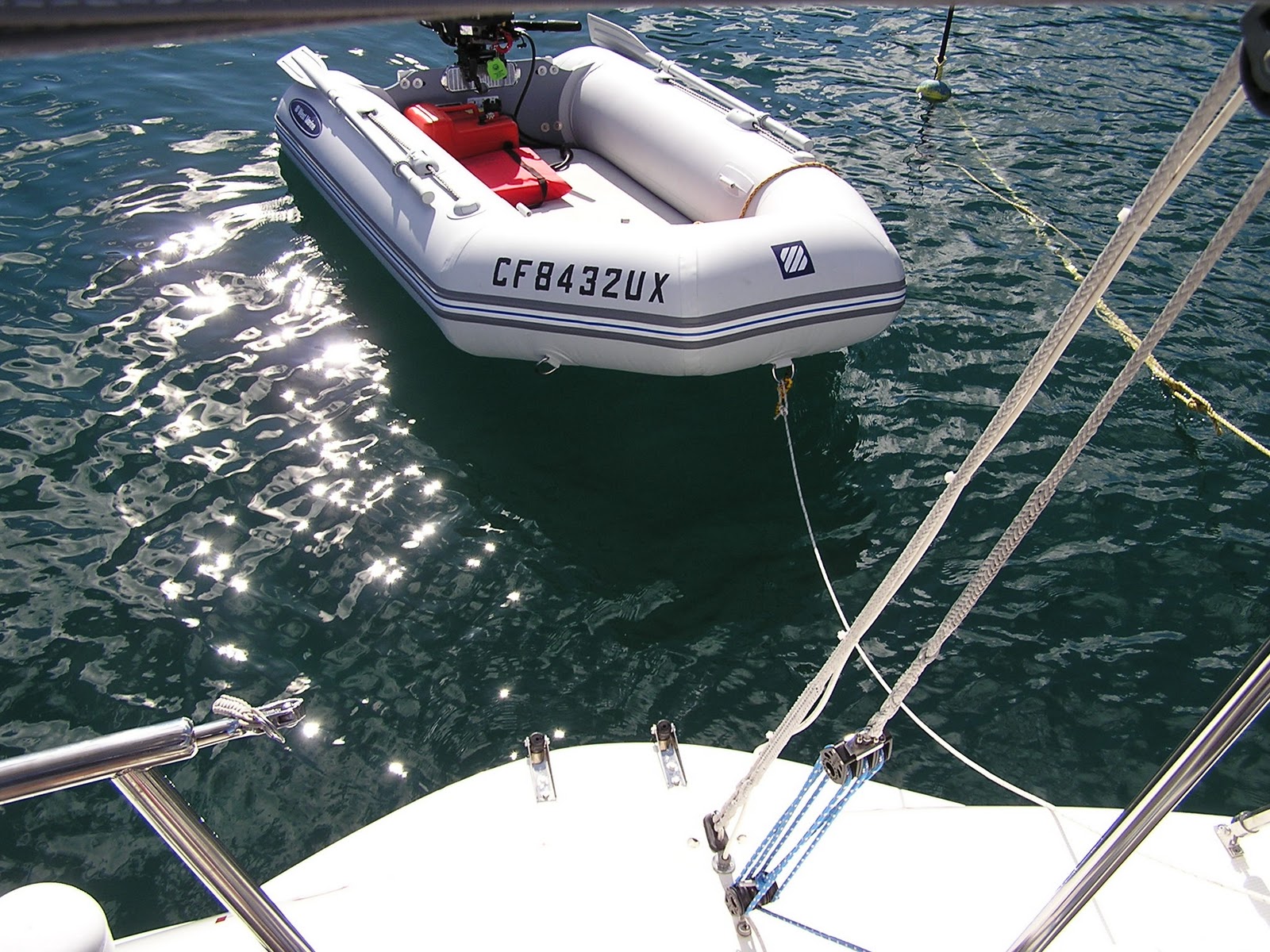 |
| On the mooring with the swim ladder deployed |
 |
| Nice, clean wake |
????
 |
| The autopilot does the driving while Catalina recedes in the Honcho's wake. |

Monday, 25 October 2010
The Pace Slows
It's been about six weeks since I started working full time on preparing the Honcho for extended cruising in Mexico. Until yesterday it's been long days and nights of work to get the boat set up and prepared. Today I can say that we're basically ready to go. All that's left is final provisions and fuel. For the first time I could sit back and relax a bit. With my workload tapering off I've had time for a morning jog on the beach the last few days, and time to reflect more on the voyage instead of the multitude of tasks to be completed before I could say the boat and crew are ready. But now the days are getting shorter and the nights colder, telling me it's time to go.
Our course south will take us first to Ensenada where we'll clear customs and collect all the necessary permits for a vessel traveling in Mexican waters. This will take a couple of days. Then the Honcho will leave the cities behind and head south along the coast of the Baja Peninsula. Our first landfall will be Bahia San Bartolome, or Turtle Bay, about 300 miles from Ensenada. We'll spend a couple of days there, then continue on to Bahia Santa Maria, another 225 miles south. Bahia Santa Maria lies at roughly 25 degrees north latitude, and it is at this point where the weather usually turns from colder north Pacific conditions to warmer, more tropical conditions. In spite of the tropical latitude, the landscape there, as nearly everywhere else on the peninsula is arid and desert-like. We'll hang out in Bahia Santa Maria for a few days, then continue south past Cabo San Lucas, at the tip of the peninsula. Cabo lies about 175 miles south of Bahia Santa Maria and in addition to being a tourist destination, is the point where we'll leave the Baja Peninsula and cross the Sea of Cortez, making landfall at Puerto Vallarta. PV is about 300 miles southeast of Cabo San Lucas. That will conclude the first leg of the voyage.
Read More..
Our course south will take us first to Ensenada where we'll clear customs and collect all the necessary permits for a vessel traveling in Mexican waters. This will take a couple of days. Then the Honcho will leave the cities behind and head south along the coast of the Baja Peninsula. Our first landfall will be Bahia San Bartolome, or Turtle Bay, about 300 miles from Ensenada. We'll spend a couple of days there, then continue on to Bahia Santa Maria, another 225 miles south. Bahia Santa Maria lies at roughly 25 degrees north latitude, and it is at this point where the weather usually turns from colder north Pacific conditions to warmer, more tropical conditions. In spite of the tropical latitude, the landscape there, as nearly everywhere else on the peninsula is arid and desert-like. We'll hang out in Bahia Santa Maria for a few days, then continue south past Cabo San Lucas, at the tip of the peninsula. Cabo lies about 175 miles south of Bahia Santa Maria and in addition to being a tourist destination, is the point where we'll leave the Baja Peninsula and cross the Sea of Cortez, making landfall at Puerto Vallarta. PV is about 300 miles southeast of Cabo San Lucas. That will conclude the first leg of the voyage.
Saturday, 23 October 2010
Building the transom extension
Well, the transom extension is finished. It took longer to complete than I expected. This was due mostly to weather. Since starting the project we�ve seen weather records here in Long Beach matched or beaten in September and October. In late September we had a heat wave in which the temperature reached 111 degrees. Then in October everything changed and between the first and 23rd, we�ve had ten days of rain. This kind of weather is not conducive to doing fiberglass work outdoors. In spite of all that, the thing is done and the boat is just about ready to head south.

Okay, back to the process of building the extension. Step one was to take photos and dimensions of the existing transom geometry. This enabled me to develop the basic design and dimensions of the extension in the computer. Then I moved all the movable weight in the boat as far forward as possible to get the bow down and the stern up. This brought the bottom of the transom up a couple of inches�not nearly enough, so I put a couple of plastic trash barrels on the bow and filled them with water. This added another roughly 500 pounds on the bow, bringing it down a total of about seven inches. You would think that seven inches down in the bow would result in the stern going up a roughly equal distance. This is not the case on the Honcho. On this boat, the stern rises only about three and a half inches. The reason for this is that the longitudinal center of buoyancy, what you might call the flotational pivot point, of the boat is located aft of amidships. This is not so good for working on the transom while lying on the dock, but it helps the motion of the boat underway.

 |
| Before |
After getting the boat situated in the slip the real work began. I mocked up the basic shape of the extension with bits of wood, poster board and hotmelt glue to confirm the design. Using the mockup, I made a few minor changes to the CAD file and then produced working drawings of the mold that I would build onto the transom. This, and all subsequent work was done either lying or sitting on the dock and working on a part that was six or eight inches below that level.
With the mold in place I glassed in the lower part of the extension, which would be a faired extension of the hull bottom. If I was doing this in the comfort of a shop I would have vacuum infused all the glass parts, but on a boat floating in a slip there was no way I�d be able to get a workable vacuum bag on it. So I did it the old fashioned way with a bucket, brush and roller. When this part was cured, it was time to build the upper deck of the extension. Using half inch marine plywood, I shaped a deck piece so it fitted perfectly onto the lower part. I applied a layer of chopped strand mat to the underside of it and tacked it in place with Duraglas. The next step was to apply layers of mat and cloth to the top and fair it to the transom. A couple of coats of gelcoat were sprayed on using a little Preval sprayer. Then I created a pattern for the nonskid and rolled on thickened gelcoat. The last step was to bolt on the boarding ladder and go out for a sail. Total cost for the extension, not counting the ladder was about $200 in materials and 40 hours of labor.
Sunday, 19 September 2010
Transom Extension
The first time I sailed on the Honcho I noticed that the transom was immersed as we motored out of the harbor, dragging a small wave along with it�. Not good. Later, under sail, even with the boat heeled ten degrees, there it was, a little wave following the transom around everywhere we went. That little wave was telling me that Honcho�s transom sucks. I mean it sucks a little wave along behind it, squandering energy that could and should be used to make the boat go. For a yacht designer this simply won�t do.
?
?Later, another problem became apparent. There is a very stylish recess in the transom that serves as a step and a place to bolt on the boarding ladder. It�s very French. That is to say that it looks good but, mon amie, it does not work so well. There is a nice recess for the ladder, but no place to put stuff or stand if the ladder is not deployed. Having an inconvenient boarding ladder is, well, inconvenient. But having a transom that sucks, that's just wrong.
 |
| Beneteau 36s7 with Immersed Transom Trouble |
??
So I decided to build a small transom extension that will do three things. First it will stop the transom suckage (an industry term). Second it will provide a place to put stuff and stand on when boarding the boat from the dinghy or just checking the transom, which I do periodically. Third, it will increase the sailing waterline length by about a foot. As all students of yacht design know, the theoretical hull speed of any boat is 1.34 times the square root of its waterline length. I�ll save you the math, on the Honcho that translates to an increase of approximately one tenth of a knot in theoretical hull speed. Putting it another way, Honcho with the extension will go roughly two miles further than Honcho without the extension in a 24 hour run. Let�s face it, that�s not much�.But, I�ll be a lot more relaxed over the next 10,000 miles, or however many we sail, whenever I look over the transom and see a nice, clean, non sucking wake behind us. After all, cruising is supposed to be relaxing, right?
 |
| Here is a J/44 with Transom Trouble that was vastly improved by adding an extension. In this case we added a very substantial extension that included engine exhaust, cockpit drains and bilge discharge thruhulls. Honcho's modifications will not be nearly as extensive as these |
Over the next week or so, I�ll explain how to build a transom extension.
?? ??
Saturday, 11 September 2010
Some Interesting Circumnavigators
I think of Joshua Slocum as the first world cruiser. In 1895 he set out from Boston in an old wooden sloop that he rebuilt, and sailed solo around the world by way of Cape Horn, Torres Straits and Cape Agulhas. The Spray, as it had been named years before he owned it, had the following dimensions:
LOA: 37'
Beam: 14'
Draft: 4'-2"
When the Spray left Boston in 1895 it had a 14' long bowsprit and a 34' boom, In South America Slocum shortened them to about 10� and 25� to make the boat easier to handle. Still, the fifty-something year old Slocum had to be fairly acrobatic to set, reef and douse its sails. Another interesting fact is that the Spray had no cockpit for shelter at sea, no self steering gear and no winches. Everything aboard the Spray, including the anchor windlass, was �handraulic�. Slocum must have been the epitome of a sailor in every sense of the word to sail that boat single-handed around the world. Since his historic voyage, many people have circumnavigated the globe.
One thing Slocum wrote in his classic narrative of his voyage was that you need not be an expert sailor to circumnavigate, and that point has been emphatically driven home recently. I refer you to seventeen year old Zac Sunderland, who managed to stagger around the world in an old Islander 36, and the even younger Jessica Watson who accomplished a solo nonstop circumnavigation in a Sparkman & Stephens 34. One of the most interesting recent circumnavigations was that of Pat and Ali Schulte in their 35 foot catamaran. I highly recommend their lighthearted and amusing book about their travels. You can find it at www.bumfuzzle.com.
One of my favorite circumnavigators was Harry Pidgeon. Harry built his 34 foot Seagoer yawl on the beach in San Pedro, California. Harry was a rafter, a rambler, an accomplished photographer and a pretty good story teller too. His book, �Around the World Singlehanded: The Cruise of the �Islander�� is well worth searching for. I always admired the calm, confident way he set about building his boat and simply sailing over the horizon. You can find out more about this fascinating sailor at: http://captainharrypidgeon.org/
It�s interesting to note that all five of these circumnavigations were done in boats with an average length of about 35 feet, none of which was designed or built with such ambitious voyages in mind. Yet these fairly average people ranging in age from 16 to pretty old achieved these admirable goals without any serious problems. You can find a list of notable circumnavigators at http://www.joshuaslocumsocietyintl.org/solo/solotable.htm
Read More..
LOA: 37'
Beam: 14'
Draft: 4'-2"
When the Spray left Boston in 1895 it had a 14' long bowsprit and a 34' boom, In South America Slocum shortened them to about 10� and 25� to make the boat easier to handle. Still, the fifty-something year old Slocum had to be fairly acrobatic to set, reef and douse its sails. Another interesting fact is that the Spray had no cockpit for shelter at sea, no self steering gear and no winches. Everything aboard the Spray, including the anchor windlass, was �handraulic�. Slocum must have been the epitome of a sailor in every sense of the word to sail that boat single-handed around the world. Since his historic voyage, many people have circumnavigated the globe.
One thing Slocum wrote in his classic narrative of his voyage was that you need not be an expert sailor to circumnavigate, and that point has been emphatically driven home recently. I refer you to seventeen year old Zac Sunderland, who managed to stagger around the world in an old Islander 36, and the even younger Jessica Watson who accomplished a solo nonstop circumnavigation in a Sparkman & Stephens 34. One of the most interesting recent circumnavigations was that of Pat and Ali Schulte in their 35 foot catamaran. I highly recommend their lighthearted and amusing book about their travels. You can find it at www.bumfuzzle.com.
One of my favorite circumnavigators was Harry Pidgeon. Harry built his 34 foot Seagoer yawl on the beach in San Pedro, California. Harry was a rafter, a rambler, an accomplished photographer and a pretty good story teller too. His book, �Around the World Singlehanded: The Cruise of the �Islander�� is well worth searching for. I always admired the calm, confident way he set about building his boat and simply sailing over the horizon. You can find out more about this fascinating sailor at: http://captainharrypidgeon.org/
It�s interesting to note that all five of these circumnavigations were done in boats with an average length of about 35 feet, none of which was designed or built with such ambitious voyages in mind. Yet these fairly average people ranging in age from 16 to pretty old achieved these admirable goals without any serious problems. You can find a list of notable circumnavigators at http://www.joshuaslocumsocietyintl.org/solo/solotable.htm
Wind Child

Congratulations to Rudy Heessels and crew on the completion of their Pacific voyage aboard Wind Child, his Beneteau 36s7. From their home port in Washington, they sailed down the coast to San Diego in time to participate in the 2009 Baja Haha. Then in the spring of this year they took off on the Pacific Puddle Jump to the Marquesas, then on to Tahiti, and finally returned to Sequim, Washington by way of Hawaii. You can read all about it on their blog: http://www.sailblogs.com/member/rpo/
Honcho as a Cruising Boat
 |
| Honcho Glides Into Cat Harbor |
LOA: 34.50'
Bmax: 12.50'
Draft: 6.10'
Ballast: 3,650 lb
Disp: 11,684 lb (Honcho weighs about 12,500 in cruising trim)
SA: 605 sf (100%)
D/L: 173
SA/D: 18.8
Bal/Disp: .31
For you students of yacht design, the displacement/length ratio (D/L) is an indicator of the weight of the boat relative to its length. These days a D/L ratio of 173 is fairly conservative. You could say the same for the sail area/displacement ratio (SA/D). As old Josh Slocum once said, "The calculations are well and good, but how does she sail?" Well, as you would expect, the Honcho is a bit sticky in light air compared to a racer, but trundles along quite nicely in 12-18 knots true with a full main and #2 up. Point the boat downwind in a breeze with the big kite up and it's fun to sail. But I would say that this boat is happiest on a reach in 15 knots of wind.
The sailplan is excellent for a cruiser. The main is big, with efficient controls and the foretriangle is fairly small. This is an easy boat to balance and once you find the groove you can lock the wheel and boat will steer itself if you pay a little attention to the traveler. All the sail controls are handy and I've dialed in the block and tackle on the sheet, vang, traveler, outhaul, cunningham and backstay so that everything is easy.
I�ve made a few changes to the boat that are designed to make it more seaworthy or more comfortable:
- Reinforced the stemhead with a chainplate and tension rod. It was originally simply bolted to the deck and had a tendency to lift when the backstay was tensioned up. At the same time I reinforced the deck in that area and extended the stemhead fitting to accommodate stowing an anchor as well as provide a tack fitting for the asymmetrical spinnaker.
- Installed an anchor windlass.
- Replaced the batteries with 2 group 31 and 1 4D Lifeline AGM batteries.
- Installed an autopilot.
- Installed a watermaker and replaced the hot water heater.
- Installed a manual freshwater pump in the galley (the boat came with pressure water only).
- Replaced a leaky, slow hydraulic backstay adjuster with block and tackle.
- Installed a dodger and replaced the bimini.
- Installed an outboard motor hoist along with padeyes so the dinghy can be lashed to the deck forward of the mast.
- Replaced all the portlights. The old ones were crazed and leaky.
- Replaced the old mainsheet with a coarse/fine block and tackle system.
- Replaced all the old beat up rope clutches with new Spinlocks
- Replaced all the sheets, halyards and control lines.
- Installed a SSB radio.
- Added a transom extension/swimstep
- Replaced the nav lights with new LED Aquasignals
- Added all the safety gear necessary for passagemaking.
- Installed a GPS chartplotter in the cockpit
 |
| Notice the gap between the stemhead and deck. There was no reinforcing structure underneath it except for a backing plate. |
Subscribe to:
Posts (Atom)


.jpg)


