Tuesday, 22 February 2011
Ixtapa
 |
| Zihuatanejo |
 |
| Hobie Cat |
Judy's birthday was much more than a simple party, it was an Event, with guests flying in from various points in the States, and as far away as Denmark for five days of festivities. We arrived on Feb. 12th and participated in a day long outing to Isla Grande, then a day of Hobie Cat racing and the grand finale party on the 15th. We met a lot of great people and had a wonderful time at the party, the highlight of which was Torben, Judy's husband, shedding his conservative Danish demeanor to grab the mike and belt out an excellent rendition of Blue Suede Shoes. He truly rocked the place. After three days of partying, we spent the next day taking care of boat chores and relaxing. The following day we took some friends out to Isla Grande where we swam and relaxed and I had an opportunity to scrub the bottom of the boat myself. I'm glad to report that it was surprisingly clean, with only some serious growth on the speed and depth sensor thru-hulls. I checked the rudder, prop shaft, strut and prop as well as the zincs, all in good shape.
 |
| Pina Colada Isla Grande Style |
On our last day in Ixtapa we decided to visit the Cocodrilario (Crocodile preserve) in Playa Linda, since we had yet to see any crocs in the wild, except for one poor little duffer in a flood control canal in Puerto Vallarta. Taking the bus, which is our usual mode of land transportation in Mexico, is always interesting. Local buses charge between 5 and 12 Pesos and if they don't have a music system, a local musician often climbs aboard and serenades the riders with a guitar and song. The cocodrilario is located at the bus stop in Playa Linda so we got to see the crocs, iguanas, turtles and other wildlife up close. I like that there's nothing but a chain link fence between the spectators and the animals, you can get within a few feet of them, so we got lots of up close and personal photos. Playa Linda is a beautiful beach with dozens of vendor stalls selling everything from toy crocs to clothing, along with delicious food and Mexican beer. Isla Grande lies less than a mile off the coast and tourists arrive by the busload to take pangas out to the island for a day of snorkeling, sipping and sun. We wandered around the place for a while, but quickly tired of the tourist crowds and grabbed a bus back to the marina, where we began preparations to leave Ixtapa. Lisa went up to the office to check us out while I loaded the boat with diesel...a few minutes later she came running back, telling me that finally there was a crocodile swimming through the marina, which she got photos of. Frankly, I'm a bit croc'd out and didn't need to see it myself.
 |
| Croc |
We cleared the breakwater around 1630, and set a course that would take us out around Punta Ixtapa and northwest, back toward Manzanillo. I must say I felt a twinge of regret as we rounded the point. Ixtapa marks the furthest south we will go on this voyage, and every mile we travel from now on will be homeward bound. I'd rather be headed for the other horizon.

Sunday, 13 February 2011
Barra de Navidad to Ixtapa
We spent three days anchored in the lagoon at beautiful Barra de Navidad, but the days were slipping by and soon it was time to move on, as the Honcho needed to be in Ixtapa no later than February 12th. So we upped the anchor and headed south once again toward Las Hadas, in Bahia Manzanillo, about 25 miles down the coast. The sailing was excellent, with bright sunshine, following seas and a pleasant 15 knot breeze. Alas, the fishing was not as good as the sailing. Trolling the trusty cedar plug, we caught nothing except a 10 pound cavally, which is not good eating, so we released it and sailed on, still hungry for some fresh dorado.
We anchored in a lovely spot at Las Hadas, across the bay from the city of Manzanillo. Manzanillo is an old city, having been a stopover for Spanish galleons en route from Manila to Panama in the 16th century. Today it is Mexico's busiest commercial port, handling over 22 million tons of cargo in 2008. Part of the reason for this commercial success is that it is a convenient alternative to the congested ports of Los Angeles and Long Beach in California. Manzanillo is located in a beautiful bay with lots of beaches and excellent fishing so it's also a popular vacation destination and served about 30 cruise ships in 2008.
Aside from relaxing around the pool at the Las Hadas resort, we made a couple of sorties to the local supermarket and Walmart for some much needed provisons, then sailed for Ixtapa, about 180 miles south. Our course took the Honcho southwest across Bahia Manzanillo and out past Roca Vela (Sail Rock). From there we turned south, then southeast for the long run down the coast. Leaving at 1600, we had a fresh breeze and great sailing until dark when the wind fell light and we were obliged to start the motor. By 1000 the next morning the wind came up again and we hoisted the jib and doused the engine, sailing close inshore so we could enjoy the beautiful scenery of the Mexican coast. By nightfall we were approaching the busy commercial port of Lazaro Cardenas. For several hours we dodged between fast moving freighters as we motored past the harbor. Hurrying to get past Lazaro Cardenas, we crossed Bahia de Peticalco then had to slow down as we approached Isla Grande, also called Isla Ixtapa, to wait for sunrise so we could pick our way through the many rocks around the entrance to Marina Ixtapa, where we planned to stay for a few days. By mid morning the Honcho was tied up in the marina and the crew was enjoying a meal at one of the nearby waterside restaurants.
We anchored in a lovely spot at Las Hadas, across the bay from the city of Manzanillo. Manzanillo is an old city, having been a stopover for Spanish galleons en route from Manila to Panama in the 16th century. Today it is Mexico's busiest commercial port, handling over 22 million tons of cargo in 2008. Part of the reason for this commercial success is that it is a convenient alternative to the congested ports of Los Angeles and Long Beach in California. Manzanillo is located in a beautiful bay with lots of beaches and excellent fishing so it's also a popular vacation destination and served about 30 cruise ships in 2008.
Aside from relaxing around the pool at the Las Hadas resort, we made a couple of sorties to the local supermarket and Walmart for some much needed provisons, then sailed for Ixtapa, about 180 miles south. Our course took the Honcho southwest across Bahia Manzanillo and out past Roca Vela (Sail Rock). From there we turned south, then southeast for the long run down the coast. Leaving at 1600, we had a fresh breeze and great sailing until dark when the wind fell light and we were obliged to start the motor. By 1000 the next morning the wind came up again and we hoisted the jib and doused the engine, sailing close inshore so we could enjoy the beautiful scenery of the Mexican coast. By nightfall we were approaching the busy commercial port of Lazaro Cardenas. For several hours we dodged between fast moving freighters as we motored past the harbor. Hurrying to get past Lazaro Cardenas, we crossed Bahia de Peticalco then had to slow down as we approached Isla Grande, also called Isla Ixtapa, to wait for sunrise so we could pick our way through the many rocks around the entrance to Marina Ixtapa, where we planned to stay for a few days. By mid morning the Honcho was tied up in the marina and the crew was enjoying a meal at one of the nearby waterside restaurants.
Saturday, 5 February 2011
Barra de Navidad
The Honcho sailed from Tenacatita on Thursday, February 3rd, bound for Barra de Navidad, about 14 miles down the coast. For this short hop we didn't hoist any sails. Instead we motored along the coast, looking in on a couple of coves where we might like to anchor in the future. As we approached the entrance to the lagoon at Barra, the wind piped up to about 20 knots and the sea grew lumpy and confused. The lagoon where we planned to anchor is up a narrow channel with shoals on both sides. Using waypoints taken from Shawn Breeding and Heather Bansmer's "Pacific Mexico, A Cruiser's Guidebook", I programmed the GPS with our route into the anchorage, and we got in around 1400 without mishap. We got the hook down in about 10 feet of murky water and sat back to enjoy the view while the wind whistled in the rigging.
The next day we joined some friends for a bus ride to Melaque, a seaside town on the northern side of Bahia de Navidad. Not a particularly picturesque place, Melaque does boast a bank and the excellent Hawaiian Market. We stocked up on food and beverages at the market, and pesos at the bank, then had lunch in a seaside restaurant before heading back to the boat.
A word on cruising guides. The Honcho left California with copies of "Charlies Charts" by Charles and Margo Wood, and "Mexico Boating Guide" by Pat Rains. In Puerto Vallarta we picked up a copy of the Pacific Mexico Guide. Charlies Charts, originally published in 1982 and periodically updated has been the most widely used guidebook for this area. The Rains guidebook was first published more recently and offers better maps and charts as well as some photographs. The Pacific Mexico book, published in 2010, is illustrated with accurate charts and maps using satellite photos and GPS technology. It is a significant improvement over the other guides in terms of providing accurate navigational information. Since acquiring this book, the others have, for the most part, stayed in the bookshelf. I highly recommend the Pacific Mexico Cruising Guide, as well as Shawn and Heather's other book, Sea of Cortez Cruising Guide.
The next day we joined some friends for a bus ride to Melaque, a seaside town on the northern side of Bahia de Navidad. Not a particularly picturesque place, Melaque does boast a bank and the excellent Hawaiian Market. We stocked up on food and beverages at the market, and pesos at the bank, then had lunch in a seaside restaurant before heading back to the boat.
A word on cruising guides. The Honcho left California with copies of "Charlies Charts" by Charles and Margo Wood, and "Mexico Boating Guide" by Pat Rains. In Puerto Vallarta we picked up a copy of the Pacific Mexico Guide. Charlies Charts, originally published in 1982 and periodically updated has been the most widely used guidebook for this area. The Rains guidebook was first published more recently and offers better maps and charts as well as some photographs. The Pacific Mexico book, published in 2010, is illustrated with accurate charts and maps using satellite photos and GPS technology. It is a significant improvement over the other guides in terms of providing accurate navigational information. Since acquiring this book, the others have, for the most part, stayed in the bookshelf. I highly recommend the Pacific Mexico Cruising Guide, as well as Shawn and Heather's other book, Sea of Cortez Cruising Guide.
Tenacatita
 |
| Tenacatita Sunset |
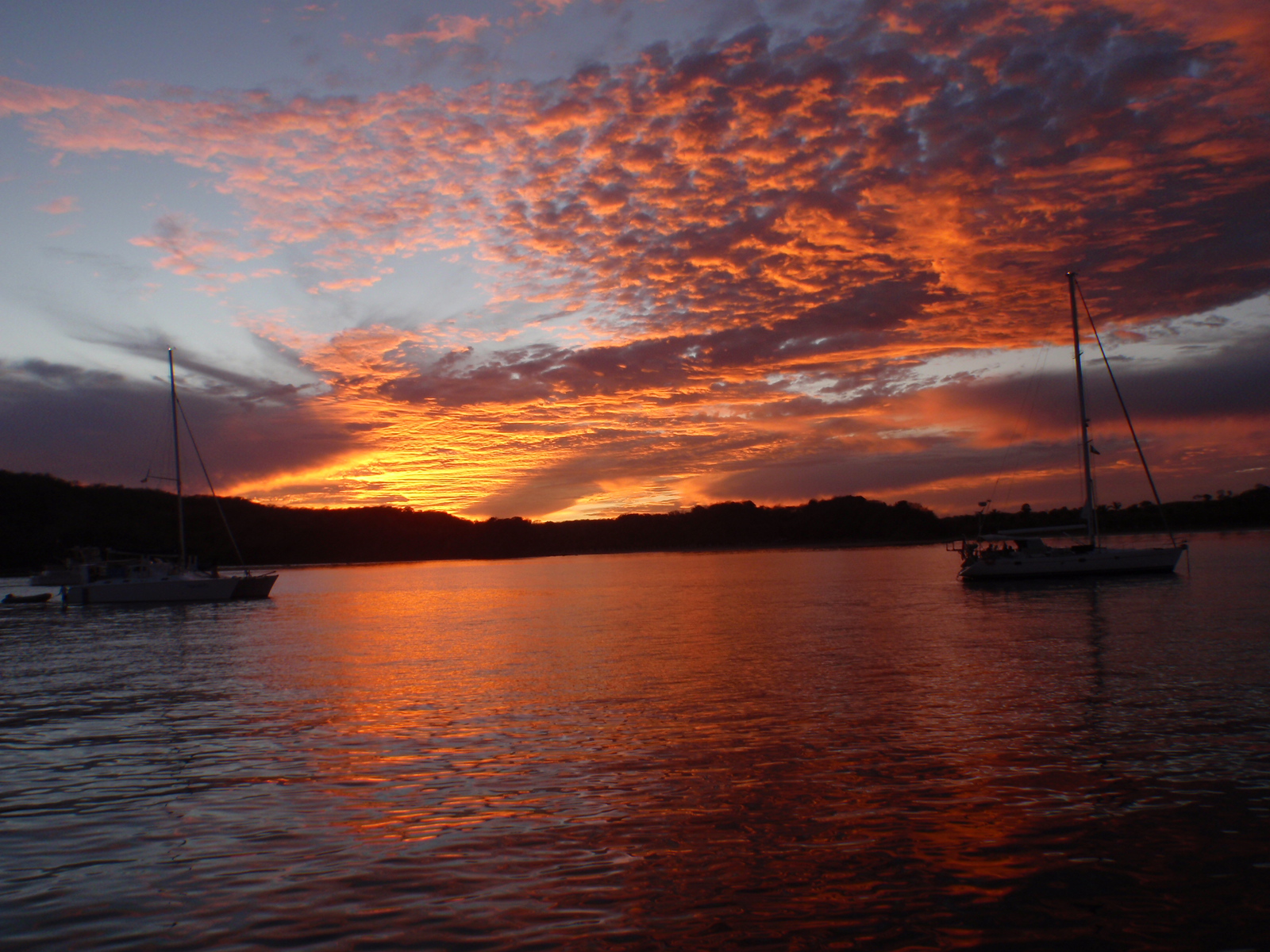
Bahia Tenacatita is the most beautiful place the Honcho has visited so far on this voyage. After we arrived here we just sat in the cockpit and enjoyed the magnificent views of the golden sand beaches to our north and east, the craggy rocks to our west and southwest, and the pretty little town of La Manzanilla across the bay to our south, then were treated to a beautiful sunset. We've been here three days, doing very little except enjoying the scenery and visiting with friends. Wednesday we took the dinghy up the small estuary where there are supposed to be crocodiles but we didn't see any. That was fine by me, as we did see lots of other wildlfe as we motored slowly through the mangroves. In spite of the beauty of the place, there has been trouble here recently. A developer showed up a few months ago with armed guards and bulldozers and chased everyone off the beach in one part of the bay where there had been some palapa restaurants that locals and yatistas liked to hang out, claiming that he owned the land that others thought they owned. Apparently the developer won this argument because we were met with some of the guards a mile or so up the estuary, and that's as far as we got to go.
 |
| Another Approach to Cruising We've seen this Nordhavn 63 in various places along the Mexican coast. |
The day before we left Tenacatita we took the dinghy across the bay to La Manzanilla, a quaint fishing and tourist village, where we stocked up on fresh vegetables. Located on the southeast side of the bay, it is exposed to the open ocean so going ashore means landing the dinghy through the surf. We stayed dry going in but got a bit damp going out, as the wind and waves had built during the afternoon. If you're looking for a quiet seaside vacation, far from the crowds, but still with a little spice, you might like La Manzanilla. To me, it appears to be Mexican with a Mediterranean twist.
Monday, 31 January 2011
Bahia Chamela to Tenacatita
We spent four days in peaceful Bahia Chamela. It was a windy passage from La Cruz so the first day in the bay was devoted to catching up on sleep and enjoying a magnificent sunset aboard the boat. The next day we wandered around the village of Perula, entertained fellow cruisers aboard the boat and were treated to a magnificent night of stargazing. There was another boat anchored very close to us so I was up every two hours to make sure we didn't tangle as the wind and current shifted throughout the very dark and moonless night. Around 0400 I was checking our anchor and noticed the Southern Cross low in the sky to the south, then looked the other way and saw Polaris, the north star, not far above the northern horizon, with the Big Dipper circling it. In between was the Milky Way, with its billions of stars and the mighty Orion was directly overhead. I sat for some minutes in the cockpit in awe of this wonderful show.
The following day we motored out to Isla Cocinas, one of several small islands in the southern reaches of Bahia Chamela. We anchored on the northeast side of the island near a tiny sand beach that was crowded with pelicans. We landed the dinghy through the small surf and discovered pelicans nesting in the cactus. It was a wonder how a pair of pelicans could build a nest and hatch their young in the top of a 20 foot tall cactus. Later we circumnavigated the island in the dinghy, returning to the Honcho around 1600.
We left Bahia Chamela around 1000 this morning, motoring slowly out of the bay in almost no wind. Around 1100 the wind filled in, light at first, and we hoisted sails and shut down the engine. Our course took us out past the tiny cove at Paraiso and Punta Etiopia. We sailed well out to sea and as the day wore on the wind built to about 20 knots. With a following sea and wind, the Honcho surfed along at speeds of up to 10 knots, a new record for the boat. We were at the mouth of Bahia Tenacatita by 1600 and were snugly anchored in the upper bay by 1700.
Tenacatita is a lovely bay, surrounded by beatiful beaches and lush tropical vegetation. We're only 19 degrees north of the equator here and it feels like it. We'll spend a few days exploring the area, perhaps indulge in a coco loco, and do some serious snorkeling out near Punta Hermanos.
The following day we motored out to Isla Cocinas, one of several small islands in the southern reaches of Bahia Chamela. We anchored on the northeast side of the island near a tiny sand beach that was crowded with pelicans. We landed the dinghy through the small surf and discovered pelicans nesting in the cactus. It was a wonder how a pair of pelicans could build a nest and hatch their young in the top of a 20 foot tall cactus. Later we circumnavigated the island in the dinghy, returning to the Honcho around 1600.
We left Bahia Chamela around 1000 this morning, motoring slowly out of the bay in almost no wind. Around 1100 the wind filled in, light at first, and we hoisted sails and shut down the engine. Our course took us out past the tiny cove at Paraiso and Punta Etiopia. We sailed well out to sea and as the day wore on the wind built to about 20 knots. With a following sea and wind, the Honcho surfed along at speeds of up to 10 knots, a new record for the boat. We were at the mouth of Bahia Tenacatita by 1600 and were snugly anchored in the upper bay by 1700.
Tenacatita is a lovely bay, surrounded by beatiful beaches and lush tropical vegetation. We're only 19 degrees north of the equator here and it feels like it. We'll spend a few days exploring the area, perhaps indulge in a coco loco, and do some serious snorkeling out near Punta Hermanos.
Saturday, 29 January 2011
Beneteau First 42s7
A few days ago a Beneteau 42s7 arrived on our dock in Marina La Cruz. The owner, an Aussie, bought the boat in L.A. and is sailing it home to Australia. The 42s7 is a big sister to the Honcho, so naturally I jumped at the chance to go for a sail aboard her. We left the dock around 11:00am and sailed a nine mile beat out to Punta de Mita in a breeze that started at about 6 knots and built to about 16 as we approached the point. Flying a fairly tired dacron main and 120% roller furling jib and towing a dinghy, we weren't exactly setting any speed records, but I did get a good sense of how the boat might perform if it was set up in racing trim. Handling, as you would expect from a Farr design, is crisp and positive. In light air the boat was sticky, but I attribute that to the small jib and the dinghy we were towing. As the breeze built to about 10 knots the boat began to come alive, and by the time we got close to the point, we were passing all the other boats in sight in spite of the tired sails and dinghy. It is very clear to me that this boat, in racing trim with a good suit of sails will be a pretty effective racer.
Here are some dimensions and stats:
LOA: 42'- 6"
LWL: 35'- 9"
Bmax: 13'- 6"
Ballast: 5,840lb (std), 6,283 (race)
Draft: 7'- 7" (race), 5'- 11" (standard), 5'-6" (shoal)
Sail Area: 771sf (std), 845sf (race)
Displacement/Length ratio: 178
Sail Area?Disp ratio: 17.8 (std), 19.5 (race)
The boat we sailed aboard has the deep keel and standard rig. This is a good combination where there is plenty of water, but the deep draft limits where the boat can be cruised. The taller racing rig includes running backstays, which most cruisers would object to. The hull, rig and foils were designed by the Bruce Farr office while the styling and interior were done by Philippe Starck. The Honcho's styling and interior were also done by Starck, with the hull and foils by Jean Berret. While the Honcho has impressive sailing performance in view of it's cruising accommodations, the 42s7 is certainly the better performing boat for its size. Drawing from their vast experience with racing yachts, the Farr office gave the 42s7 a slippery hull with a fine entry, relatively narrow beam and fairly powerful stern sections. This hullform is more racer than cruiser and that racing pedigree makes the hull a pleasure to look at.
On deck, the similarities between the 36s7 and 42s7 are obvious. Both boats have sleek cabin trunks and very distinctive styling. In my opinion the 36 is the better looking boat with regard to the decks. Designed after the 42, it shows subtle refinements to the shape and details that I find more attractive and functional. With that said, both boats suffer from cockpits that are too small for really comfortable cruising or racing efficiency. Being from sunny California, I like big, comfortable cockpits and it would have been very easy for the designers to make the cockpits longer and more spacious, thus making them better for both cruising and racing. The cabin trunks on both boats are very wide, leaving little space to move around the decks. I understand the reasoning behind this, a wider cabin trunk means a more spacious interior, but my preference would be to go with a slightly narrower cabin and wider decks.
The 42s7 has a unique swimstep arrangement. It pivots out of the transom to create a large and convenient platform, and when in the stowed position, fairs into the transom. There is a lot to like about this arrangement but I would be just as happy if the builder had opted for an open transom. As you know, I had to build a swimstep on the Honcho and would have been much happier if it had been built with an open transom or at least had a serviceable swimstep molded into it. I should say, however, that within the crowded confines of the 42s7's cockpit, everything is egonomically sound and well designed. This particular boat has the mainsheet traveler mounted just forward of the helm, which is good from a sailing standpoint, but makes it difficult to lie down on the cockpit seats and take a snooze, which is very important to me. Fortunately Beneteau molded a beam into the cabin top where a mid-boom traveler can be installed, and many of the 42s7's have that arrangement. I was aboard one with a mid-boom traveler not long ago and its cockpit is definitely a friendlier place without being bisected by the traveler.
The 42s7 has the same type of cabin portlights as the 36s7. They open outward instead of inward. this has the benefit of making them better at keeping water out of the boat, but the drawback of being magnets for jibsheets. In fact, the Honcho had a broken portlight when we bought it because a jibsheet got caught on it sometime in the past. We are very careful about them when sailing.
The 42s7 has lots of space below. This is due in part to the smallish cockpit and the wide cabin trunk. The 36s7's interior layout is, in my opinion, just about perfect for a small cruiser. Having lived aboard the boat for several months now, I can say that it's as comfortable and functional as can be expected in a small boat. The same is true, for the most part, of the 42s7. Beneteau offered both a two-cabin, and three-cabin layout in the 42s7. The three-cabin version was probably intended for the charter business, with three large double cabins and the galley strung along the port side of the main salon. This galley arrangement would work well in an apartment but is not suitable for an ocean going boat. The two cabin version has a large and well designed 'U' shaped galley aft to starboard in the main cabin. With the large dinette and tasteful design elements, it's a nice layout for living aboard and entertaining. Sleeping arrangements are great for cruising. The owner's suite, just forward of the mast, includes a large pullman berth, lots of lockers and storage, and a private head and shower in the bow. There is also a large private stateroom aft to port, with an adjoining head. The only downside is the lack of good sea berths. Queen size berths are great at anchor, but when you're at sea, you want nice deep berths with secure lee cloths or boards.
I occasionally hear critical remarks about the structural integrity of Beneteaus. After living aboard one, and crawling all over many of them looking for cracks and flaws, I can say that with regard to structural elements every one I've been aboard has been very well designed and built. I did reinforce the stemhead on the Honcho, but there are dozens of unreinforced 36s7's sailing around without stemhead problems. There are lots of Beneteaus out there that aren't pretty, or particularly good sailers, but I'm pretty certain they are all structurally sound. If I had the time, I'd gladly jump aboard my friend's 42s7 and sail it across the Pacific to
Australia.
Overall, I like the 42s7 quite a lot. It's big enough to be comfortable at sea, fast enough to make sailing it exciting and it's nice looking too. I plan to do some racing aboard one in a few weeks...I'm looking forward to that.
 |
| Beneteau 42s7 This and all other images of the 42s7 were taken from yachtworld.com, where there are several of these boats listed for sale |
Here are some dimensions and stats:
LOA: 42'- 6"
LWL: 35'- 9"
Bmax: 13'- 6"
Ballast: 5,840lb (std), 6,283 (race)
Draft: 7'- 7" (race), 5'- 11" (standard), 5'-6" (shoal)
Sail Area: 771sf (std), 845sf (race)
Displacement/Length ratio: 178
Sail Area?Disp ratio: 17.8 (std), 19.5 (race)
The boat we sailed aboard has the deep keel and standard rig. This is a good combination where there is plenty of water, but the deep draft limits where the boat can be cruised. The taller racing rig includes running backstays, which most cruisers would object to. The hull, rig and foils were designed by the Bruce Farr office while the styling and interior were done by Philippe Starck. The Honcho's styling and interior were also done by Starck, with the hull and foils by Jean Berret. While the Honcho has impressive sailing performance in view of it's cruising accommodations, the 42s7 is certainly the better performing boat for its size. Drawing from their vast experience with racing yachts, the Farr office gave the 42s7 a slippery hull with a fine entry, relatively narrow beam and fairly powerful stern sections. This hullform is more racer than cruiser and that racing pedigree makes the hull a pleasure to look at.
On deck, the similarities between the 36s7 and 42s7 are obvious. Both boats have sleek cabin trunks and very distinctive styling. In my opinion the 36 is the better looking boat with regard to the decks. Designed after the 42, it shows subtle refinements to the shape and details that I find more attractive and functional. With that said, both boats suffer from cockpits that are too small for really comfortable cruising or racing efficiency. Being from sunny California, I like big, comfortable cockpits and it would have been very easy for the designers to make the cockpits longer and more spacious, thus making them better for both cruising and racing. The cabin trunks on both boats are very wide, leaving little space to move around the decks. I understand the reasoning behind this, a wider cabin trunk means a more spacious interior, but my preference would be to go with a slightly narrower cabin and wider decks.
 |
| Large dinette |
The 42s7 has a unique swimstep arrangement. It pivots out of the transom to create a large and convenient platform, and when in the stowed position, fairs into the transom. There is a lot to like about this arrangement but I would be just as happy if the builder had opted for an open transom. As you know, I had to build a swimstep on the Honcho and would have been much happier if it had been built with an open transom or at least had a serviceable swimstep molded into it. I should say, however, that within the crowded confines of the 42s7's cockpit, everything is egonomically sound and well designed. This particular boat has the mainsheet traveler mounted just forward of the helm, which is good from a sailing standpoint, but makes it difficult to lie down on the cockpit seats and take a snooze, which is very important to me. Fortunately Beneteau molded a beam into the cabin top where a mid-boom traveler can be installed, and many of the 42s7's have that arrangement. I was aboard one with a mid-boom traveler not long ago and its cockpit is definitely a friendlier place without being bisected by the traveler.
The 42s7 has the same type of cabin portlights as the 36s7. They open outward instead of inward. this has the benefit of making them better at keeping water out of the boat, but the drawback of being magnets for jibsheets. In fact, the Honcho had a broken portlight when we bought it because a jibsheet got caught on it sometime in the past. We are very careful about them when sailing.
The 42s7 has lots of space below. This is due in part to the smallish cockpit and the wide cabin trunk. The 36s7's interior layout is, in my opinion, just about perfect for a small cruiser. Having lived aboard the boat for several months now, I can say that it's as comfortable and functional as can be expected in a small boat. The same is true, for the most part, of the 42s7. Beneteau offered both a two-cabin, and three-cabin layout in the 42s7. The three-cabin version was probably intended for the charter business, with three large double cabins and the galley strung along the port side of the main salon. This galley arrangement would work well in an apartment but is not suitable for an ocean going boat. The two cabin version has a large and well designed 'U' shaped galley aft to starboard in the main cabin. With the large dinette and tasteful design elements, it's a nice layout for living aboard and entertaining. Sleeping arrangements are great for cruising. The owner's suite, just forward of the mast, includes a large pullman berth, lots of lockers and storage, and a private head and shower in the bow. There is also a large private stateroom aft to port, with an adjoining head. The only downside is the lack of good sea berths. Queen size berths are great at anchor, but when you're at sea, you want nice deep berths with secure lee cloths or boards.
 |
| Two cabin layout. |
I occasionally hear critical remarks about the structural integrity of Beneteaus. After living aboard one, and crawling all over many of them looking for cracks and flaws, I can say that with regard to structural elements every one I've been aboard has been very well designed and built. I did reinforce the stemhead on the Honcho, but there are dozens of unreinforced 36s7's sailing around without stemhead problems. There are lots of Beneteaus out there that aren't pretty, or particularly good sailers, but I'm pretty certain they are all structurally sound. If I had the time, I'd gladly jump aboard my friend's 42s7 and sail it across the Pacific to
Australia.
Overall, I like the 42s7 quite a lot. It's big enough to be comfortable at sea, fast enough to make sailing it exciting and it's nice looking too. I plan to do some racing aboard one in a few weeks...I'm looking forward to that.
Friday, 28 January 2011
Bahia Chamela
The Honcho finally cleared the breakwater in La Cruz, bound for Bahia Chamela around 1600 on Thursday, Jan. 27th. Our course took us southwestward across Banderas Bay and around Cabo Corrientes. We had light air for the first 25 miles, then caught a strong breeze outside the cape and got a good push south. Passing Punta Ipala, we kept on going and arrived at Bahia Chamela, roughly 95 miles down the coast at 0930. We got the hook down in the lee of Punta Perula just off the village of the same name. The anchorage here affords good protection from northerly winds and swells but is exposed to southerly weather, which is more likely to occur in summer months than this time of year. We'll hang out here and explore for a couple of days before continuing on to Tenacatita.
Subscribe to:
Posts (Atom)


.jpg)


