Sunday, 23 June 2013
Timing is Everything
I've been installing the Single Sideband radio over the last couple of weekends. It's not a small job to find suitable locations for the control head and speaker, receiver and antenna tuner, then get all the wiring done in a seaman-like manner mainly because space for these items is very much at a premium. It also turned out to be a bigger challenge than I expected to get the copper foil for the ground plane installed from the antenna tuner to the keel. But everything is installed and wired except for the connections to the batteries, which I will not do until we replace the lead acid batteries with AGM's in a couple of weeks.
While that work is being done, we're also varnishing the cap rails. I really didn't want to go down that road but the teak was at the point where it had to be done, or else. So we got them well sanded and two coats on, with three or four more to come. I am resigned to the fact that they'll need a coat every six months or so.
Anyway, yesterday I went to pump some water through the aft head, which I do every time we arrive at the boat, and it wouldn't go. I checked the thru-hull valves, both intake and discharge were open and functional. Then I poured fresh water into the bowl and pumped it through, and it was absolutely normal. So I knew the problem was on the intake side, and I double checked the ball valve and checked outside the boat to make sure there wasn't a plastic bag or something blocking the intake thru-hull. Nope, all looked good. So the next step was to shut the valve and pull the intake hose off and check for a blockage there. I pulled it off the ball valve, expecting to find some seaweed or other flotsam, but it was clean, so I tried pumping again and it still wouldn't go. But I knew the problem was somewhere between the ball valve and the pump so I disconnected the other end of the hose, where it connects to the head pump and found the problem. It was a fish stuck tail-first in the intake of the head. The poor duffer was in up to his gills and jammed pretty tight in the hole. So I pulled him out and Lisa threw him back in the water, where he flapped his flippers feebly before sinking out of sight. After I put everything back together we were sitting in the cockpit speculating on how bad timing can ruin a fish's day. He must have thought he'd found a really neat little hidey hole and backed himself into it, where he was enjoying life and watching the world go by out his front door. Imagine his surprise and consternation when I pumped the head and he found himself headed bassackwards up the intake hose to the head, where he jammed like a cork in a bottle. I was astonished that he was still alive and I bet he was glad to see me, but my guess is that he was pretty banged up and probably didn't make it. Talk about being in the wrong place at the wrong time!
While that work is being done, we're also varnishing the cap rails. I really didn't want to go down that road but the teak was at the point where it had to be done, or else. So we got them well sanded and two coats on, with three or four more to come. I am resigned to the fact that they'll need a coat every six months or so.
Anyway, yesterday I went to pump some water through the aft head, which I do every time we arrive at the boat, and it wouldn't go. I checked the thru-hull valves, both intake and discharge were open and functional. Then I poured fresh water into the bowl and pumped it through, and it was absolutely normal. So I knew the problem was on the intake side, and I double checked the ball valve and checked outside the boat to make sure there wasn't a plastic bag or something blocking the intake thru-hull. Nope, all looked good. So the next step was to shut the valve and pull the intake hose off and check for a blockage there. I pulled it off the ball valve, expecting to find some seaweed or other flotsam, but it was clean, so I tried pumping again and it still wouldn't go. But I knew the problem was somewhere between the ball valve and the pump so I disconnected the other end of the hose, where it connects to the head pump and found the problem. It was a fish stuck tail-first in the intake of the head. The poor duffer was in up to his gills and jammed pretty tight in the hole. So I pulled him out and Lisa threw him back in the water, where he flapped his flippers feebly before sinking out of sight. After I put everything back together we were sitting in the cockpit speculating on how bad timing can ruin a fish's day. He must have thought he'd found a really neat little hidey hole and backed himself into it, where he was enjoying life and watching the world go by out his front door. Imagine his surprise and consternation when I pumped the head and he found himself headed bassackwards up the intake hose to the head, where he jammed like a cork in a bottle. I was astonished that he was still alive and I bet he was glad to see me, but my guess is that he was pretty banged up and probably didn't make it. Talk about being in the wrong place at the wrong time!

Friday, 21 June 2013
Elan 400 Review
Here is an interesting new yacht from a British designer, Rob Humphreys, and Slovenia based Elan Yachts. The Elan 400 is their latest collaboration and it is indeed a unique boat. It is a racer/cruiser with twin rudders, hard chines and a very distinctive look. It's a look that I find visually quite attractive.
Let's start by studying the hull. In the plan view, notice that it's rather full in the bow at the deck level, fairing into a moderate beam of 12.69 feet. It carries that beam all the way aft where we find hard chines and a near vertical transom. At 16,500 pounds displacement the Elan 400 has a displacement/length ratio of 141. This is not much lighter than my unabashedly cruisey Beneteau 423, which has a D/L ratio 154. But coupled with a sail area/displacement ratio of 21.1, the Elan will be much quicker in all conditions than my slightly underpowered Beneteau, which has a SA/D of only about 16.0. With these data points, it's clear that the Elan is a pretty sporty ride, but what about those chines and the twin rudders? Do they offer any meaningful advantages or are they there merely for style? Starting with the chines, I would say that they do little, if anything, for performance. Don't get me wrong, chines have been shown to enhance performance on sailboats. But in my opinion they only make a difference when a boat is in planing mode, which won't be very often for the Elan. I should point out that the Humphreys firm has designed at least one VO70 with chines, and I am certain they make a critical performance difference on such a light and powerful boat. But the 400 is a family style racer/cruiser and I think the chines are there more for style than planing performance. There is nothing wrong with this, they add visual interest and certainly don't take away any performance potential.
What about the twin rudders? Once again, on a VO70 they make a lot of sense. But does that translate to a racer/cruiser like the Elan 400? It would be very interesting to compare a single ruddered 400 with a twin ruddered version. I have no data to support my opinion, but my gut feeling is that in most conditions that average people sail in, the single ruddered boat would perform as well or better than her twin ruddered sister. Here in southern California, we have lots of kelp and I can foresee plenty of fiddling around with a kelp stick and a fair amount of strong language as a racing crew struggles with kelp on our local offshore races. When I think of the added weight, drag and cost of a twin wheel-twin rudder arrangement, I would demand a meaningful improvement in performance from the two rudders and I just don't think it's there in typical conditions on a boat of this type. With all that said, I'd love to go for a ride on one of these boats.
Moving on to the deck, I'm impressed with the innovative features incorporated into it. The transom is wide open, with a seat panel spanning it. This panel is removable and doubles as a gangplank, complete with wheels on the shoreside end, for when you're Med moored in Monte Carlo. The transom also has a drop-down panel making it into a water-level swim step with boarding ladder and transom shower.
The cockpit itself is very well laid out for a racing crew, with plenty of room to move and ergonomically sensible access to winches, etc. The twin wheels are mounted on fairly lethal looking pedestals and give the helmsman a great view. The general arrangement is typical of the modern racer/cruiser, with short seats forward and wide open space aft. The traveler is mounted on the cockpit sole, which I think is the best place for it and the halyard winches are on the cabin top where they should be. The designers have incorporated a number of tricky features into this area. There is a cleverly designed dining table that retracts into the cockpit sole, retractable footrests for the helmsman, and a recess near the transom for the life raft. Add covered bins for sheets and a retractable companionway hatch board and you've got a pretty busy cockpit. Yet it looks clean and elegant!
The rest of the deck is fairly conventional with a low and aesthetically pleasing cabin trunk, jib tracks mounted close inboard and an anchor windlass and locker forward. The boat is equipped with inhauls for the jib, which is an indicator of how serious Elan is about racing performance. Your average cruising sailor wouldn't know what to do with them.
Elan offers the 400 with either two or three cabins. I chose the two cabin version mainly because I prefer to have a dedicated nav station instead of a fold-away chart desk. I think those things look great at boat shows but are not particularly useful. Of course if you're sailing is limited to local waters you have little need for a dedicated chart table and the space would be better used for other purposes.
The accommodations plan incorporates a good sized forward cabin with a V-berth, seats and storage lockers. Elan thoughtfully refrained from pushing the berth too far forward so the foot of the bunk is reasonably wide. As in the rest of the boat, there is a plethora of locker doors that conceal lots of fairly small shelves. In spite of all those doors, it looks like usable storage space is somewhat limited. This is because the builder has pushed the lockers well outboard, making them quite shallow, The trade-off is the visual sensation of bright, wide open space below. I think this is perfectly acceptable given that the Elan 400 is not intended for living aboard or long offshore passagemaking.
Given the intended purpose of the boat, the galley is adequate, although you may wish for a bit more storage space here. The aft stateroom is quite large and comfortable looking. The hard chines may contribute to the extra space here, or it could just be that the transom on the 400 is in the neighborhood of eleven feet wide.
Overall, there is much to like about the Elan 400. The tall rig with non overlapping headsails provides lots of horsepower. The twin rudders should provide precise steering and the deep keel will keep the boat on its feet. As I mentioned before, to my eye this is a pretty boat that has excellent performance potential. While the squared off trapezoid shape deadlights in the hull could have been more artfully designed I expect the Elan 400 to turn heads wherever she goes. I took all the photos shown here from Elan's excellent web site and I invite you to visit www.elan-yachts.com to learn more about this interesting boat.
 |
| Elan 400: Slovenian Speedster |
Let's start by studying the hull. In the plan view, notice that it's rather full in the bow at the deck level, fairing into a moderate beam of 12.69 feet. It carries that beam all the way aft where we find hard chines and a near vertical transom. At 16,500 pounds displacement the Elan 400 has a displacement/length ratio of 141. This is not much lighter than my unabashedly cruisey Beneteau 423, which has a D/L ratio 154. But coupled with a sail area/displacement ratio of 21.1, the Elan will be much quicker in all conditions than my slightly underpowered Beneteau, which has a SA/D of only about 16.0. With these data points, it's clear that the Elan is a pretty sporty ride, but what about those chines and the twin rudders? Do they offer any meaningful advantages or are they there merely for style? Starting with the chines, I would say that they do little, if anything, for performance. Don't get me wrong, chines have been shown to enhance performance on sailboats. But in my opinion they only make a difference when a boat is in planing mode, which won't be very often for the Elan. I should point out that the Humphreys firm has designed at least one VO70 with chines, and I am certain they make a critical performance difference on such a light and powerful boat. But the 400 is a family style racer/cruiser and I think the chines are there more for style than planing performance. There is nothing wrong with this, they add visual interest and certainly don't take away any performance potential.
 |
| Humphreys VO70 at speed. Notice the chine at work, and the weather rudder almost completely out of the water. |
What about the twin rudders? Once again, on a VO70 they make a lot of sense. But does that translate to a racer/cruiser like the Elan 400? It would be very interesting to compare a single ruddered 400 with a twin ruddered version. I have no data to support my opinion, but my gut feeling is that in most conditions that average people sail in, the single ruddered boat would perform as well or better than her twin ruddered sister. Here in southern California, we have lots of kelp and I can foresee plenty of fiddling around with a kelp stick and a fair amount of strong language as a racing crew struggles with kelp on our local offshore races. When I think of the added weight, drag and cost of a twin wheel-twin rudder arrangement, I would demand a meaningful improvement in performance from the two rudders and I just don't think it's there in typical conditions on a boat of this type. With all that said, I'd love to go for a ride on one of these boats.
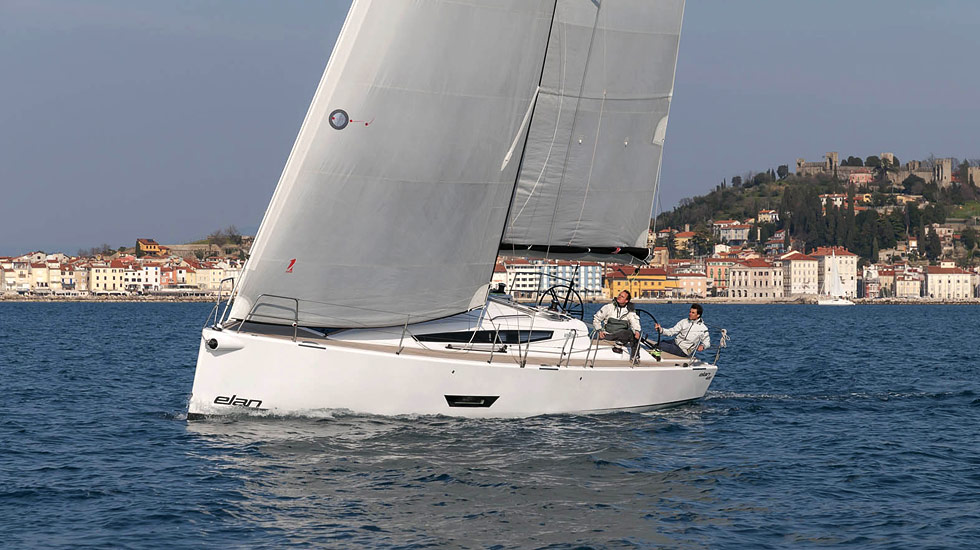 |
| With its powerful hull, bow pole, non-overlapping jib and svelte cabin trunk, the Elan 400 is a sporty looking ride. |
Moving on to the deck, I'm impressed with the innovative features incorporated into it. The transom is wide open, with a seat panel spanning it. This panel is removable and doubles as a gangplank, complete with wheels on the shoreside end, for when you're Med moored in Monte Carlo. The transom also has a drop-down panel making it into a water-level swim step with boarding ladder and transom shower.
 |
| The cockpit is beautifully laid out for racing. |
The cockpit itself is very well laid out for a racing crew, with plenty of room to move and ergonomically sensible access to winches, etc. The twin wheels are mounted on fairly lethal looking pedestals and give the helmsman a great view. The general arrangement is typical of the modern racer/cruiser, with short seats forward and wide open space aft. The traveler is mounted on the cockpit sole, which I think is the best place for it and the halyard winches are on the cabin top where they should be. The designers have incorporated a number of tricky features into this area. There is a cleverly designed dining table that retracts into the cockpit sole, retractable footrests for the helmsman, and a recess near the transom for the life raft. Add covered bins for sheets and a retractable companionway hatch board and you've got a pretty busy cockpit. Yet it looks clean and elegant!
 |
| Beautifully detailed deck |
The rest of the deck is fairly conventional with a low and aesthetically pleasing cabin trunk, jib tracks mounted close inboard and an anchor windlass and locker forward. The boat is equipped with inhauls for the jib, which is an indicator of how serious Elan is about racing performance. Your average cruising sailor wouldn't know what to do with them.
Elan offers the 400 with either two or three cabins. I chose the two cabin version mainly because I prefer to have a dedicated nav station instead of a fold-away chart desk. I think those things look great at boat shows but are not particularly useful. Of course if you're sailing is limited to local waters you have little need for a dedicated chart table and the space would be better used for other purposes.
 |
| Sensible layout for casual racing and weekends at the island. |
The accommodations plan incorporates a good sized forward cabin with a V-berth, seats and storage lockers. Elan thoughtfully refrained from pushing the berth too far forward so the foot of the bunk is reasonably wide. As in the rest of the boat, there is a plethora of locker doors that conceal lots of fairly small shelves. In spite of all those doors, it looks like usable storage space is somewhat limited. This is because the builder has pushed the lockers well outboard, making them quite shallow, The trade-off is the visual sensation of bright, wide open space below. I think this is perfectly acceptable given that the Elan 400 is not intended for living aboard or long offshore passagemaking.
 |
| In the three cabin version, the chart table folds away to make a full length settee on the port side of the salon. |
Given the intended purpose of the boat, the galley is adequate, although you may wish for a bit more storage space here. The aft stateroom is quite large and comfortable looking. The hard chines may contribute to the extra space here, or it could just be that the transom on the 400 is in the neighborhood of eleven feet wide.
 |
| The 400 looks fast. |
Overall, there is much to like about the Elan 400. The tall rig with non overlapping headsails provides lots of horsepower. The twin rudders should provide precise steering and the deep keel will keep the boat on its feet. As I mentioned before, to my eye this is a pretty boat that has excellent performance potential. While the squared off trapezoid shape deadlights in the hull could have been more artfully designed I expect the Elan 400 to turn heads wherever she goes. I took all the photos shown here from Elan's excellent web site and I invite you to visit www.elan-yachts.com to learn more about this interesting boat.
Tuesday, 4 June 2013
The State of the Sport
 |
| Oracle on its foils. A new level of sailing performance |
I've been thinking lately about the state of the sailing industry in the US, and, frankly, it's not pretty for the designers or the builders. Since the "Great Recession" there has been a decline in yacht design activity in this country. With a few exceptions, most of the designers I know are struggling to find commissions and many builders of custom and semi-custom yachts have diversified into powerboats or other products, or simply shut their doors. Is this the natural ebb and flow of business cycles, or are there other forces at work? It may be a matter of business cycles but I think there is more to it than that. It's pretty clear that the recession took a lot of money out of the sailing industry, which is to be expected since many people have been understandably more focused on their economic survival than new boats.
 |
| International Laser at speed |
Another factor is the way people spend their most precious commodity, leisure time. Sailing is time consuming compared to other sports that compete for your recreation time. Golf is a good example. You can go play a round of golf on a Saturday morning and be home in time for brunch. You drop your clubs in the garage and you're ready to spend the rest of the day doing other things. Sailing, on the other hand, is pretty much an all-day affair. If you just want to go out for a couple of hours, you head down to the boat, spend a half hour getting it ready, then push off from the dock and, if you're lucky, there is a breeze and you go out and enjoy sailing for a couple of hours. But who wants to sail for just a couple of hours on a Saturday? Instead you spend the day on the water, enjoy the hell out of it, then get back to the dock around four in the afternoon. Then you spend an hour folding sails, hosing down the boat, etc. and perhaps have a cold beverage and watch the sunset. Sounds like a good day to me. But for many, that doesn't work because they always have so many other things to do. Further, in many families not everyone involved in the decision-making process is as enamored of sailing as we are, so compromises must be made. Soccer, baseball, lacrosse, tennis, golf, riding, biking, hiking, surfing, etc. all compete for their time and interest, and most of those sports are less work, less expensive and less time consuming than sailing, so it's no wonder the sailing industry is struggling.
Another interesting symptom of the sailing malaise is the average age of the people you find out on the race course on any given weekend. It's been going up. Of course there are younger people coming into the sport and I am pleased to see the vibrant junior programs of the yacht clubs in my town. Still, the geezer-to-young buck ratio at my yacht club appears to be on the rise. Among the ranks of the cruisers, both local and long distance, the average age also seems to be on the increase. I guess it's all part of that 70 is the new 60 paradigm.
 |
| A Hans Christian 38 drives to weather |
With all of these forces at work, there seems to be a lot of hand wringing over the changing sociological and economic landscape in the sport of sailing. Declining sales, declining demographics, fewer boats on the starting lines, danger and death at the Americas Cup...Yikes, it's enough to make you trade your boat shoes for golf shoes.
For some this is a catastrophe. My God, our beloved sport is shrinking! What shall we do? Well, I have a couple of recommendations. First take a deep breath and relax. So what if our sport is shrinking? It'll find some point of equilibrium, some point where it's in balance with all the other forces that work on our leisure time, our psyches, and our multifarious commitments. Second, remember that you enjoy the sport. Remember that there are thousands of us out there enjoying our time on the water. If you're in the recreational boating industry, think about building the quality of the sailing experience instead of the quantity. Take your family and friends out sailing and don't worry that some or maybe even most of them don't connect with the absolute pleasure we derive from it. I'll wager that there is someone who has encouraged you to try something new, mountain climbing, horseback riding or whatever, that just didn't work for you. Those sports are no poorer because you didn't go out and buy a new Stetson or ice ax. And our sport is no poorer because someone came, saw... and decided they'd rather be on a mountain trail.
 |
| Left Coast Dart headed your way |
Frankly, I'm not the least bit disappointed that our sport is in something of a decline. Here in California, in the last year or so we've lost eleven people in yacht racing accidents. The jury is still out on the death of Andy Simpson, the crewman who died when the Swedish Americas Cup catamaran capsized, but the other deaths can be attributed to operator error. So either we need to improve the skills and knowledge of the folks that are already out sailing, or we might be better off if people who don't have those skills took up a different sport, or got the necessary training before heading offshore. Sailing is a lovely sport, pastime, and lifestyle, but it's not for everyone so let's just relax and enjoy it. We can and should welcome anyone who joins in, and we need not be concerned when people don't get it and prefer other things. Sailing and the sailing industry will survive and thrive in its own way, its own time and at its own level.
Tuesday, 5 March 2013
Finisterra's New Canvas

The dodger and bimini on The Cat's Meow were a faded shade of green and were at the end of their useful life when we bought the boat. I like the color green, and I like cats. But I can't say I like green cats or green dodgers, so the day we bought her we knew we'd soon replace the green with new cadet gray canvas. The job is just about complete and we are quite pleased with it.
 |
| New Dodger |
It's always an interesting experience to design a dodger for a boat. In this case, the stainless steel framework was already installed and was in good condition. The challenge was to use the existing frame to redesign the dodger so it meets our specific needs. I like to be able to see over the dodger from the helm and Lisa doesn't like to have to duck under it. Since I'm about seven inches taller than her I was able to adjust the height to accommodate us perfectly. This involved lowering it about three inches by cutting a little off the frames and adjusting the angles of them a bit.
I think most of the dodgers I see around my marina are too tall and clunky looking, which is surprising since virtually all dodgers are custom made. I am also of the opinion that most of the time, the person who designs the dodger gives little consideration to the aesthetic effect of the dodger on the overall look of the boat. I understand that their primary purpose is to provide protection from wind and spray but I'm not prepared to sacrifice style for the minimal added protection of a taller dodger. So, perfectionist that I am, I took dimensions and photographs and made CAD drawings of the whole thing superimposed on the profile of the boat and puttered around with it until I was satisfied with it. Then I adjusted the angles of the frames this way and that until I had it all just so. When all that was done, I passed this information on to Dan at Harbor Custom Canvas in Long Beach and he, being a master dodger builder, converted it into reality. We had them build the dodger on our last boat and found their workmanship and service to be excellent in all respects then, and they did another outstanding job on the Finisterra.
 |
| Lots of Strataglass for good visibility, a full length grab rail and a zippered roll-up section amidships |
 |
| New bimini |
We had snaps fitted to the sides and back, and a zipper on the forward side. These are for side curtains and a filler piece that connects the dodger to the bimini and provides shade over the entire cockpit. The side curtains will be made of polypropylene mesh and will attach to the top rails of the pulpits and lifelines. The mesh is fairly see-through and lets the breeze pass through as well.
 |
| This view gives a sense of the proportions of the dodger and bimini |
 |
| Dodger + filler + bimini = comfortable cockpit |
Monday, 18 February 2013
Dehler 41 Review
About a year ago, when we were still searching for a new boat, I came across a beautiful 2005 Dehler 41 on Yachtworld. It had all the right gear and was well priced, but it had a teak deck and a couple of other features that made it unsuitable for us. But that is not to say that it was not a good boat. Quite the contrary, it was a fine cruiser/racer and we came close to making a bid on it in spite of all that teak.
Fast forward to February 2013...I've been eagerly anticipating the unveiling of Dehler's new 38 here in the States but not surprisingly, it's running a bit late. So while we're waiting for the new boat I thought it would be fun to take a look at the latest version of Dehler's 41 footer. The Dehler marque is not as well known on this side of the Atlantic as other German names such as Hanse and Bavaria, but the company has a long and admirable history of producing high quality boats for both cruising and racing. Unfortunately, Dehler, like many other sailboat manufacturers in the last decade, had a close encounter with oblivion, but was rescued by the Hanse Group. This German boatbuilding conglomerate owns the Moody line of yachts as well.
Back in the 1980's and '90's Dehler worked closely with the E. G. Van De Stadt design firm and produced such IOR classics as the DB1 and the Sprinta Sport, which some 35 years on is still going strong as a one design class in Europe.
For the Dehler 41, the builder turned to the firm of Judel/Vrolijk. Americas Cup aficionados may recall that Rolf Vrolijk was the chief designer for the winning 2003 Alinghi team. Friedrich "Fietje" Judel, the other half of the design team recently retired from active involvement in the office, but the J/V firm continues to produce extremely fast and good looking designs. Okay, enough history, let's take a look at the new 41.
The D41 fits into that very competitive market segment that includes the Jeanneau 409, the Beneteau First 40, Elan 400 and others. With a Displacement/Length ratio of 152 and a Sail Area/Displacement ratio of 22.85 we can call this boat a medium-light and moderately high powered cruiser/racer. But the numbers don't exactly tell the whole story. Let's take a look at the drawings and photos of the boat to get a fuller understanding of the performance potential of the D41. Notice the plumb bow and longish stern overhang in the drawing above, then take a look at the proportions of the stern in the photo below.
Those powerful aft sections add about three feet of waterline length and change the D/L ratio to a much more competitive 125. Then notice the mainsheet traveler on the cockpit sole and the removable transom door. Add the deep keel with nearly eight feet of draft and suddenly the Dehler 41 looks like a dangerous competitor on the race course.
Looking more closely at the deck, notice that the chainplates are located nearly at the sheer. This dictates non-overlapping headsails for upwind work. Again, this is something we find mostly on race boats but it also makes good sense on cruising yachts. The aft winches on the cockpit coaming are dedicated to the mainsheet. This boat is equipped with what is referred to as the German or Admirals Cup mainsheet system. It leads from the traveler up through the boom, then down to the deck from the gooseneck fitting and back aft under the deck to the winches. De riguer on grand prix racing yachts for years, this system is becoming increasingly popular among the racer/cruisers as well. In the plan view the cockpit coamings look rather hard-edged but in reality they are artfully shaped and look like a reasonably comfortable place to sit if you're steering or trimming a sheet on race day.
This is a nice racing cockpit, but what about cruising? The wide open transom, which is lightweight and functional, isn't necessarily the best thing for cruising, so Dehler compensated by incorporating a "tailgate". I'm not a fan of this arrangement because for cruisers there are ever so many reasons to step out on the transom while at anchor, in a marina or under way, and raising, lowering and generally fiddling with that thing is inconvenient at best. In my opinion a better solution would have been to extend the transom a bit and forego the tailgate. I also question the angle of the cockpit seats. They are angled aft about nine degrees. This is totally acceptable for racing because the crew will be on the rail most of the time and the trimmers will be perched on those comfortable coamings instead of on the seats. But let's say you're cruising and the crew consists of yourself and another person. When you are on watch you're likely to be sitting on those cockpit seats twisting your neck to see forward as your vessel plunges through the night toward your destination. In such conditions I think seats that are parallel to the centerline of the boat would be more comfortable. This is a small point in the overall scheme of things, but it's these details that separate a great cruising boat from a good one. On the other hand, notice that the halyard winches are on the cabin top and there is plenty of room between the helm, the mainsheet winches and the jib sheet winches. The D41 will be a more efficient boat to sail than those that have the halyards and control lines led aft, either inside or on top of the coamings to someplace near the helm.
Going below, Dehler offers a wide range of variations in the accommodations. On their web site I scrolled down until I found the one that works best for me. I recommend that you visit www.dehler.com and do the same thing. There is enough variety there to please almost everyone. Anyway, I chose the version pictured below. It offers two cabins, a relatively large galley and a single spacious head.
Beginning in the forward cabin, the V-berth is of modest but adequate dimensions, leaving plenty of space for a comfortable seat and a large locker. Aft of the main bulkhead we find a conventional main salon, with a "U"-shaped dinette to starboard and large settee to port that incorporates a nav table. Aft of the navigator's seat is the head, which incorporates a spacious shower. This will be much appreciated by those who cruise aboard this boat. The galley is of reasonable proportions and aft of it is a spacious quarter cabin. The boat is blessed with lots of storage capacity aft of the head and in the very large lazarette area. To me, the clean, simple styling of the Dehler 41 is evocative of a modern, or perhaps post-modern version of the Bauhaus school of design. Straight lines, pure functionality and simplicity of form all work together in the styling of this boat.
This stylistic approach may not work for everyone, and I have criticized the Hanse 415 for being a bit too squarish for my taste, but I have to respect the quality of design in these accommodations. The same can be said of the deck design, with its softly curving coamings in contrast with the harder edges of the rest of the cockpit, and the sleek yet functional proportions of the cabin trunk.They all strike a nice aesthetic and functional balance that appeals to me.
When I began to study the Dehler 41 I was prepared to find it unappealing, as I did the Hanse 415, but I think the designers and builder got it right on this boat. It is clearly a fast and powerful vessel, no question about that. But more than that, they found the right balance of form, function and performance. As I studied the photos and drawings of this boat, I got the sense that the D41 isn't a wolf in sheep's clothing, it's more of a wolf in wolf's clothing. I like this boat!
Fast forward to February 2013...I've been eagerly anticipating the unveiling of Dehler's new 38 here in the States but not surprisingly, it's running a bit late. So while we're waiting for the new boat I thought it would be fun to take a look at the latest version of Dehler's 41 footer. The Dehler marque is not as well known on this side of the Atlantic as other German names such as Hanse and Bavaria, but the company has a long and admirable history of producing high quality boats for both cruising and racing. Unfortunately, Dehler, like many other sailboat manufacturers in the last decade, had a close encounter with oblivion, but was rescued by the Hanse Group. This German boatbuilding conglomerate owns the Moody line of yachts as well.
Back in the 1980's and '90's Dehler worked closely with the E. G. Van De Stadt design firm and produced such IOR classics as the DB1 and the Sprinta Sport, which some 35 years on is still going strong as a one design class in Europe.
 |
| DB1 Circa 1980. A well balanced IOR design |
For the Dehler 41, the builder turned to the firm of Judel/Vrolijk. Americas Cup aficionados may recall that Rolf Vrolijk was the chief designer for the winning 2003 Alinghi team. Friedrich "Fietje" Judel, the other half of the design team recently retired from active involvement in the office, but the J/V firm continues to produce extremely fast and good looking designs. Okay, enough history, let's take a look at the new 41.
 |
| Sleek lines and no chines |
 |
| Dehler 41. Notice the very powerful stern sections. |
Those powerful aft sections add about three feet of waterline length and change the D/L ratio to a much more competitive 125. Then notice the mainsheet traveler on the cockpit sole and the removable transom door. Add the deep keel with nearly eight feet of draft and suddenly the Dehler 41 looks like a dangerous competitor on the race course.
.jpg) |
| D41 Deckplan. Clean lines, spacious cockpit, conventional ergonomics. |
Looking more closely at the deck, notice that the chainplates are located nearly at the sheer. This dictates non-overlapping headsails for upwind work. Again, this is something we find mostly on race boats but it also makes good sense on cruising yachts. The aft winches on the cockpit coaming are dedicated to the mainsheet. This boat is equipped with what is referred to as the German or Admirals Cup mainsheet system. It leads from the traveler up through the boom, then down to the deck from the gooseneck fitting and back aft under the deck to the winches. De riguer on grand prix racing yachts for years, this system is becoming increasingly popular among the racer/cruisers as well. In the plan view the cockpit coamings look rather hard-edged but in reality they are artfully shaped and look like a reasonably comfortable place to sit if you're steering or trimming a sheet on race day.
This is a nice racing cockpit, but what about cruising? The wide open transom, which is lightweight and functional, isn't necessarily the best thing for cruising, so Dehler compensated by incorporating a "tailgate". I'm not a fan of this arrangement because for cruisers there are ever so many reasons to step out on the transom while at anchor, in a marina or under way, and raising, lowering and generally fiddling with that thing is inconvenient at best. In my opinion a better solution would have been to extend the transom a bit and forego the tailgate. I also question the angle of the cockpit seats. They are angled aft about nine degrees. This is totally acceptable for racing because the crew will be on the rail most of the time and the trimmers will be perched on those comfortable coamings instead of on the seats. But let's say you're cruising and the crew consists of yourself and another person. When you are on watch you're likely to be sitting on those cockpit seats twisting your neck to see forward as your vessel plunges through the night toward your destination. In such conditions I think seats that are parallel to the centerline of the boat would be more comfortable. This is a small point in the overall scheme of things, but it's these details that separate a great cruising boat from a good one. On the other hand, notice that the halyard winches are on the cabin top and there is plenty of room between the helm, the mainsheet winches and the jib sheet winches. The D41 will be a more efficient boat to sail than those that have the halyards and control lines led aft, either inside or on top of the coamings to someplace near the helm.
Going below, Dehler offers a wide range of variations in the accommodations. On their web site I scrolled down until I found the one that works best for me. I recommend that you visit www.dehler.com and do the same thing. There is enough variety there to please almost everyone. Anyway, I chose the version pictured below. It offers two cabins, a relatively large galley and a single spacious head.
 |
| The Dehler 41 offers excellent accommodations for the cruising couple. |
Beginning in the forward cabin, the V-berth is of modest but adequate dimensions, leaving plenty of space for a comfortable seat and a large locker. Aft of the main bulkhead we find a conventional main salon, with a "U"-shaped dinette to starboard and large settee to port that incorporates a nav table. Aft of the navigator's seat is the head, which incorporates a spacious shower. This will be much appreciated by those who cruise aboard this boat. The galley is of reasonable proportions and aft of it is a spacious quarter cabin. The boat is blessed with lots of storage capacity aft of the head and in the very large lazarette area. To me, the clean, simple styling of the Dehler 41 is evocative of a modern, or perhaps post-modern version of the Bauhaus school of design. Straight lines, pure functionality and simplicity of form all work together in the styling of this boat.
 |
| I think Gropius or Mies van der Rohe would approve of the D41's styling. |
This stylistic approach may not work for everyone, and I have criticized the Hanse 415 for being a bit too squarish for my taste, but I have to respect the quality of design in these accommodations. The same can be said of the deck design, with its softly curving coamings in contrast with the harder edges of the rest of the cockpit, and the sleek yet functional proportions of the cabin trunk.They all strike a nice aesthetic and functional balance that appeals to me.
 |
| Simple elegance combined with impressive performance potential in the D41 |
Tuesday, 15 January 2013
Americas Cup 2013
Anybody who has even the slightest interest in the Americas Cup competition has seen the video of Team Oracle's spectacular crash last October. It is amazing that there was no serious damage to the boat except for the carbon wing, which was demolished. Until the crash, no one truly knew where the edge of the envelope was for these extremely powerful boats, so it was a learning experience for the crew of Oracle 17. The question now is whether they will overcome this setback in time to mount a competitive defense of the cup. The crash was certainly a serious bump in the road for them, but now they have a real, rather than theoretical understanding of how hard to push and, probably more importantly, that feeling in the collective gut of the crew of where the edge is. Anyone who has pushed a high performance boat, whether it's a 49er or TP52 beyond the edge of control, knows that feeling. Ironically, that experience, and the experience of quickly putting a broken AC72 back together, could turn out to be a winning edge when the big boats race on the bay.
Yesterday I visited the Oracle compound at Pier 80 in San Francisco and had a chance to see the nearly completely repaired 17 as well as the newest boat, which is still under construction in the same building. While there I also got a look at the newly delivered wing mast whose basic structure was built in New Zealand for completion in San Francisco. Here are some observations:
1. It wasn't until I was right up close to both the wing and the hulls that I could truly appreciate the power to weight ratio of this boat.
2. The hulls are beautifully sculpted shapes that hardly appear to be up to the task of supporting the vast size of the rig, until you realize that the wing, which towers about 130 feet above the deck, weighs only about 3,000 pounds.
3. I was impressed by the fineness of the bows of the hulls. These are almost delicate shapes that will be extremely fast in light air, but will be more challenging in a breeze. I say that because they are very fine, with commensurately little reserve buoyancy. When you consider that the center of effort in the wing is some 65 feet or so above the waterplane, with its center of gravity likely a few feet down from there, it's easy to understand that if the boat is at speed and sticks a bow or two into a wave, the chances of pitchpoling are significant. It's interesting to note that the boat that crashed didn't flip, that is, it didn't fall over sideways, it pitchpoled, or sailed over its bows. Clearly, sailing these boats will be more about power management than power generation in the conditions they are likely to encounter on San Francisco Bay.
4. The wing mast is a fairly simple shape in the profile view. It is a two-element structure, that is, a main element and a flap, and it appears to me that the real technology is in its structural design and control system.
5. Clearly the trick will be in knowing how to control the power in this rig. If there is much breeze at all during the actual races, the winner may well be the crew that has learned how to allow the rig to generate enough power without overpowering the boat and capsizing. As we have already seen, bearing off an AC72 in a breeze will be tricky. The trimmers will have to be in perfect sync with the helmsman to ease the throttle as the boat turns away from the wind.
6. The course seems awfully short for these 72 foot boats. The marks appear to be set fairly close inshore so there will be little room on the left side of the course. The venue along the city front will make for spectacular viewing but the legs are only about 3 miles long, so these boats that are easily capable of 30 knots might take 15 minutes to get from the leeward mark to the windward mark. That doesn't leave much time for tactics, so I think the key will be to win the start and then don't crash.
Yesterday I visited the Oracle compound at Pier 80 in San Francisco and had a chance to see the nearly completely repaired 17 as well as the newest boat, which is still under construction in the same building. While there I also got a look at the newly delivered wing mast whose basic structure was built in New Zealand for completion in San Francisco. Here are some observations:
1. It wasn't until I was right up close to both the wing and the hulls that I could truly appreciate the power to weight ratio of this boat.
2. The hulls are beautifully sculpted shapes that hardly appear to be up to the task of supporting the vast size of the rig, until you realize that the wing, which towers about 130 feet above the deck, weighs only about 3,000 pounds.
3. I was impressed by the fineness of the bows of the hulls. These are almost delicate shapes that will be extremely fast in light air, but will be more challenging in a breeze. I say that because they are very fine, with commensurately little reserve buoyancy. When you consider that the center of effort in the wing is some 65 feet or so above the waterplane, with its center of gravity likely a few feet down from there, it's easy to understand that if the boat is at speed and sticks a bow or two into a wave, the chances of pitchpoling are significant. It's interesting to note that the boat that crashed didn't flip, that is, it didn't fall over sideways, it pitchpoled, or sailed over its bows. Clearly, sailing these boats will be more about power management than power generation in the conditions they are likely to encounter on San Francisco Bay.
4. The wing mast is a fairly simple shape in the profile view. It is a two-element structure, that is, a main element and a flap, and it appears to me that the real technology is in its structural design and control system.
5. Clearly the trick will be in knowing how to control the power in this rig. If there is much breeze at all during the actual races, the winner may well be the crew that has learned how to allow the rig to generate enough power without overpowering the boat and capsizing. As we have already seen, bearing off an AC72 in a breeze will be tricky. The trimmers will have to be in perfect sync with the helmsman to ease the throttle as the boat turns away from the wind.
6. The course seems awfully short for these 72 foot boats. The marks appear to be set fairly close inshore so there will be little room on the left side of the course. The venue along the city front will make for spectacular viewing but the legs are only about 3 miles long, so these boats that are easily capable of 30 knots might take 15 minutes to get from the leeward mark to the windward mark. That doesn't leave much time for tactics, so I think the key will be to win the start and then don't crash.
Sunday, 13 January 2013
Finisterra Update 1-13-13
We had been planning to spend the first few days of the new year at Catalina Island but the recent cold temperatures (highs in the 50's and lows in the 30's) made that plan unappealing. So instead I worked on a couple of winter projects. First I removed the old dodger and cut the frame down a bit. The old dodger was taller than it needed to be and was not the best design. The photo below is a 'before' shot, and I'll post some pictures of the revised dodger in a couple of weeks.
Here are a couple of photos of the finished ground tackle system. It includes a chain stop mounted on a teak block and bolted through the deck, which was reinforced with a large backing plate. The chain is 200' of 5/16" type G40 spliced to 150' of 9/16" nylon 3-strand rode.
 |
| Finisterra's dodger is taller than it needs to be |
This dodger is about eight years old and is showing its age. The new one will be about four inches longer along the roof-line and two inches lower, and it will have Strataglass instead of plain vinyl window material. I think Strataglass is vastly superior to other materials because it is doesn't wrinkle and distort your view, yet it is flexible enough to roll up when you want to. I never fold the dodger down so there is no value in the extra flexibility of regular vinyl. We'll replace the bimini along with the dodger. It is also showing its age and I want to tweak the design of it a bit as well.
Another project that got underway this week was the new cockpit table. The first step was to remove the old one. I have a good deal of respect for the designers at Beneteau. They generally do a pretty good job with styling and ergonomics in their boats, but in my opinion they simply missed the mark with this table. I have tried to like it, and even encouraged others to do so, but unfortunately we could never quite get there. It's clunky looking, it's too big and it gets in the way of sailing the boat. It also makes the cockpit cramped for anything besides sitting and eating or drinking. So I took it out...Man, what a difference! We've got room to move now.
 |
| The cockpit is almost four feet wide between the seats. |
With about 3'-6" of width between the seats, the cockpit now feels spacious. With this much room it will need some foot-braces which I'll install using the existing holes in the sole. I'll build a smaller table module and mount it just forward of the binnacle. It will include a dropleaf table, storage compartment, grab-rails on the sides and a housing for a GPS that will swivel so we can see it from anywhere in the cockpit.
 |
| I love the new-found space here! |
 |
| Beneteau installs a clear plastic cover on hinges over the instruments at the helm. Nearly every Beneteau we've looked at, ours included, showed signs of the hinges coming adrift. Naturally they were installed with self tapping #6 screws which usually lose no time in working loose, so it's not long before those itty-bitty threads are stripped. I took the plastic cover off permanently, and will do something creative with the leftover holes. |
Here are a couple of views of the cockpit table. It's not pretty but with the drop-leaves attached, it makes into a large dining table in the cockpit. On our boat the leaves are beautifully varnished teak.
 |
| The table is stoutly made with a nice welded stainless steel frame that includes a foot-rest. The table comes with a plastic lid that fits loosely on top. |
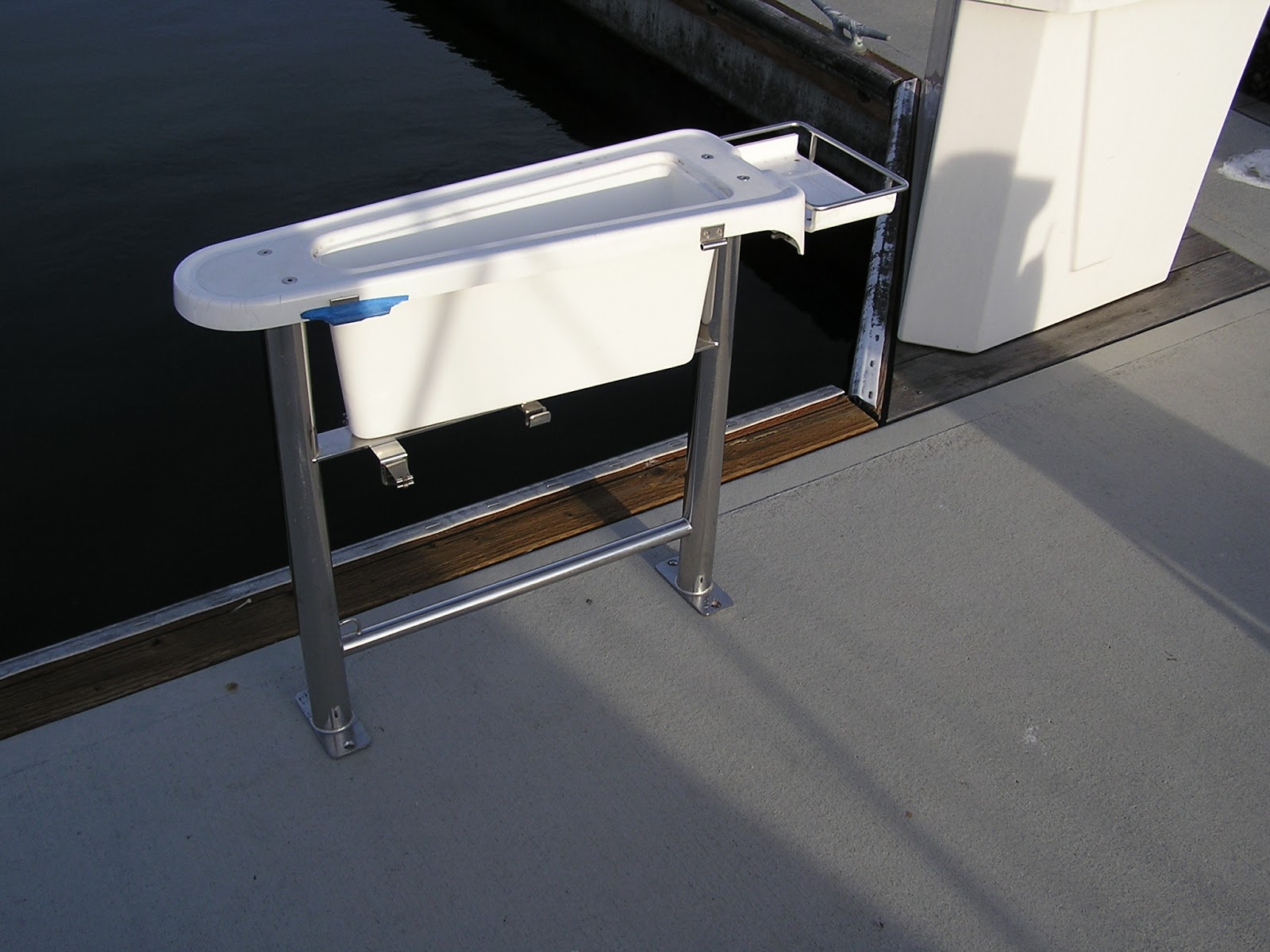 |
| The drop-leaves are attached to the table with slip-pin hinges, and the blue tape covers the forward one because it had an uncanny ability to grab clothing as you go past it. Beneteau used a RTM (Resin Transfer Molding) process to make this molded fiberglass part. This is a cost effective and environmentally responsible process that results in a strong, lightweight part with a smooth finish on both sides. I'm a big fan of RTM. |
Here are a couple of photos of the finished ground tackle system. It includes a chain stop mounted on a teak block and bolted through the deck, which was reinforced with a large backing plate. The chain is 200' of 5/16" type G40 spliced to 150' of 9/16" nylon 3-strand rode.
 |
| The chain stop is mounted on the block to align it with the chain between the windlass and bow roller. Notice the shiny underside of the hatch. It was also made using an RTM process. The waterproof plastic box holds the handheld windlass controller. |
 |
| Anchor installed. |
There has been considerable controversy in the last few years regarding anchors, with all sorts of accusations flying in all directions. For many years I used Danforths on my racing boats. They are relatively compact and fairly reliable anchors, and are a good solution for boats that don't get into challenging anchoring situations. When I began outfitting our last boat for cruising I chose a Manson Supreme. It is what I call a spade type, as opposed to a fluke type of anchor such as a Danforth or Fortress, and while there may be disagreements about which brand anchor is better, I think the spade type of anchor is superior to the fluke types. The Manson 35 we had on the Honcho is one of the few items I kept when we sold her. When it came time to buy an anchor for the Finisterra, I felt there was little difference between the Manson and Rocna units and chose a Rocna 25 (55 LB) mainly because it was a little lighter and less expensive than the comparable Manson.
In Mexico the holding ground is varied, and we anchored in sand, mud and rock bottoms. In the lagoon at Barra De Navidad, the bottom is more like a black slurry than proper mud. In Bahia Santa Maria we spent five days anchored over a sandy bottom while 25 to 40 knot northerly winds combined with a strong southerly swell rolling into the bay, making it quite a lively anchorage. All the while the Manson did its job perfectly and I expect that the Rocna will do the same.
In Mexico the holding ground is varied, and we anchored in sand, mud and rock bottoms. In the lagoon at Barra De Navidad, the bottom is more like a black slurry than proper mud. In Bahia Santa Maria we spent five days anchored over a sandy bottom while 25 to 40 knot northerly winds combined with a strong southerly swell rolling into the bay, making it quite a lively anchorage. All the while the Manson did its job perfectly and I expect that the Rocna will do the same.
Subscribe to:
Posts (Atom)


.jpg)


